India is a cheap escape from winter. But it’s much more than that…the attraction to a country that is so large and so diverse physically, economically and spiritually is powerful. To those of us who are attracted, India can be addictive.
An Italian woman, troubled by sand fleas, walks through the water every day to avoid being on the sand. She likes to talk and I can easily hear her clearly-annunciated but heavily-accented English until she tells me about a wonderful ayurvedic massage down the beach. “Where? My husband would like a massage.” “It’s called LaTOOsa.” “Say it again?” I ask. Eventually she spells it out: L-O-T-U-S. “Ah, Lotus?” “Si, LaTOOsa!” she beams. We exchange our names. “Orrbearta!” Italian Marina exclaimed. “My sister’s name!” Roberta sounds so much better in Italian, and I’ve found a new friend in the water.
I’m enjoying conversing with British friends using expressions I haven’t heard in a long time. “Chivvy along,” a mother ordered her dawdling children. “WHAT?” said Gerard thinking he was hearing a foreign language. I explained, ‘chivvy’ meant hurry. “In all the years I’ve known you, you’ve never used that expression!” It’s not the first time I’ve surprised him.
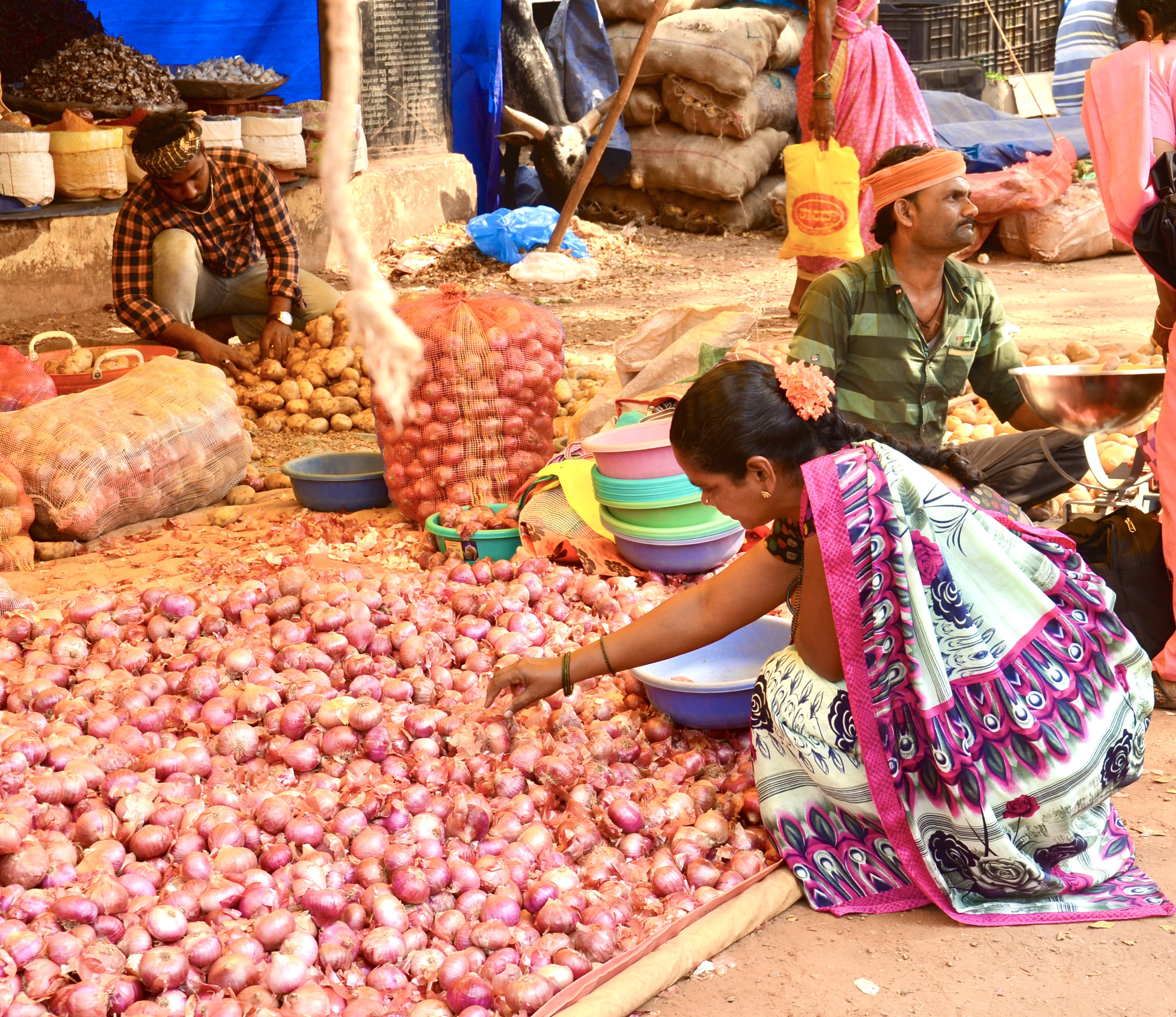
Visiting the weekly market provided a photo op.
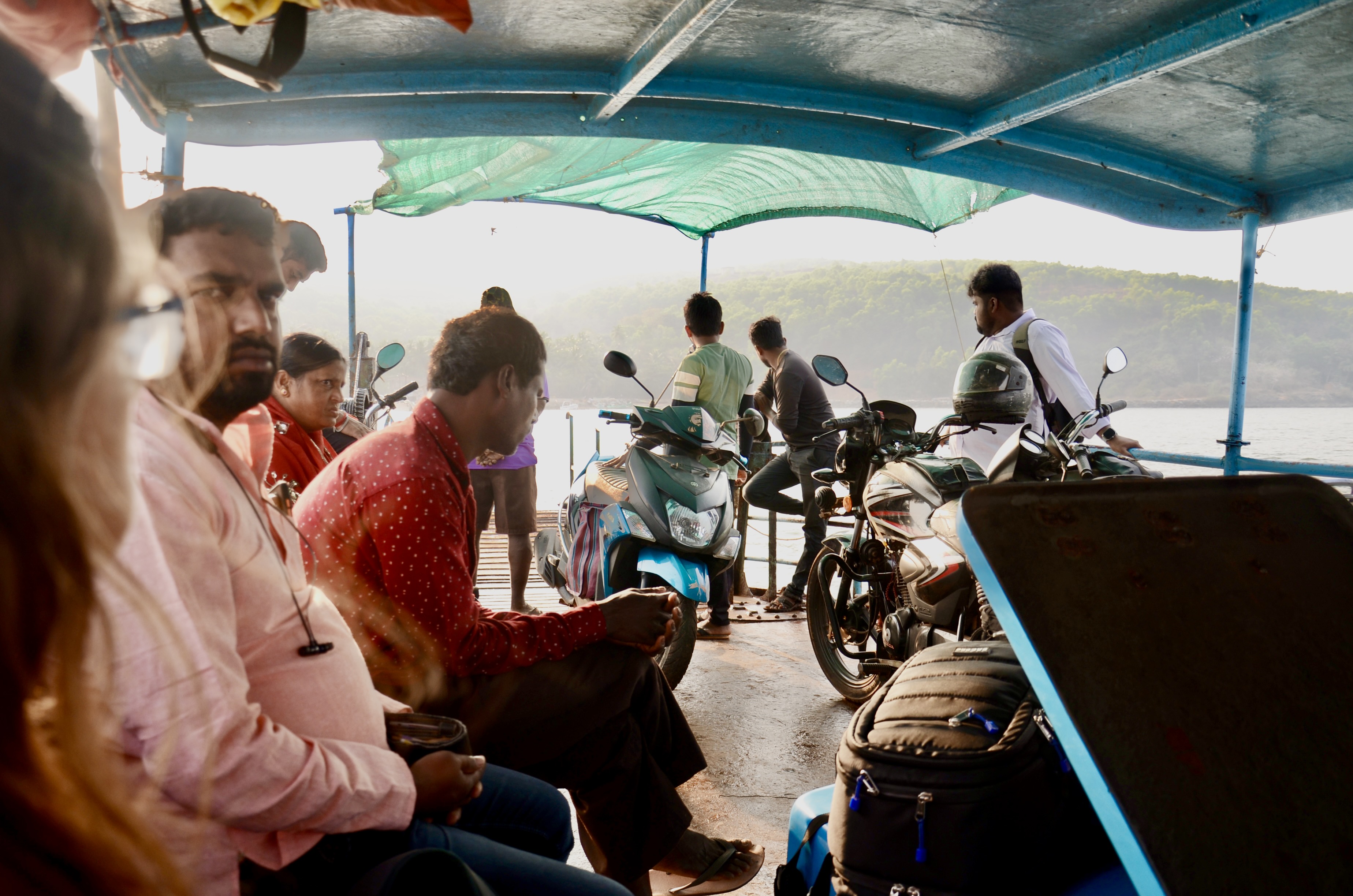
Marion and Juergen encouraged us to join them taking the ferry off the peninsula to a tiny hamlet on the mainland. Before breakfast we caught the 7.30 am bus to the port where the little ferry was waiting. People and motorbikes crowded on for the short but lovely ride.
Marina had told us of a chai shop on the other side and we set off in expectation for a nice breakfast. Four miles later, through road construction and clouds of red dust, stil no chai shop. Exhausted, thirsty and hungry we turned around.
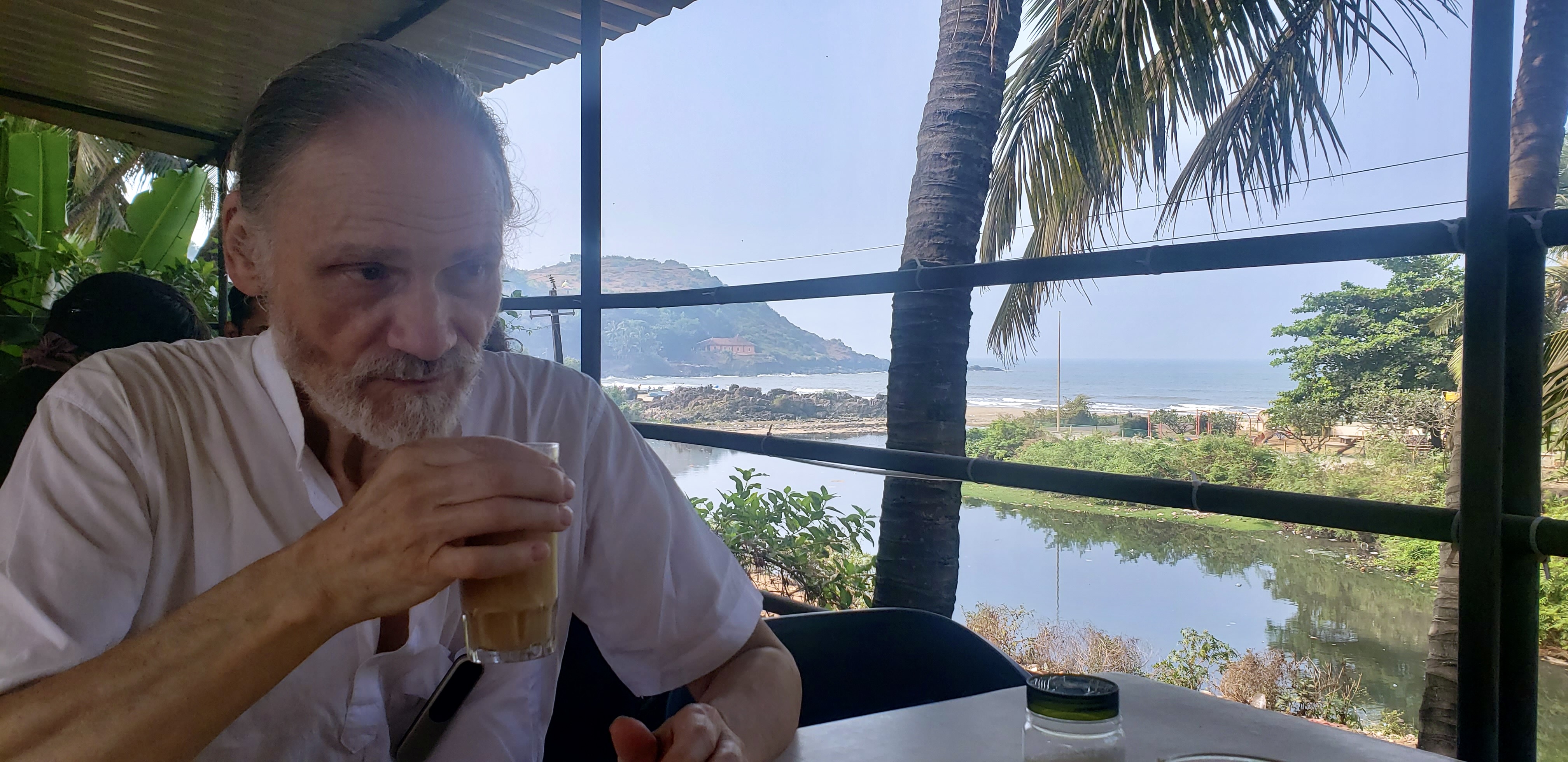
After the long walk back, we found the chai shop right where it was supposed to be and sat overlooking the bay with our chai.
But what saved the day was the unreserved friendliness of everyone. Obviously few western tourists ventured their way and we were still a curiosity: big smiles and waves from road laborers, housewives and school children. By the time we got off the ferry hoping to catch the bus back to Gokarna, it was high noon. The shopkeeper said the next bus will come in two hours. There wasn’t a rickshaw in sight. Fatigued and overheated we started walking. Eventually we caught a rickshaw back to town. Not exactly the outing we’d anticipated.
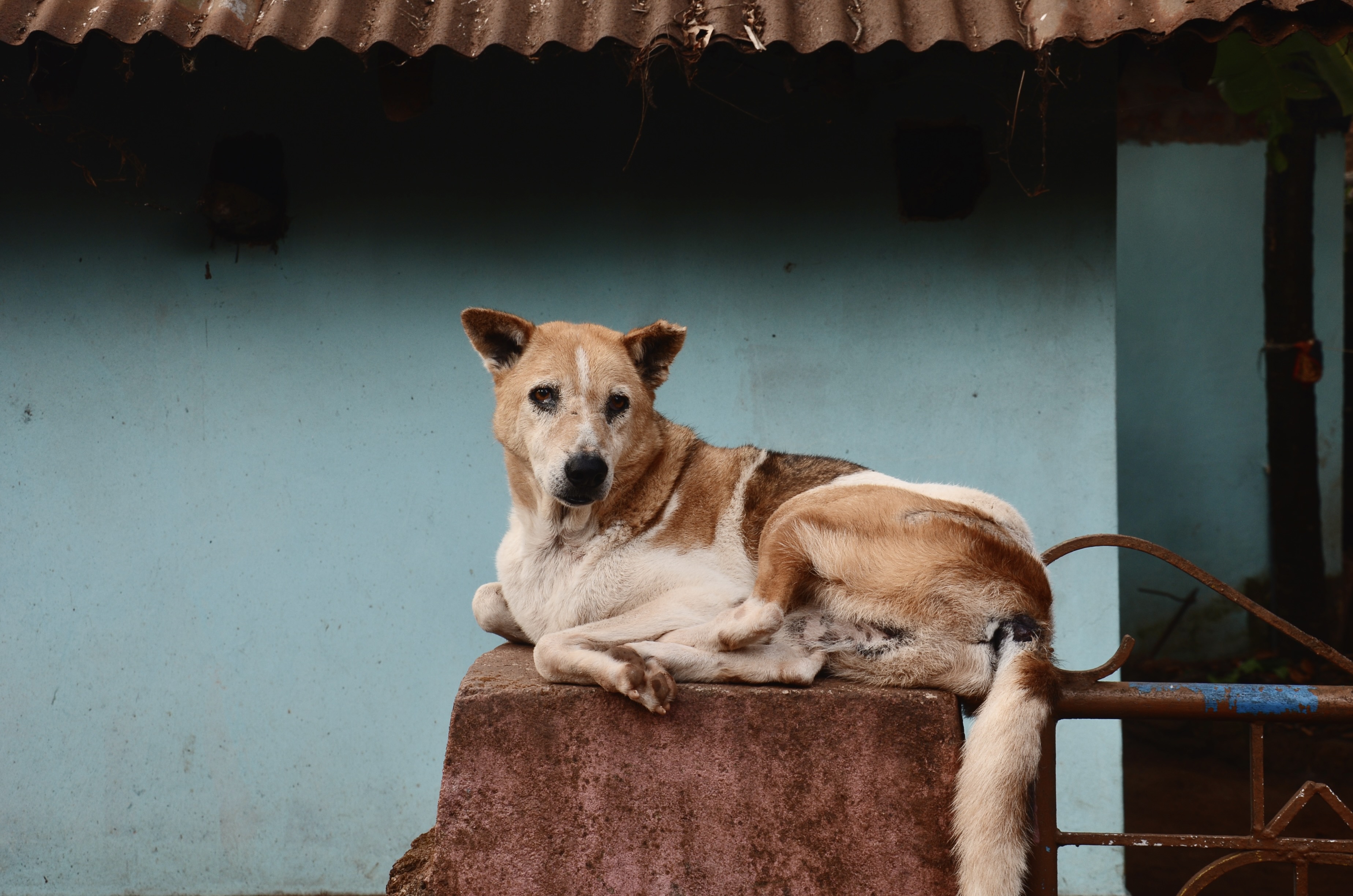
Certainly the dogs along the way could have advised us if we’d only taken the time to listen.
A few days later, bird watcher, Tina, proposed another walk to the little beach of Belekan. “About a two hour walk,” she claimed. “We’ll leave early to avoid the heat and take a bus back.”
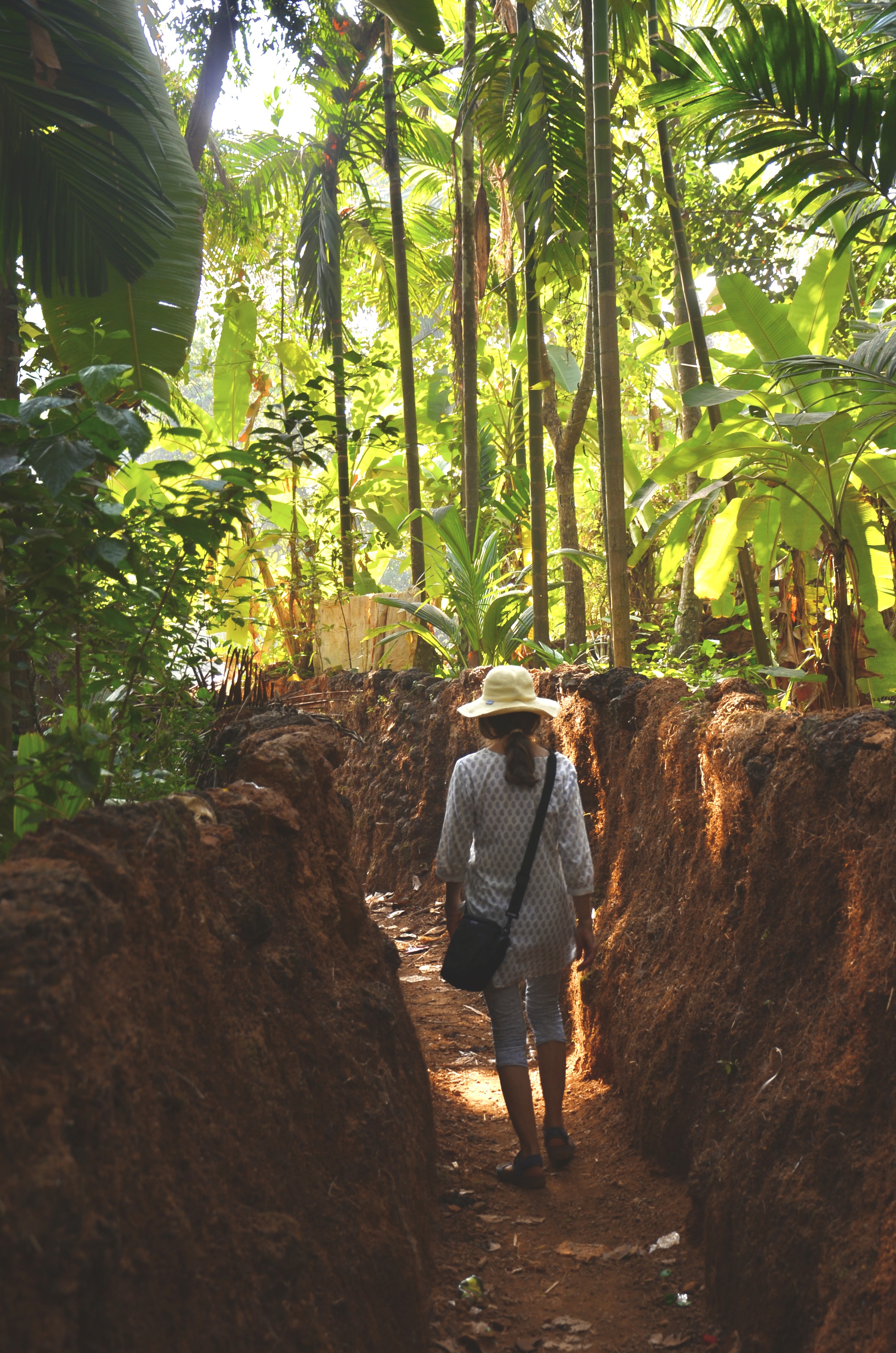
For the first hour we followed a small road through the jungle alive with bird calls. Then Tina followed a footpath that meandered past rice paddies and the odd house.
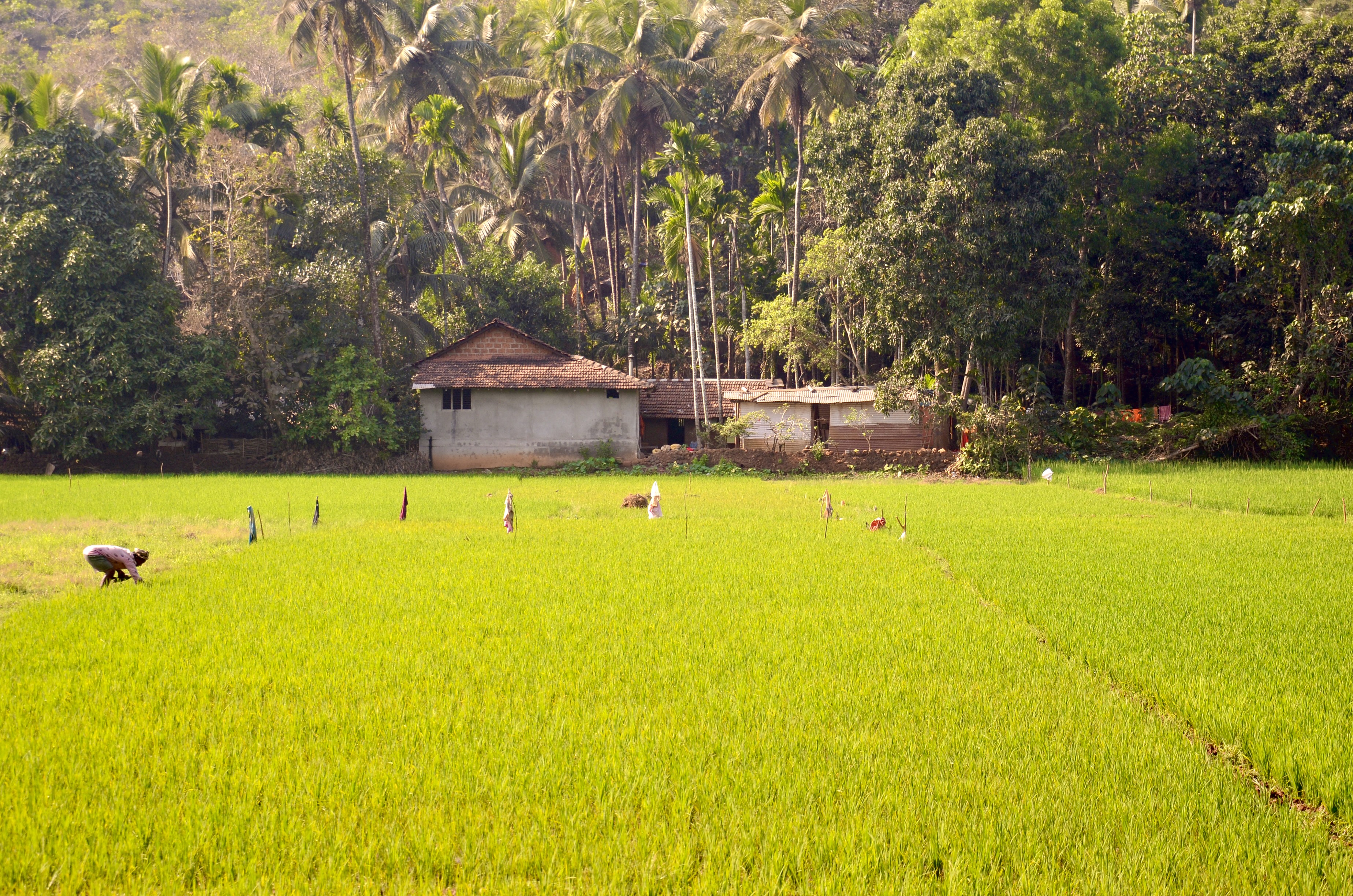
The green of the rice paddies shimmered. And if we stood still long enough we caught glimpses of white–egrets, ibis and storks. n stalks glimpses of white–egrets, ibis and storks.
Suddenly the footpath opened up to the beach. At the far end sat a cafe where the bus terminated. After our two hour trek our chai tasted even better.
Then we were informed that the bus would not be coming for another two hours. ‘Man proposes and God disposes’, someone muttered.
The general consensus was to walk back. Gerard was of a different mind, happy to hang out at the cafe and await the bus. Had I known what was being said, I would have enjoyed also staying for a swim. But not following his gut, we trudged off with the others. Now in the noon day sun, our pleasant stroll through the jungle became a test of endurance–heat, sun and no water. Finally reaching our room, Gerard collapsed on the bed. After looking at map, he huffed, “Two-hour walk, huh? That was more like ten miles!” Once again, Incredible India has its hidden surprises.
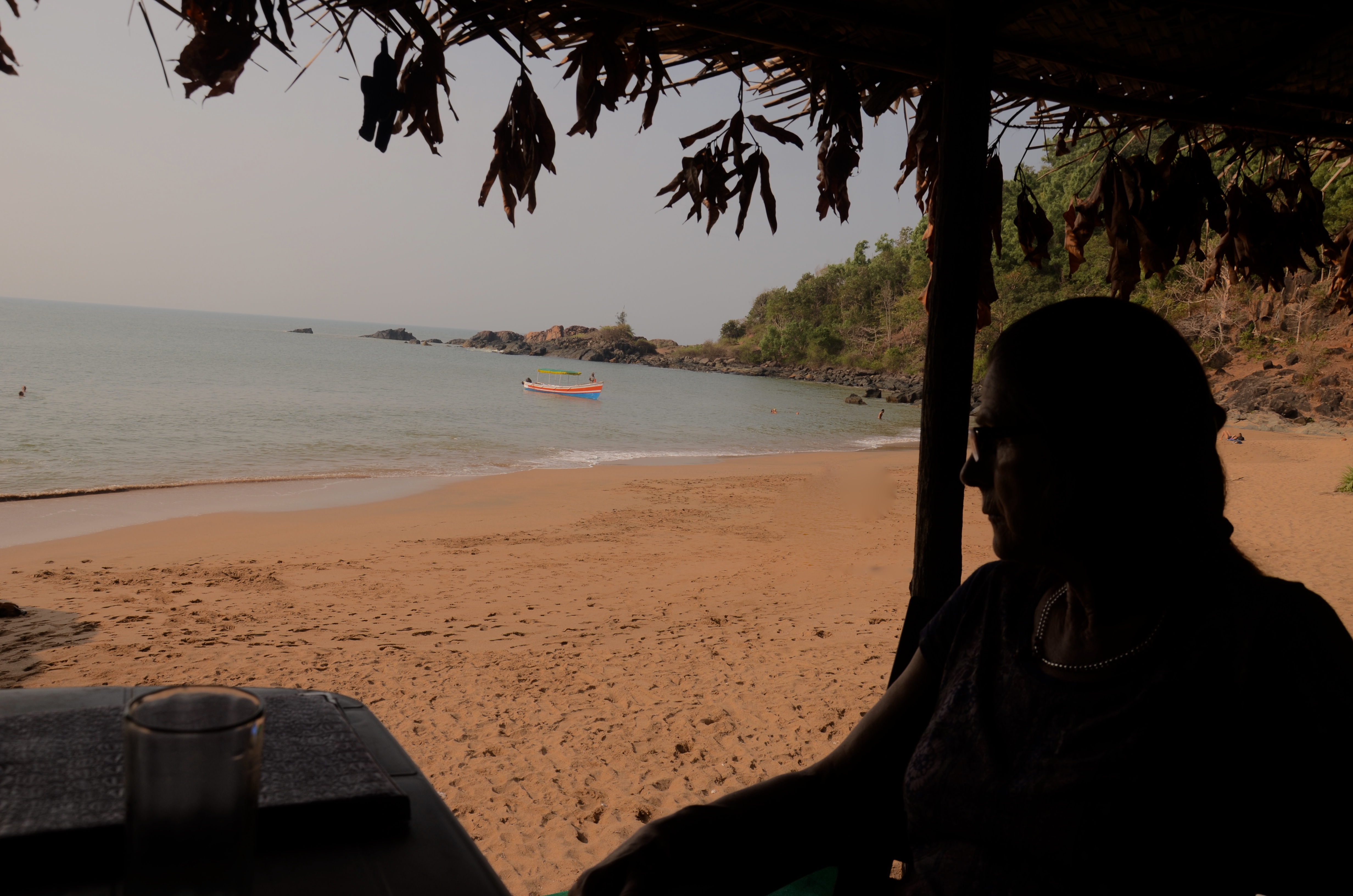
Two warnings are pinned to the guesthouse wall. One is ridiculous: “Swimming on the beach is not safe.” Hello? Have you ever tried swimming on the beach? The other is more ominous: “The owner will not be responsible for any drowning in the sea.” Undeterred by occasional rough seas, I swim twice a day, and then walk the long stretch of sand, appreciating the moment.
I enjoy the simplicity of our lifestyle; it unclutters my mind, which likes to seize on the busy minutiae of daily living back home. I may not always like the Indian meal served, but it still beats the time and mental energy devoted to cooking and food shopping. Every day, I look forward to my idli and dosa breakfast. A young Indian has just started up his little dhaba and serves us with enthusiasm.
Gerard enjoys leaving Wellington Street far behind. Oddly, he does not seem to miss painting just as I don’t miss biking, knowing they will be waiting when we return. When he’s not swimming with me or socializing, he’s busy completing his memoir which he began writing exactly four years ago in India. His favorite tunes encourage him when the writing is difficult. Mosquitos and sand flies have found his skin irresistible and he’s had to contend with a slew of itchy, inflamed bites. But two weeks into our stay the bites are reducing. Dare I say the insects are loosing interest, moving on to the next tasty newcomer?
With many of the establishments here preferring to cater to Indians now, the old time travelers congregate in just a few cafes up and down the beach. Some of us question if we’ll come to India again whether put off by traffic, pollution, plastic waste—everyone agrees that the subcontinent is drowning in a sea of plastic–or Modi. 1.4 bilion create a heck of lot of waste! Gerard and I try to do our bit by bringing a portable water filter to avoid contributing to the mountain of plastic bottles. The otherwise beautiful walk through the vegetable gardens to the beach is marred by litter. To avoid looking at it for a month, Gerard got a gunny sack and picked it up. But where to dispose of the full sack?
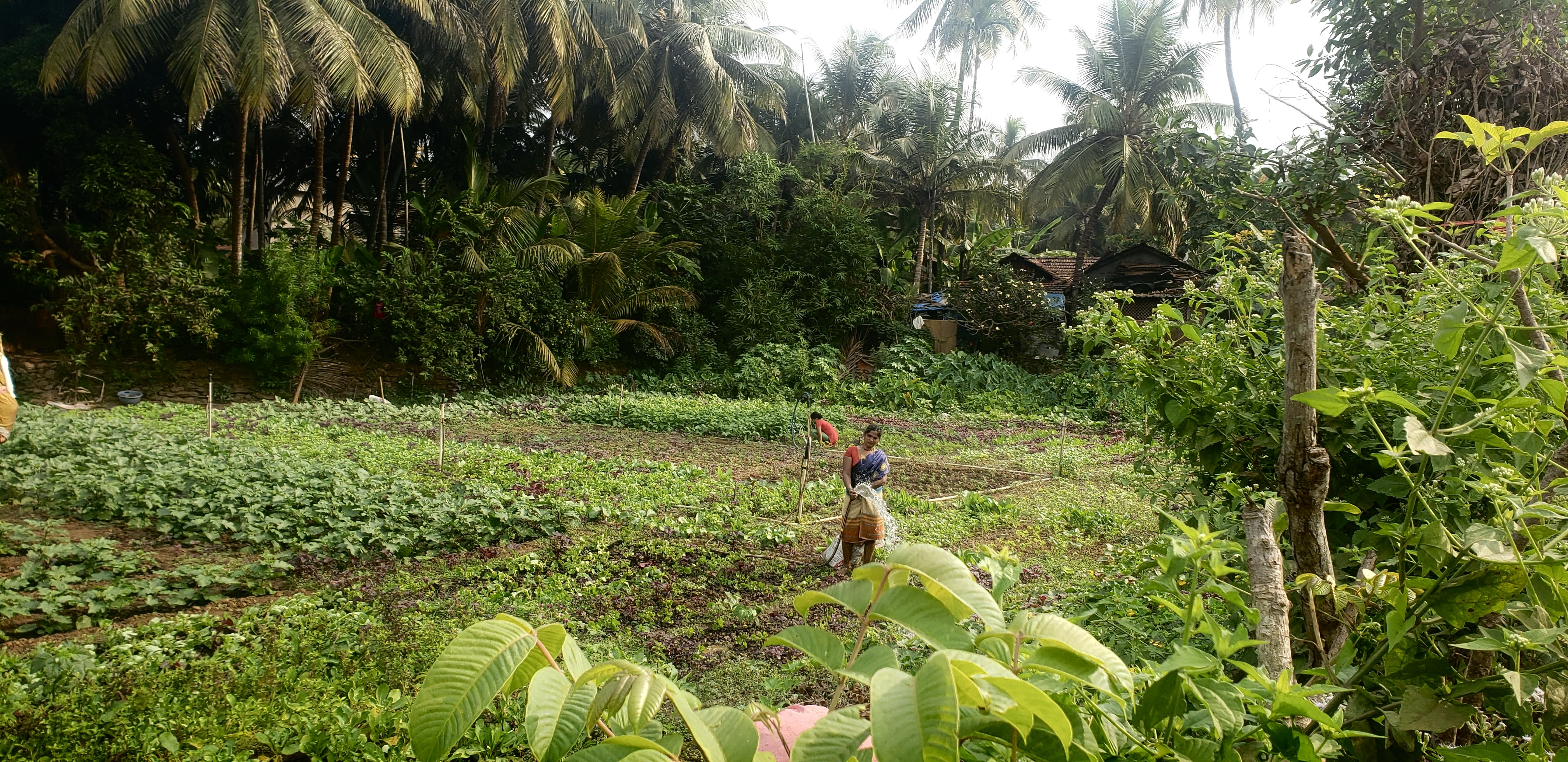
Walking through the vegetable fields we notice that each little garden has its own shallow well. So close to the sea, surprisingly these wells are not polluted by salt water. With the rich soil, the baking sun and plenty of water, the vegetables seem to grow as we watch them. Too bad not enough of them find their way into the restaurants.
Our friend Marina is a social magnate; after twenty years in Gokarna she knows the old timers and easily makes new friends. At one point, there’s nine all from her area of north London. We’re sad to see Emma leave after her brief three-week holiday. She doesn’t understand those who complain about the new influx of Indian tourists crowding on to the beach (mostly on the weekends). She looks at the long stretch of sand and says, “To me, it’s bliss!” She spent her childhood summers in south Devon and we both agree that there’s no comparison to the sardine-packed people on the beaches of Torquay and Paignton.
Although I get frustrated in trying to follow the group conversations, it doesn’t overwhelm me anymore (given the occasional meltdown). This is our third visit to India since I lost my hearing, and I’m relieved to find it has gotten somewhat easier. I know my mechanisms to avoid hearing fatigue – and when I take a mental break and space out for a while, I return to the conversation to find surprisingly the same topic is still being discussed. I don’t seem to have missed much!
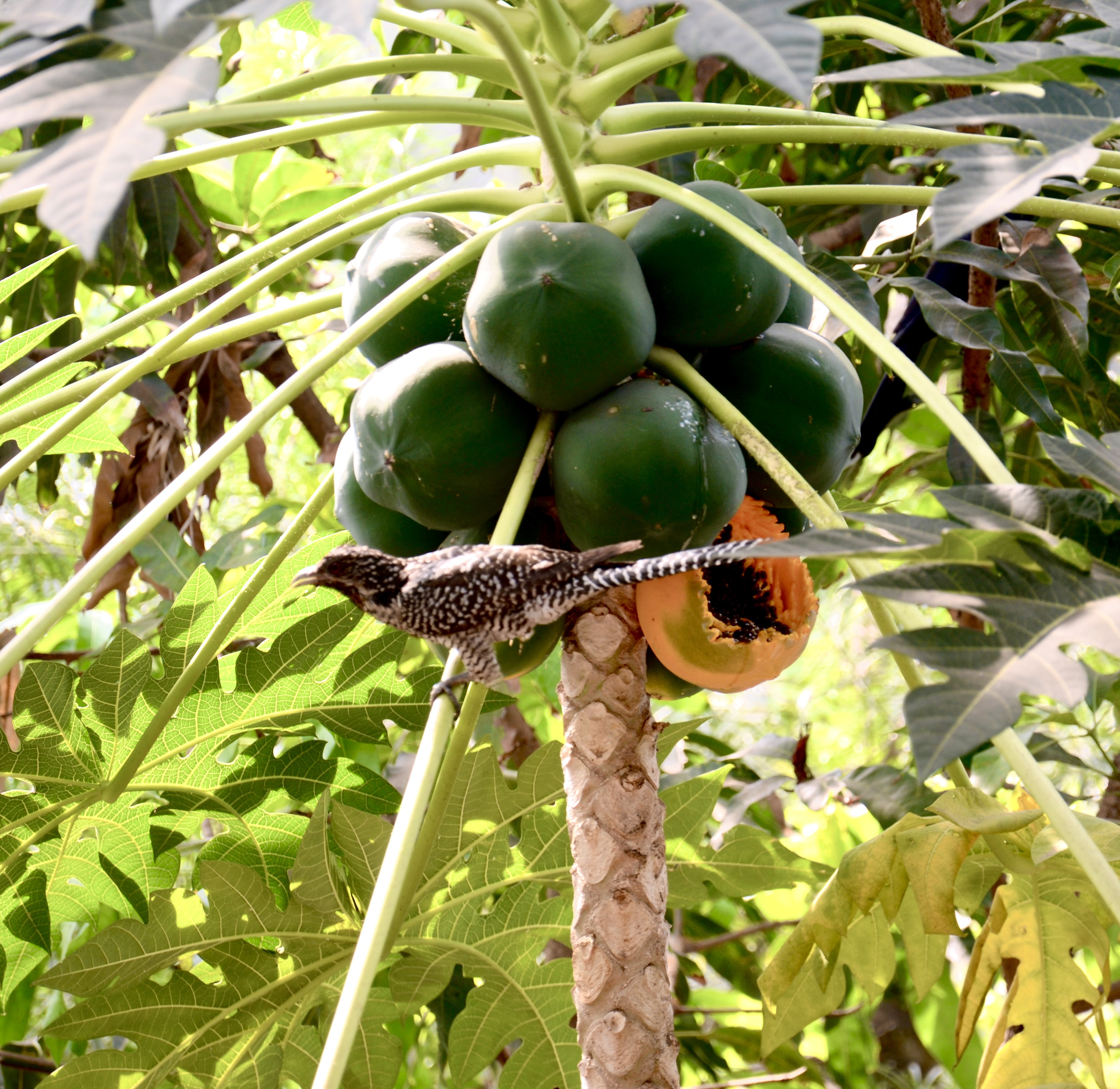
We wish we could identify the exotic tropical bird songs that I’m so grateful to hear. North London Tina’s a bird person and can recognize when Gerard provides a great imitation of a call. One is the Koel bird that we watch from our balcony in a papaya tree picking away at the fruit. Tina must be almost 80 and has traveled solo in India many times, which I find inspiring. Again, I wonder if I would have the resources to do it alone.
Our German friends, Marion and Yergen, insist that we accompany them to Kudlee Beach, a pretty sheltered cove we first visited three years ago. The descent to the beach is crowded with Indian tourists, the more so because it’s Republican Day weekend. Kudlee now caters only to Indians; several old buildings are demolished and undergrowth cleared at the near end of the beach to make way for a large luxury hotel. Rented dinghies, water ski launches and other plastic flotilla pepper the water. It’s beginning to look like Paignton! How many beautiful beachfronts are there left in the world that haven’t been ruined by over-development?
French Frederic, who we first met in the Himalayas ten years ago, took an overnight bus from Bangalore to spend three days with us. A resident of Auroville, he was on his way back to France to renew his visa. We have a special bond with him and are able to pick up where we left off four years ago in Varanasi. Swiss Peter, who visited us in Boston last summer, came down from Agonda for a few days as well. Both Gerard and I are flattered they made such an effort to visit us.
“Yes, I remember you,” the restaurant manager in Gokarna said with a half-smile. Coming from a man who, despite Gerard’s efforts, would not engage in conversation for the whole month we were here before, this was a warm welcome.
We hadn’t given much thought to another winter here. In fact after returning from a challenging time in California, trying to hear in noisy restaurants or even groups of friends, I’d told Gerard definitively that I could not handle India again. Just a few days later, Melissa, our longtime house sitter, emailed us to say she was available this winter. That did it! We’re going! I said ,visualizing the beach in Gokarna, the ghats of Varanasi, the snow-capped mountains in HP and the friends we’d have the chance to reunite with along the way. I was determined to handle my hearing loss in India as I do in the U.S. Clearly, the benefits would outweigh the difficulties.
But I do need help to get by in chaotic India. At the airport, a frustrated customs official asked, me, Do you speak Hindi or English? Later, a young Indian tried to strike up a conversation, then realizing my predicament, assured, “You’re not missing anything,” and high-fived me. Easy for him to say, but without Gerard I don’t think I could do this on my own.
We arrived in Delhi at 2 am, Even though the airport is now no different than any other airport in the world it’s still a shock for us to walk through duty-free that is predominantly alcohol. As we predicted our hotel did not let us in despite our reservation and claim of 24-hour check in. We eventually found another where the manager woke up long enough to give us an inflated price. After inspecting the room, Gerard bargained with the sleepy manager for a reasonable rate. In the morning, I looked out the window on a large colorful umbrella with a sign saying ‘Baba Masala Tea.’ A white-haired gentleman pounded out fresh ginger and cinnamon sticks in a mortar and pestle to make the best chai in the neighborhood. Just when we need it, a chai wallah appears.
We were interested to see how India had changed in the past three years. It’s too early to know, but in the airport we couldn’t help noticing posters of Modi’s nationalistic agenda, with his ridiculous slogan: ‘1.4 billion people, one dream.’ The continuing strife between Hindus and Moslems begs the question: what is the one dream? We were surprised to see so few long term travelers like ourselves in the Pahargunj area of Delhi. Consequently, many of the shops catering to tourists have disappeared, returning Pahargunj to Indian consumers.
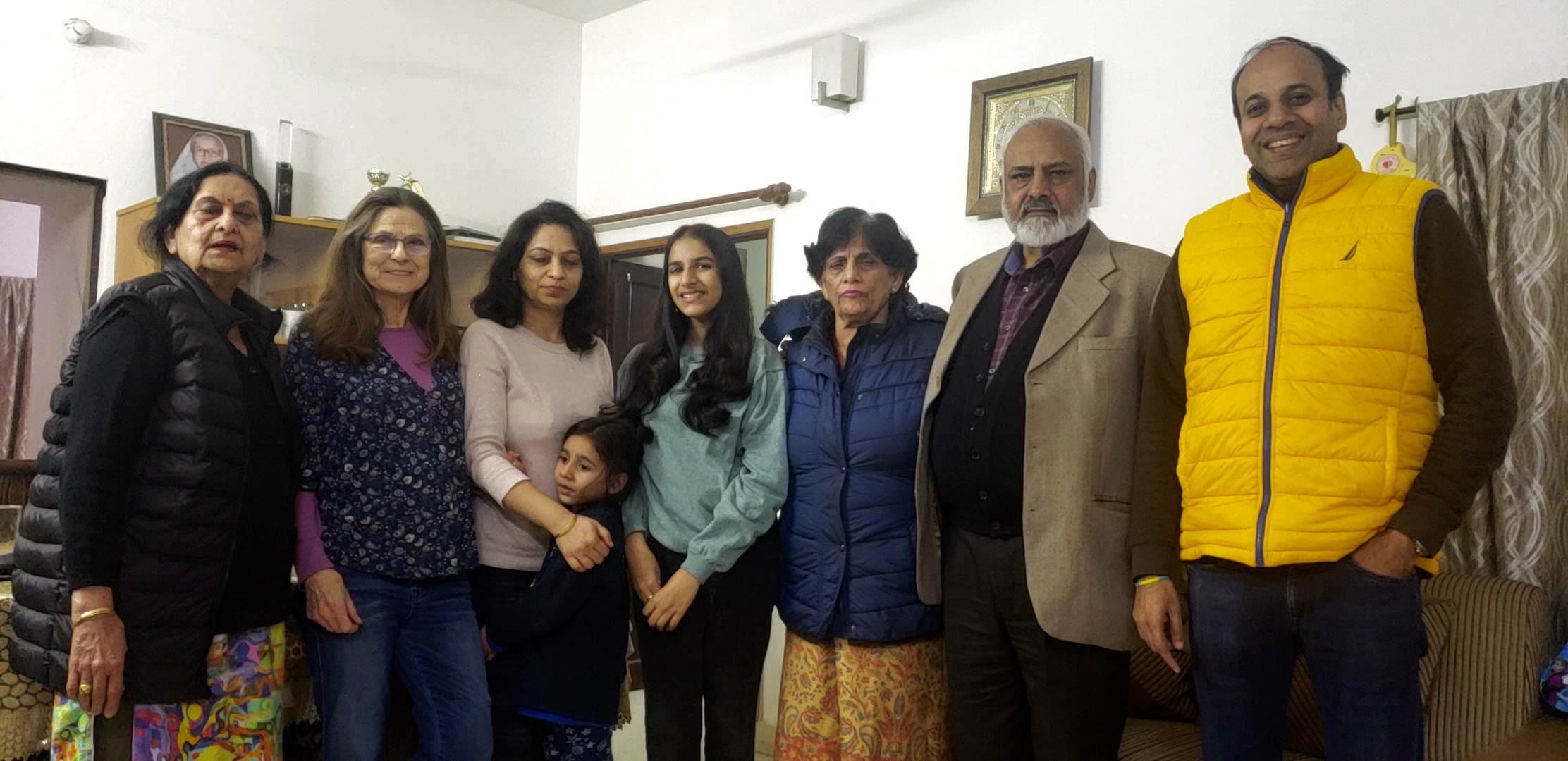
On our way to see the family in Gurgoan we were impressed by the metro, still running like clockwork and unusually clean for Delhi, unlike the buses and trains which are constantly breaking down. It was wonderful to be in their company again and we were surprised at how the children had grown. Five-year old Tanya’s cheeky personality has emerged, her English better than her Hindi, her mother says. And Simrita has grown into a gracious fourteen year old. She took me shopping in the nearby market. Sympathetic to my hearing loss, and lack of Hindi, she guided me through the process, reminiscent of how I did the same for my blind father many years ago.
The family knew it was Gerard’s birthday and Simrita wanted to bake Gerard a surprise cake. After dinner she disappeared into the kitchen and proudly emerged some time later with a freshly baked chocolate cake. Shruti stuck her knife in and said it needed more cooking, so Simrita returned to the kitchen. Soon after we heard a loud crash followed by sobbing, Simrita had turned the cake on to a glass plate and dropped it on the tiled floor. At Shruti’s insistence, she eventually appeared and placed the cake with embedded glass shards in front of Gerard, and we sang ‘happy birthday,’ before the cake was trashed.
The two-hour pre departure requirement for our domestic flight to Goa, was no overkill. The long line of passengers at check in (that would challenge anyone with claustrophobia) the interminable walk to the departure gate, and finally a bus ride to board the plane on the tarmac at least a couple of miles from the gate. Nevertheless, the plane took off on time! Gerard, with his love of trains and disdain of airports, couldn’t help mentioning how much easier it would have been to board a train and enjoy a more pleasant, if longer, journey. The following day, when our two-hour train ride to Gokarna was delayed by two hours, I had the satisfaction of pointing out the incongruity of waiting the same amount of time as the journey!
We struggled to book our room online and the internet pictures failed to meet up to reality. But after we’d moved the bed to face the window and Gerard got to work with his rag and disinfectant, the room became our home at the beach.
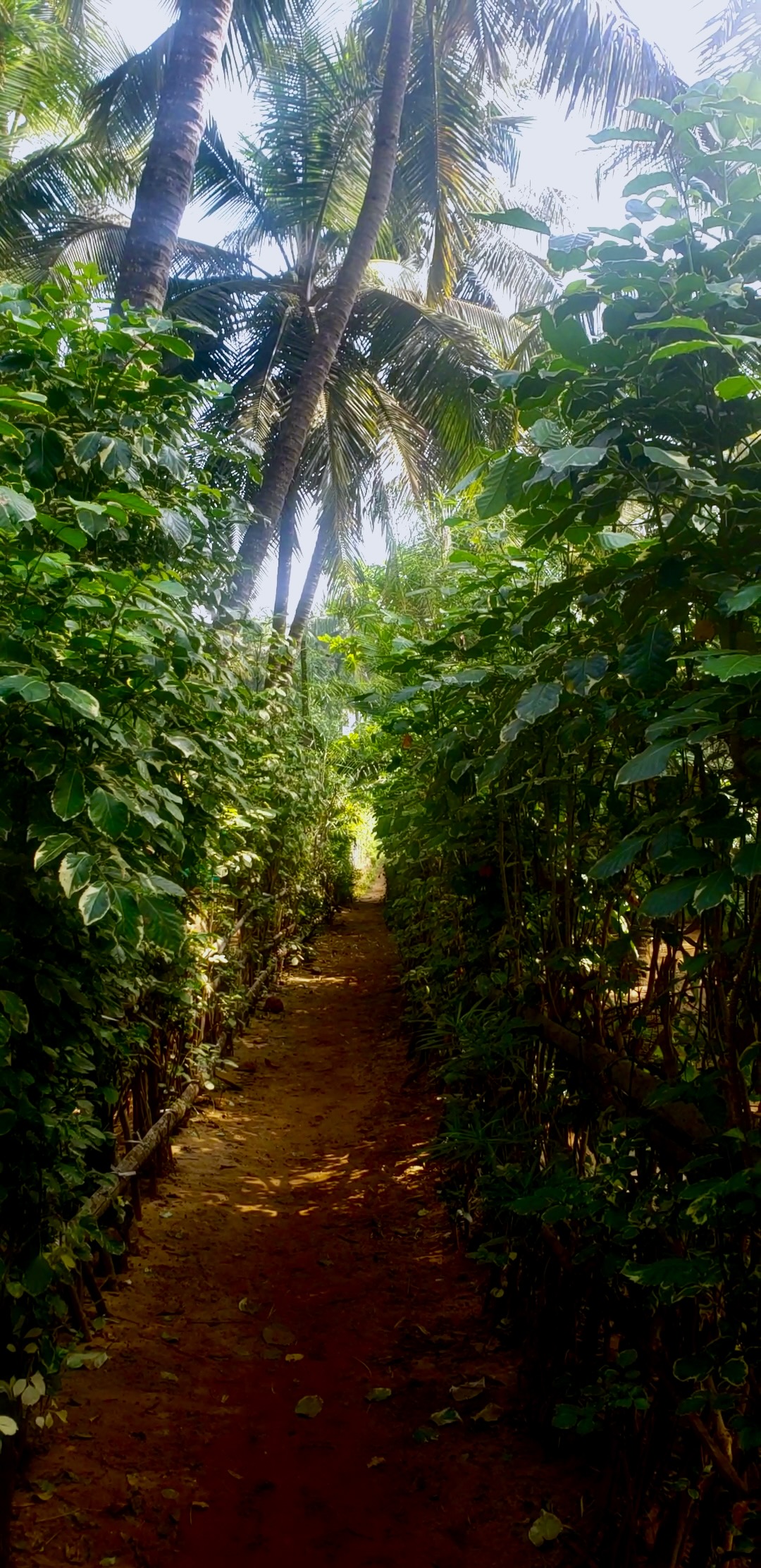
As it turned out, pre-booking paid off. Friends have told us it’s hard to find a place to stay because guesthouses are now only renting to affluent young Indians who come on the weekends. The owners can double the price and not bother to rent the rooms during the week, telling tourists like ourselves they have nothing available. Our guesthouse is only a three-minute walk from the beach, through vegetable gardens. Palm trees shelter our balcony from the heat of the day while allowing the amber glow of the late afternoon light to filter through.
Thinking of friends who couldn’t return for health or economic reasons, or chose not to (avoiding Russians), we’re grateful to be here. On our arrival, Frederic one of our oldest Indian connections, was already waiting at our guesthouse.
For over two years we hadn’t been anywhere except Philadelphia. With great anticipation, we left for three weeks in England on the busiest travel day since covid: a combination of spring, pent up desire to travel, and the Boston Marathon. Would I have to sit next to a sweaty runner, on his way home? Surprisingly the airport was quiet, with hardly an attendant to help us check in. Yes, there were eight runners on the plane, given priority boarding, but they’d taken the time to shower. Heathrow was as busy as ever, but once again, there was hardly an attendant in sight, even at passport control. Automation! It’s another indication of how impersonal the world is becoming: everything done on devices.
For me the trip began long before I stepped on the airplane, carefully planning and coordinating all of the different people we wanted to see. As the plane left the ground I could let it go, no more planning. We stayed the first five days in the Bayswater neighborhood of London. Our airbnb was on a quiet side street, a three-minute walk from Hyde Park and Kensington Gardens, the trees and grass dazzling in their springtime green vibrancy.
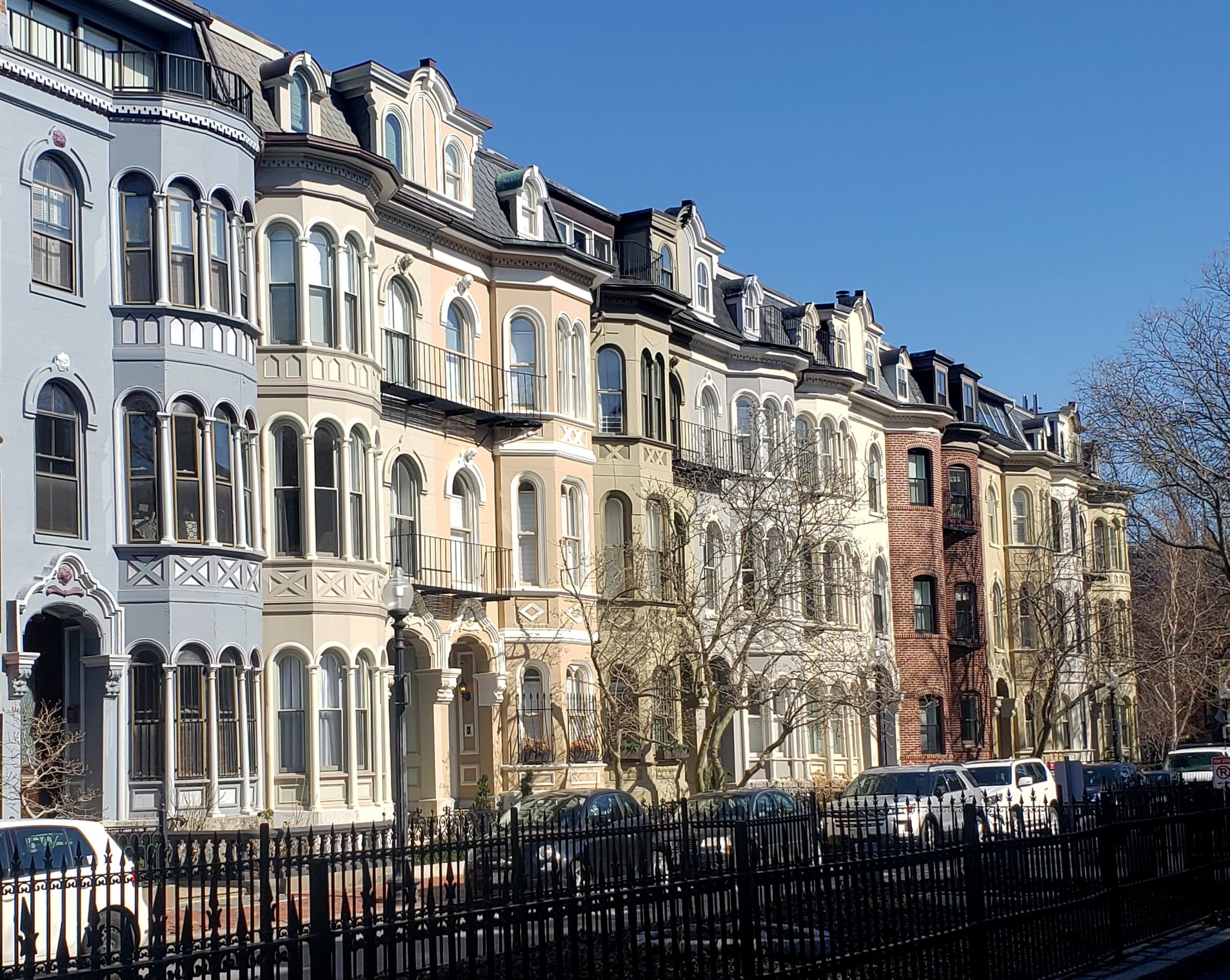
In nearby Queensway, Gerard was fascinated by the elegant six-story Victorian townhouses built around garden squares. Originally designed as single families, he wondered who could afford these in the 1860s? On the other hand, the Empire was at it absolute peak. London must have been awash with money. Gerard laughed at the term ‘Commonwealth’; it seemed like the wealth was funneled directly to London. So much for the peasants in the colonies! After WW2 the neighborhood went into decline, but now it’s definitely upscale again with lots of foreign ownership.
On Westbourne Grove, we managed to find Fresco’s again, an affordable Lebanese cafe with excellent moussaka and falafel. We ate there repeatedly, and the owners were amused that we knew the Egyptian singer, Oum Kalthoum. My longtime boarding school friend, Stephanie, lives just down the street, in a studio apartment with her artist husband. She’s been in the neighborhood almost since I left England fifty years ago. Even though I don’t see Stephanie very often, our relationship is more like sisters than friends.
In nearby Notting Hill, we met up with Marina whom we first met several years ago in Himachal Pradesh. She’d just returned from another winter in India on a business visa and was still trying to adjust. Loving India, she’s been returning there since her visit as a young woman. She found the impact of covid devastating on all those dependent on tourism. Together, we walked through Portobello Road Market. But it was disappointing. It was hardly recognizable from when I knew it back in the ‘60s; no longer any chance of finding unexpected treasures among junk.
Marion, my roommate from University days, came all the way from her home in Cumbria and joined us at the Tate Modern on the Embankment. Gerard went through a special exhibit of surrealist art, while I caught up with Marion sitting in front of a huge picture window looking out on the Thames. We didn’t stay long enough to do the museum justice. The following day Gerard and I went to the Tate Britain. We’d forgotten that that the Turner gallery is preceded by six large Rofko paintings, called the Seagram series. He donated them to the Tate in honor of Turner. Just before leaving Boston, we went to see the Turner show at the MFA, wetting our appetite for more.
My brother drove us to Winchester for a family reunion. Once again my cousin, Cherryl, hosted a lunch for the other cousins etc. We asked them how often they get together. Not since the last time you were here four years ago, they laughed!
We stayed the night with more University friends, Tim and Sally, who live virtually down the street from Cherryl. Now that their children have gone, they’re seriously considering downsizing. We were happy to have the chance to stay one more time in their spacious house with its sprawling grounds.
The train ride to our next stop in Devon was very nostalgic for me: how many times had I traveled this very route on my way to boarding school? We stayed with a couple we first met in Varanasi, who live on the edge of Dartmoor.
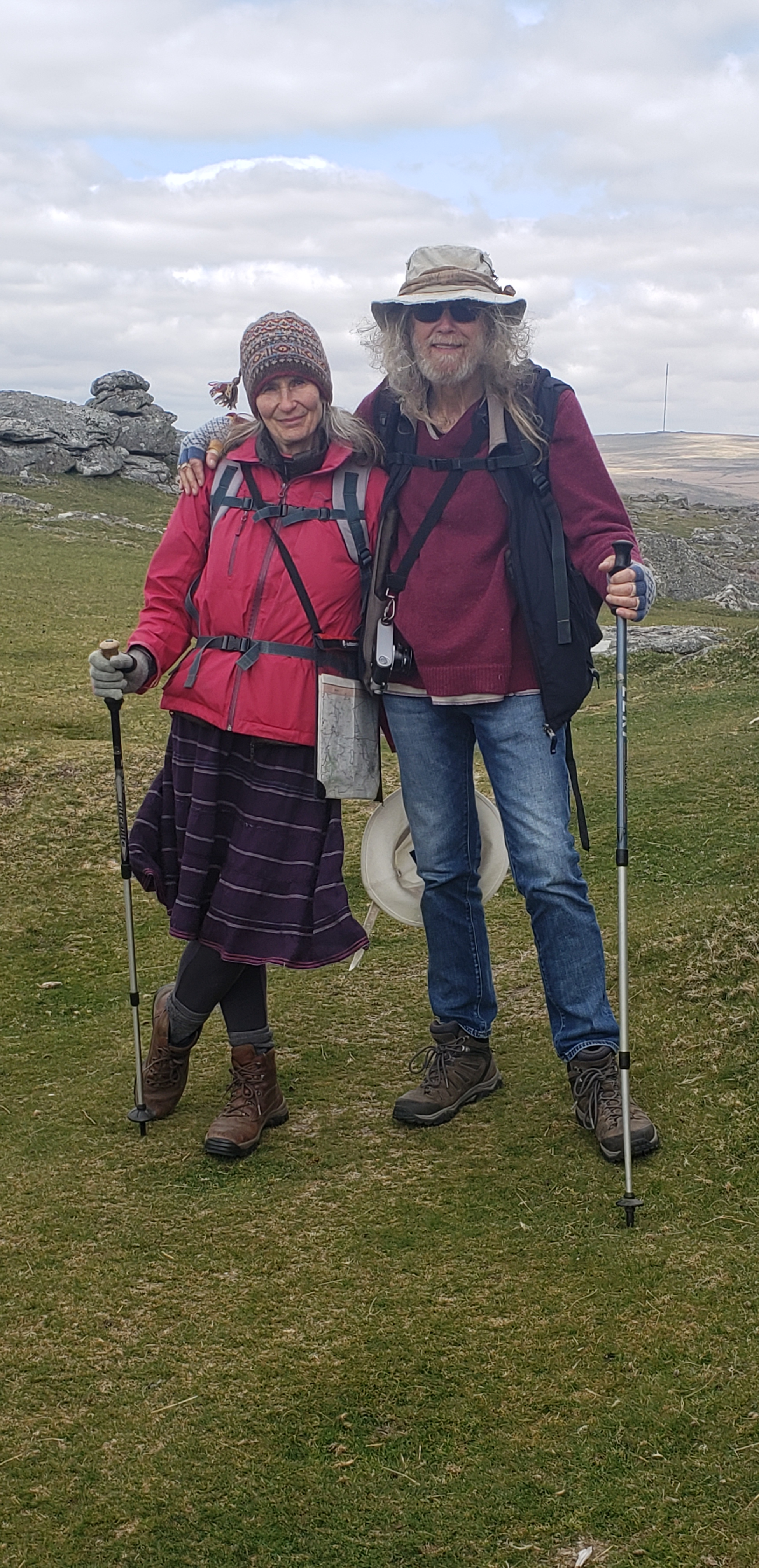
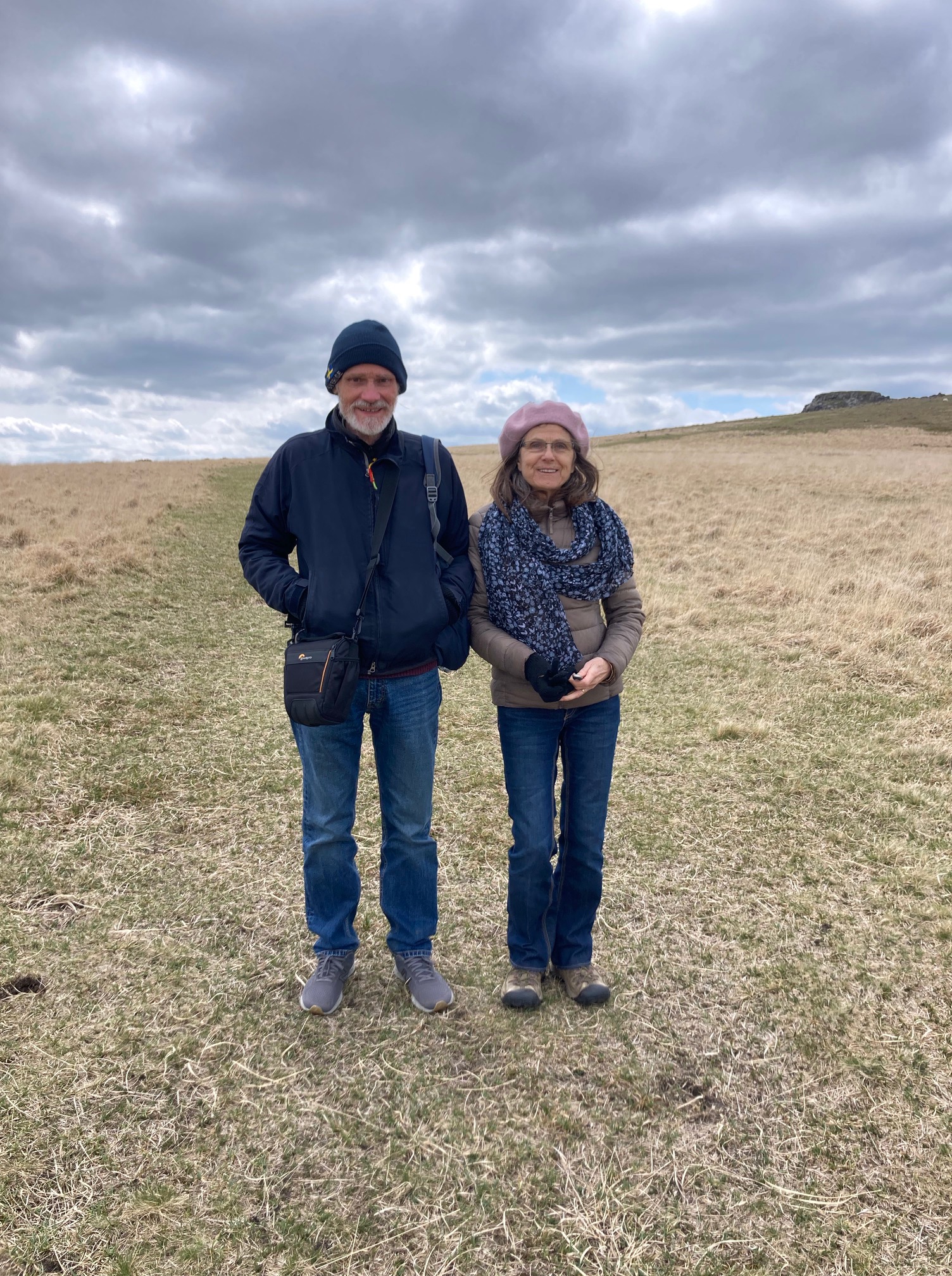
We’d imagined a rustic moorland location, but the village of Capstone was surprisingly civilized and we loved their terraced house with its luscious back garden that put ours to shame. Within a five minute walk, you’re on the moor! For three days we walked over the moor, up Sheeps Tor, down into the valley past the remains of an Iron age village, and a Norman church.
Their old hands at this and packed sandwiches and thermos of hot tea we drank in a spot sheltered from the wind. At the end of the first day, collapsing into a chair, Gerard asked, how far do you think I walked today? Expecting to hear eight miles or so, Sandhya looked at her phone and said, 3.8 miles! Gerard groaned and sank deeper into the chair, saying, that’s all?
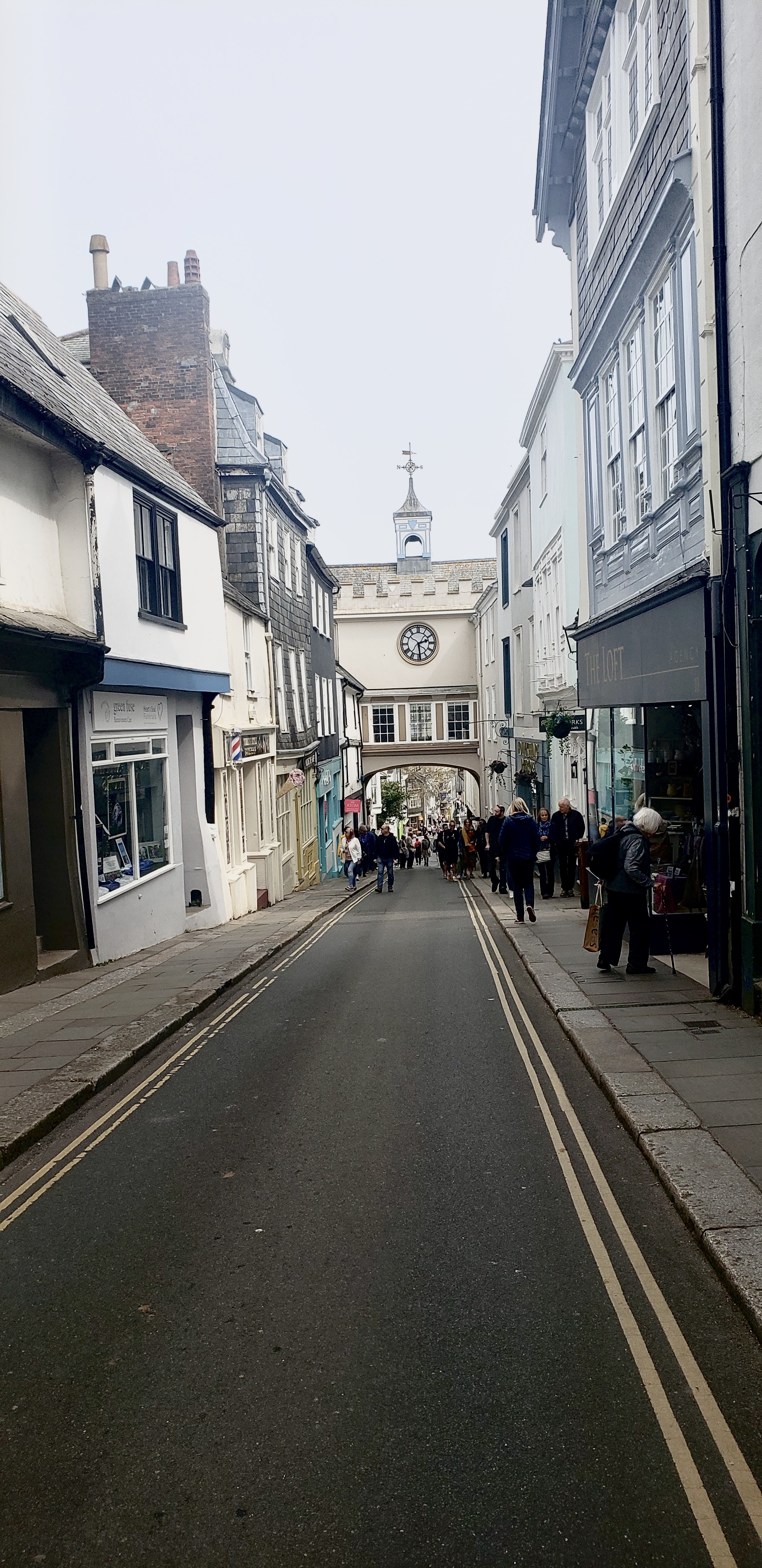
Our last day in Devon we spent in my hometown, Totnes. So familiar but hard now to believe I grew up there. The centre of the old medieval town has not changed but everything – the steep fore street and clock tower…the house I grew up in… all seemed so diminutive. Reminding me how when I first arrived, the US struck me as so large and spacious.
The reunion with the two daughters of the family who fostered me after my mother died was sweetly nostalgic. Another friend from India, who lives in nearby Buckfastleigh, joined us for lunch. We first met Oliver, many years ago, on the muddy streets of Orchha, looking for a hotel in the rain.
Kate and Nigel were waiting for us as we got off the train in Bath. Kate is another friend who goes back to my boarding school days. She had a routine of walking her son’s dog and asked us to go along.
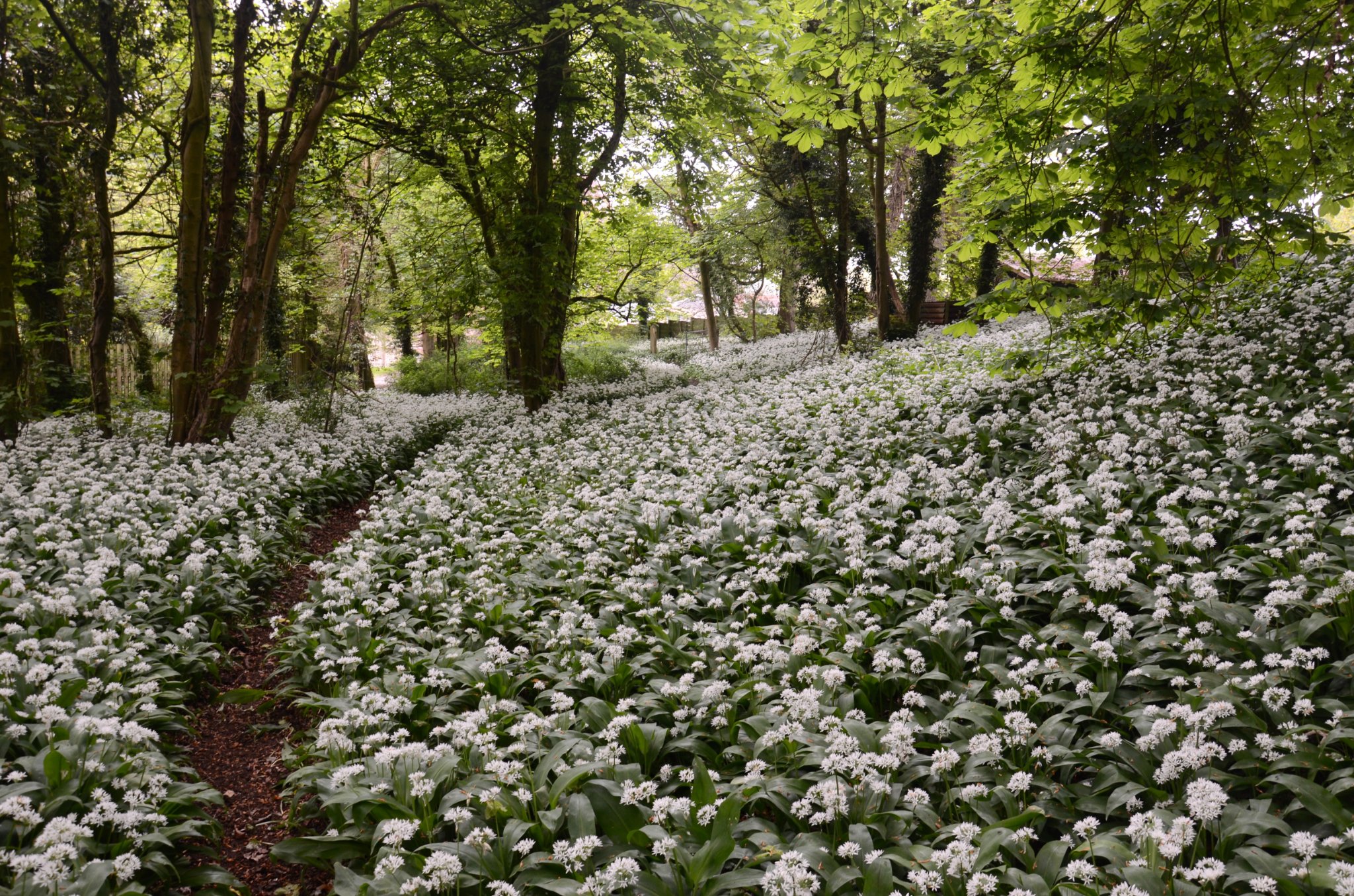
Spring was in full bloom, cowslips, primroses, bluebells…but particularly striking was a carpet of wild garlic that Gerard had never seen (or smelt) before, and I’d forgotten. It wasn’t just another walk but a trek through nature’s bounty of spring flowers.
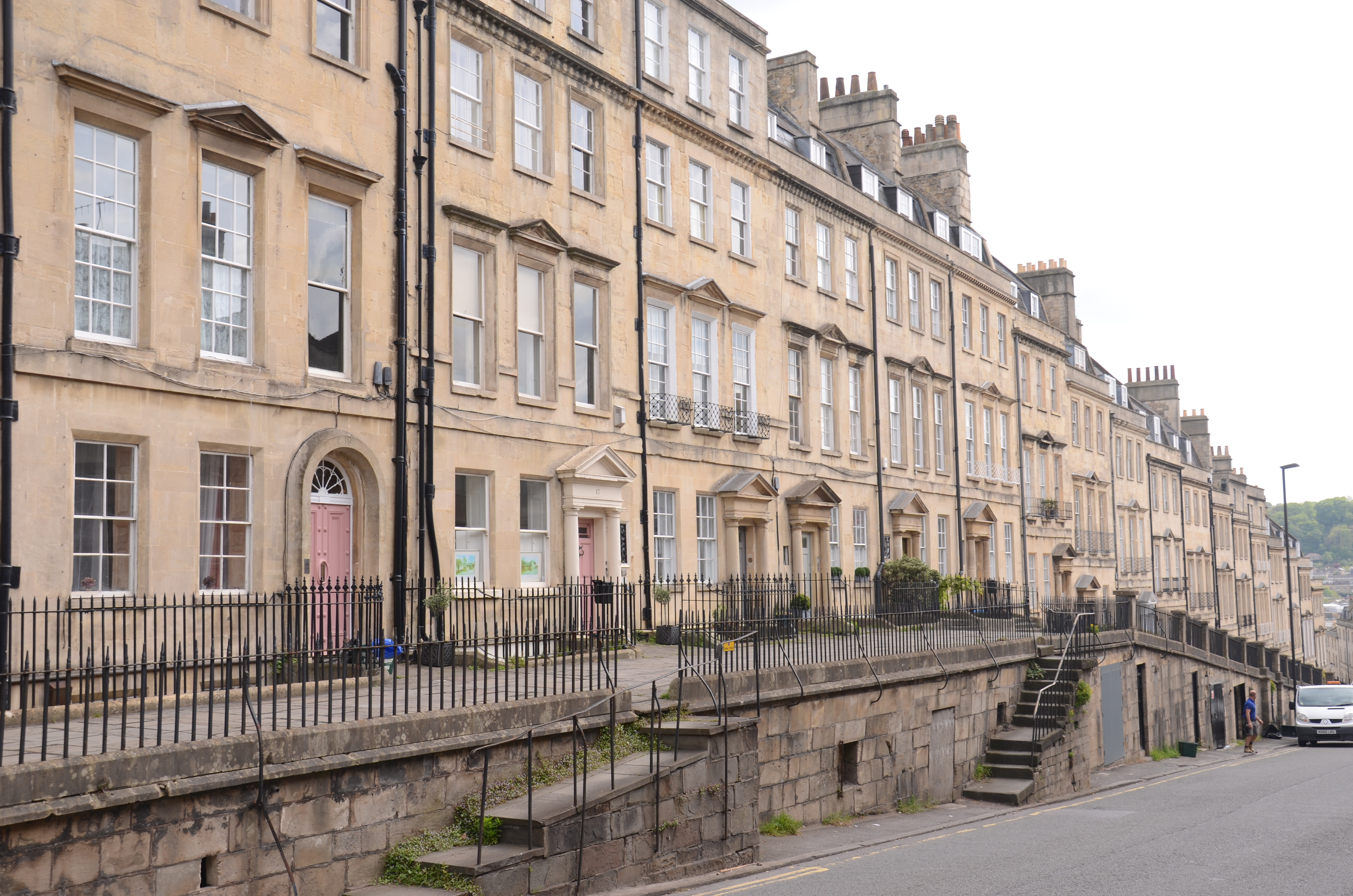
Walking around Bath, I could tell Gerard was having difficulty with orientating himself given the city’s winding streets going up and down the hills. His usual excellent sense of direction was tested.
Taking a break over a sandwich at lunch, Gerard commented on an older woman’s long (to her waist) shiny gray hair that he found riveting. He insisted on saying something, but out of respect directed his complement to the woman’s husband. She lit up like a light bulb while her husband smiled. During our short talk, she asked if we liked Bob Dylan’s music or painting? Painting, Gerard quickly clarified. Oh, there’s a gallery just round the corner. We had to go. Interestingly, a friend had suggested we visit Dylan’s Tottenham Court Road gallery when in London; we hadn’t made it. But Dylan had caught up with us in Bath! We both liked his paintings but were amazed at the prices.
Our last couple of days in Bath were spent with a very old friend from Totnes, that I’d not seen since my early teens. The daughter of the owner of our local pub, she and I had bonded over the Beatles…and boys. Thanks to social media, we recently reconnected and she insisted we visit when in Bath. I must admit I was apprehensive, but I quickly understood why Toni and I had been such good friends. How easily we picked up where we left off! Childhood reminiscing over great meals cooked by her husband.
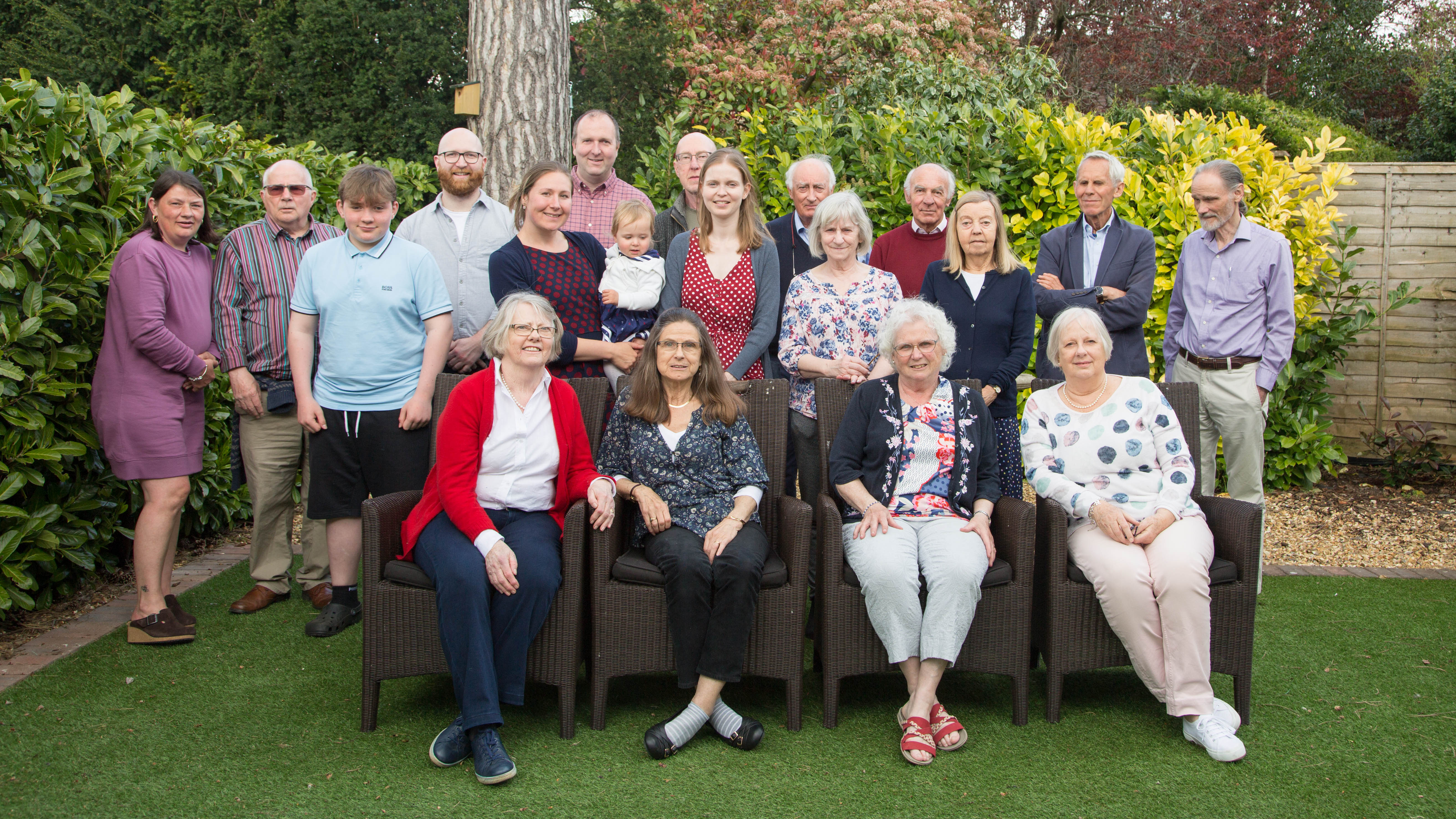
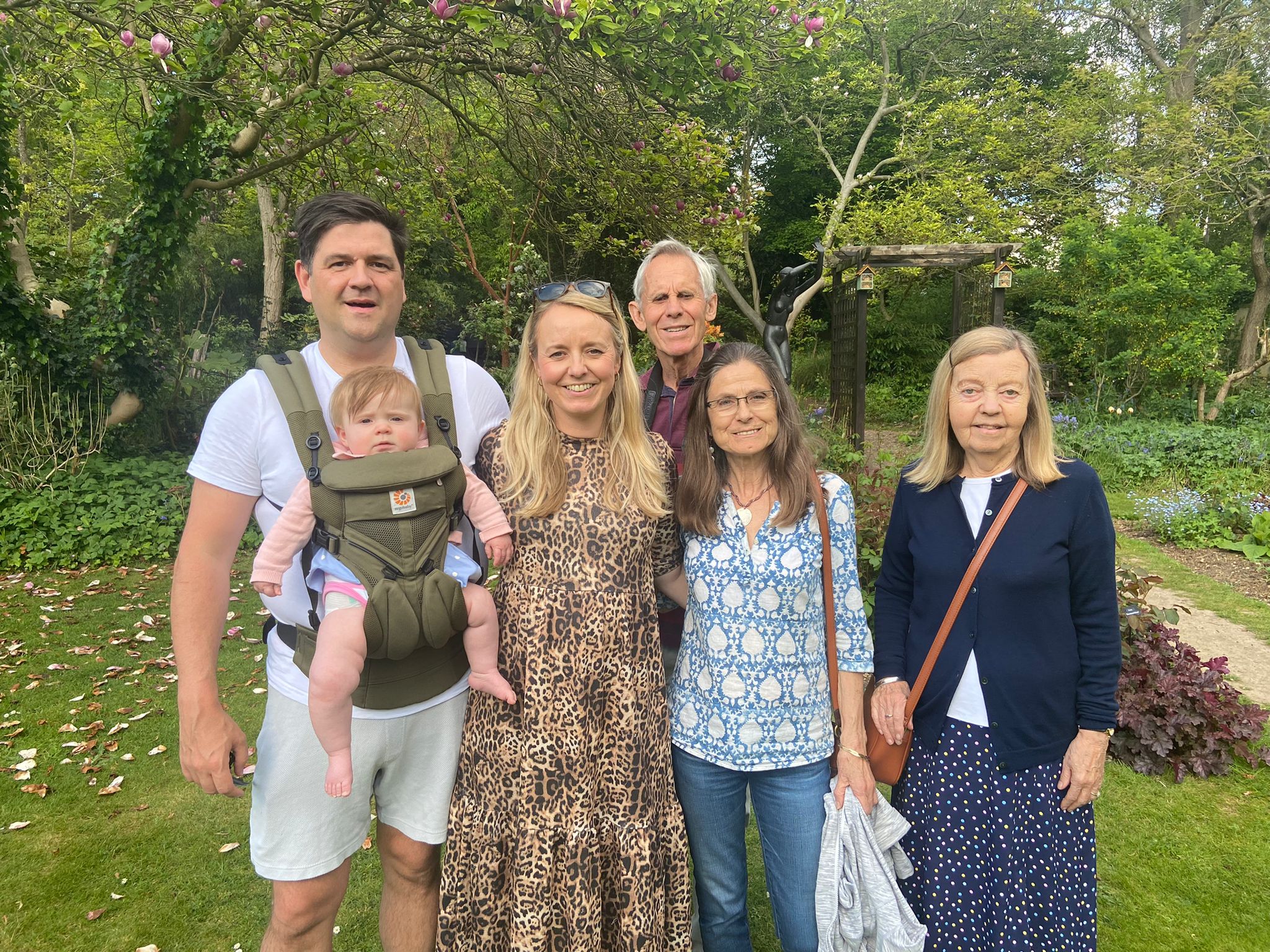
Back in London, we celebrated my sister-in-law’s 75th birthday with the extended family. Niece Maria and husband Ryan, hosted in their new home. It was a casual day, interacting with people who are family but I rarely see. Since our last visit, two new husbands and three baby girls have joined the family. When I left England back in 1973, my brother had just married; today a total of 12 (great nephew Patrick had returned to Cambridge University) gathered with us in Maria’s back garden over homemade pizza and birthday cake. I never would have expected Jeremy to have such a large family. Why? After spending his childhood taking or my father and me, I would have thought he’d had enough.
We’d managed to see a lot of friends, but not everyone. Sadly, two more friends from India were unable to join us. Jonny was suffering from long term covid, and Michael had recently broken his arm. And we didn’t manage to get to the Isle of Wight to see Gloria, an Afro American friend of Gerard’s from Boston, who followed him to England, then married a friend of mine at University and decided to settle in the country. A priority for next time.
Before leaving we spent a day and a night with my boarding school friend Torie and husband Julian who live near Heathrow.
Our good fortune they took us to the airport where we had our fit-to-fly tests several hours before boarding the plane home. Uploaded with a QR code on your phone…(providing you have one!) this is a specific test mandatory for entering the US.
We knew nothing about the test until United Airlines sent us a check-in email a few days before our flight. Not believing it was mandatory, I kept telling Gerard, forget it, we don’t need it, they’re not going to stop us! But Mr Cautious insisted. After a long afternoon of trying to figure out how to get the test (available we read by mail from the US, which now we were in England was no help at all) the doctor daughter of a friend saved the day, directing us to a site at Heathrow. We booked appointments for the day we flew and got the negative test results back in plenty of time before our flight. As we checked in, several people were bumped from their flight for not having the specific fit-to-fly test results. I turned to Gerard, I guess you were right after all!
As my brother would say, it was ‘quite a successful trip!’ Of course, I still had hearing problems, especially in crowded places, restaurants and with men. But with women I did ok. Our entire three weeks, the weather surprised us. Only one early morning drizzle…and plenty of soft English sunshine. Now back home, the three weeks are a blur, but with so many unforgettable memories. What made it special for me was reuniting with friends and family, and with my homeland. Gerard had a wonderful time but wouldn’t use the term ;exciting’ for England. Maybe we will find something exciting next winter – whether in Prague, India, Tunisia…or somewhere still to be considered.
Happy New Year to all our blog followers. We will miss our friends in India for another year, and sympathise with the local merchants who must be suffering due to the lack of tourism. A good friend who managed to get back to Gokarna in South India says the pilgrims and Indian tourists don’t make up for the loss of another season without westerners. Four-week visas with one week quarantine are not appealing to travelers of our ilk.
Two western friends still in India, live in the Auroville community, which has grown exponentially since its beginnings in 1968. Covid has had little impact to life there. But once again Auroville has erupted with internal conflict.
This time, over a road project to connect the four different zones within the compound. The consequences of this ‘progress’ include the destruction of the forest, its planting begun over 50 years ago. The opposing point of view is ‘leave well enough alone’. Our friends say that if the divisiveness continues, they’re prepared to move on.
Losing a loved one around Christmas adds insult to injury. Two good friends just lost their mothers, stirring up memories of my own mother’s passing at Christmastime when I was eight years old. After her death, we never had Christmas at home again. From then on, my father, brother and I spent the holiday with relatives. I celebrated beneath the bedclothes, singing carols and creating the Christmas I’d lost. One clear Christmas Eve, spotting the evening star for the first time, I was convinced I was seeing the same star that guided the shepherds and kings to the baby Jesus. (Growing up in England, the sky was rarely clear enough to see that star!) Since my mother’s passing, His birthday for me has also been associated with death. And I can imagine my two friends who’ve recently lost their mothers will have similar feelings.
With all the calamity in the world right now, it’s easy for me to miss the beauty that’s right in front of us.
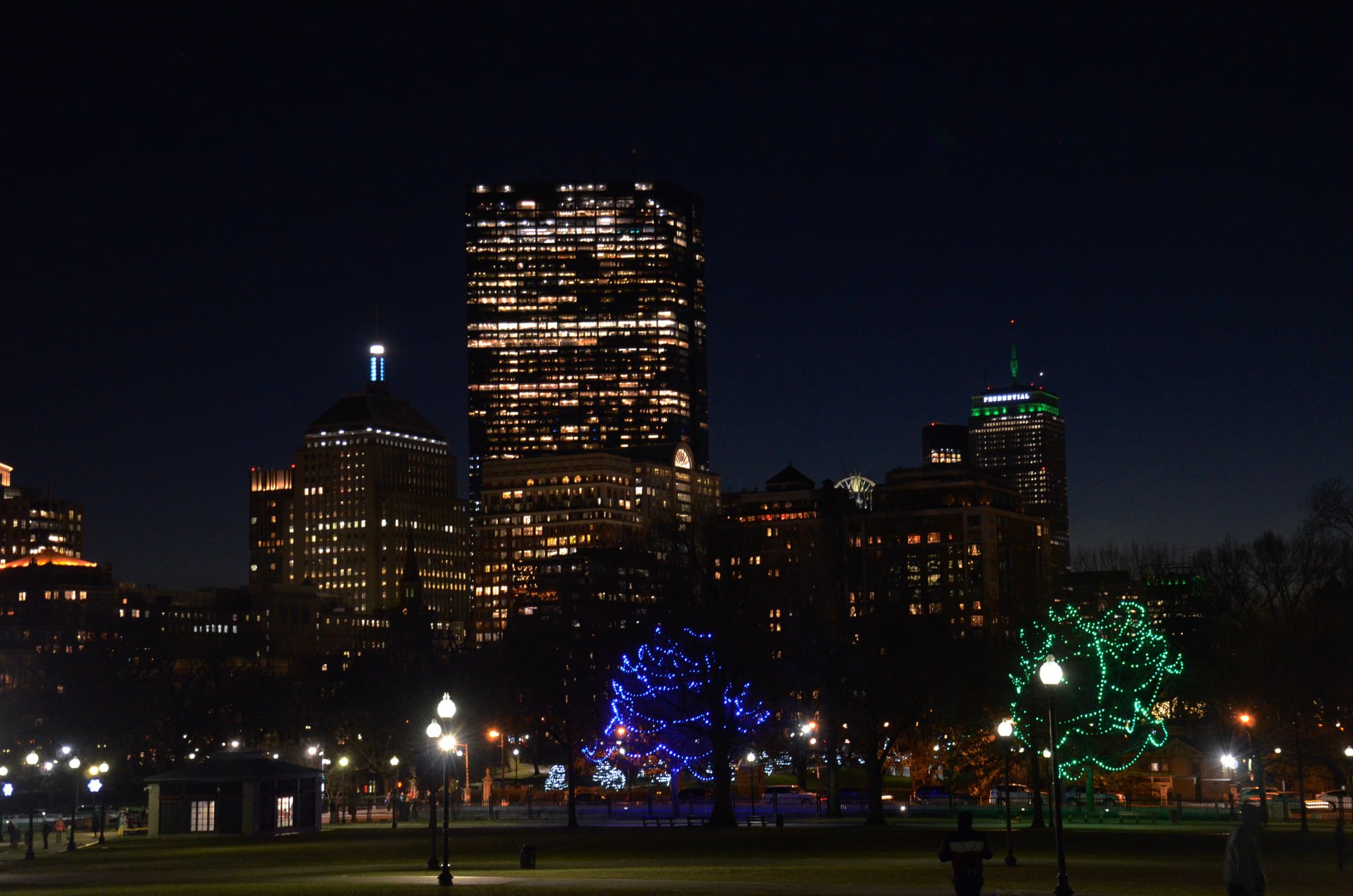
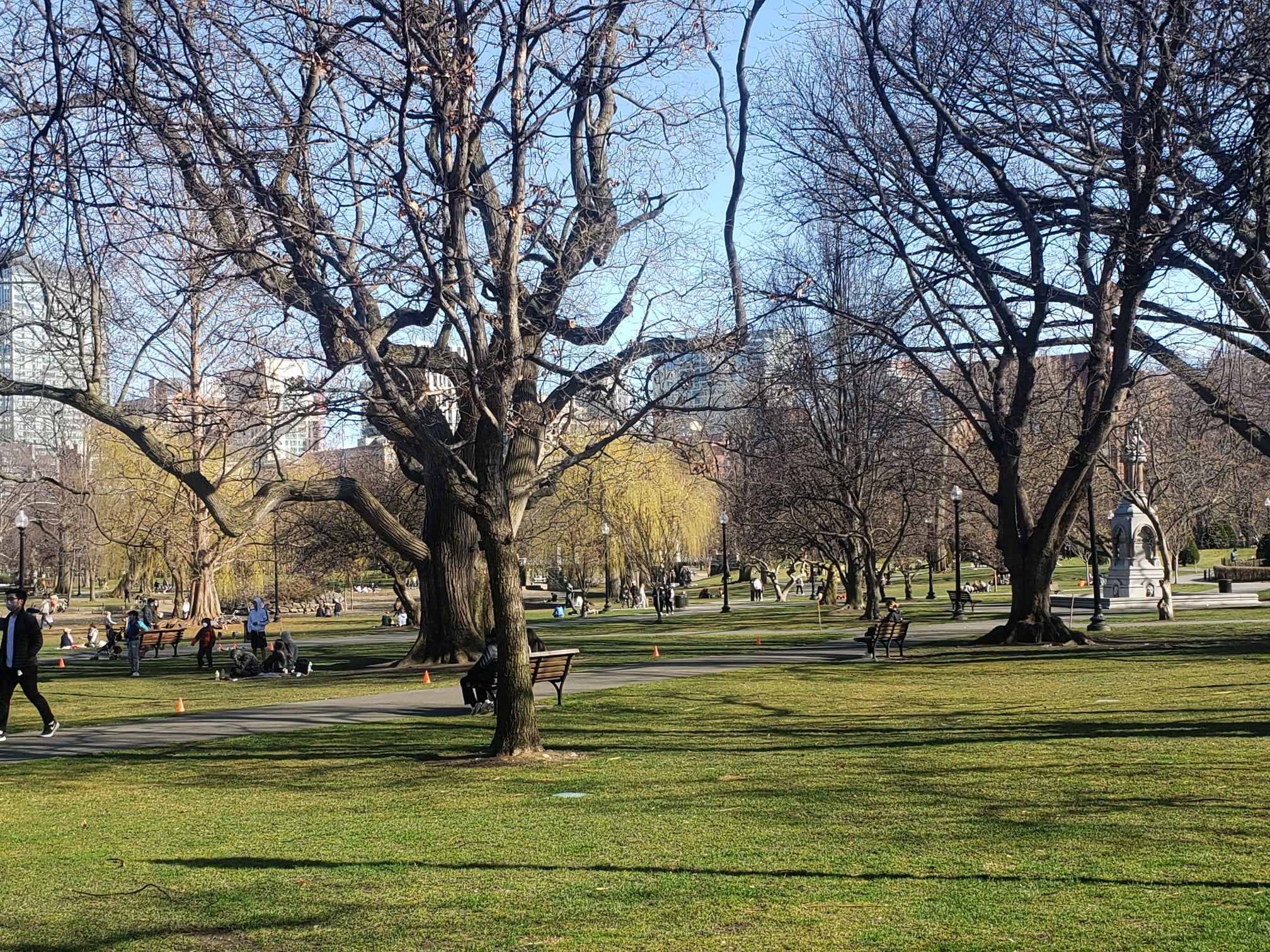
At dusk, the other night, Gerard and I walked through the Boston Common and Garden to see the Christmas lights. How magical the city can be! For a moment the world lost its sorrow in the reflection of the twinkling lights.
After a long winter of Covid, summer arrived with a gradual loosening of restrictions.
Our garden thrived with an abundance of rain, Gerard worked on the house, and I rode my bike and swam in the ocean. Thanks to global warming, the unexpected water temperature fooled me into thinking I was swimming in the Indian Ocean.
Back in July, we took our first real trip out of town since returning from India. A train journey to Philadelphia to see a show of the artists, Soutine and de Kooning, at the Barnes Collection. (Barnes was a private collector in the 1920s).
We both liked Soutine more than we thought, and De Kooning with his pink ladies less than we’d hoped.The more than 400 paintings in the collection were amazing, with the one exception – way too many Renoirs and his pink ladies!
Woman 5, DeKooing
Bather, Renoi
We spent the following day in the Philadelphia Museum of Art with its monumental collection of art.
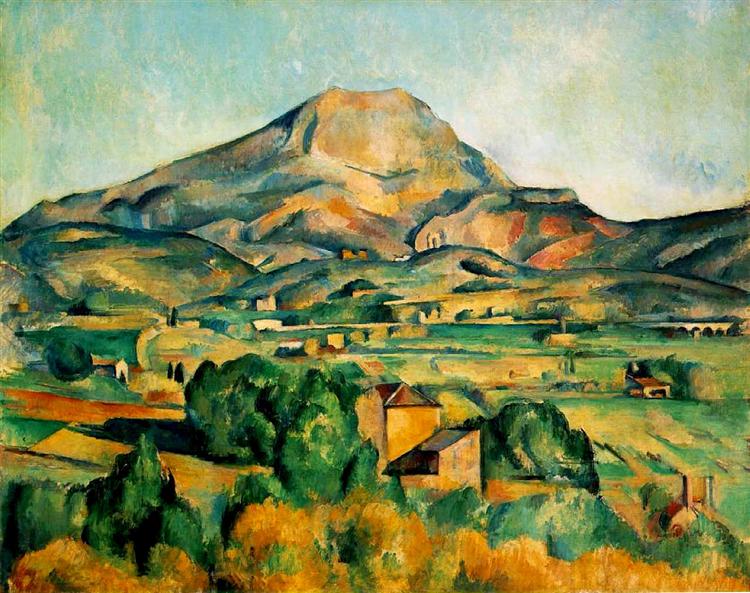
Countless paintings we’d never seen before but the Van Gogh’s and Cezanne’s were the most memorable.
Mont-Sainte-Victoire Cezanne
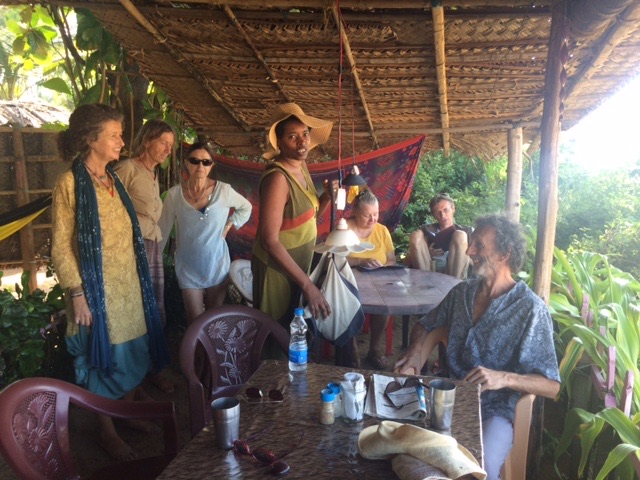
Saturated, we took the train to NYC that evening and spent a couple of days visiting friends we’d not seen in many moons. Our last time with Odella was on the beach in Gokarna!
Beachside cafe. Odella in center
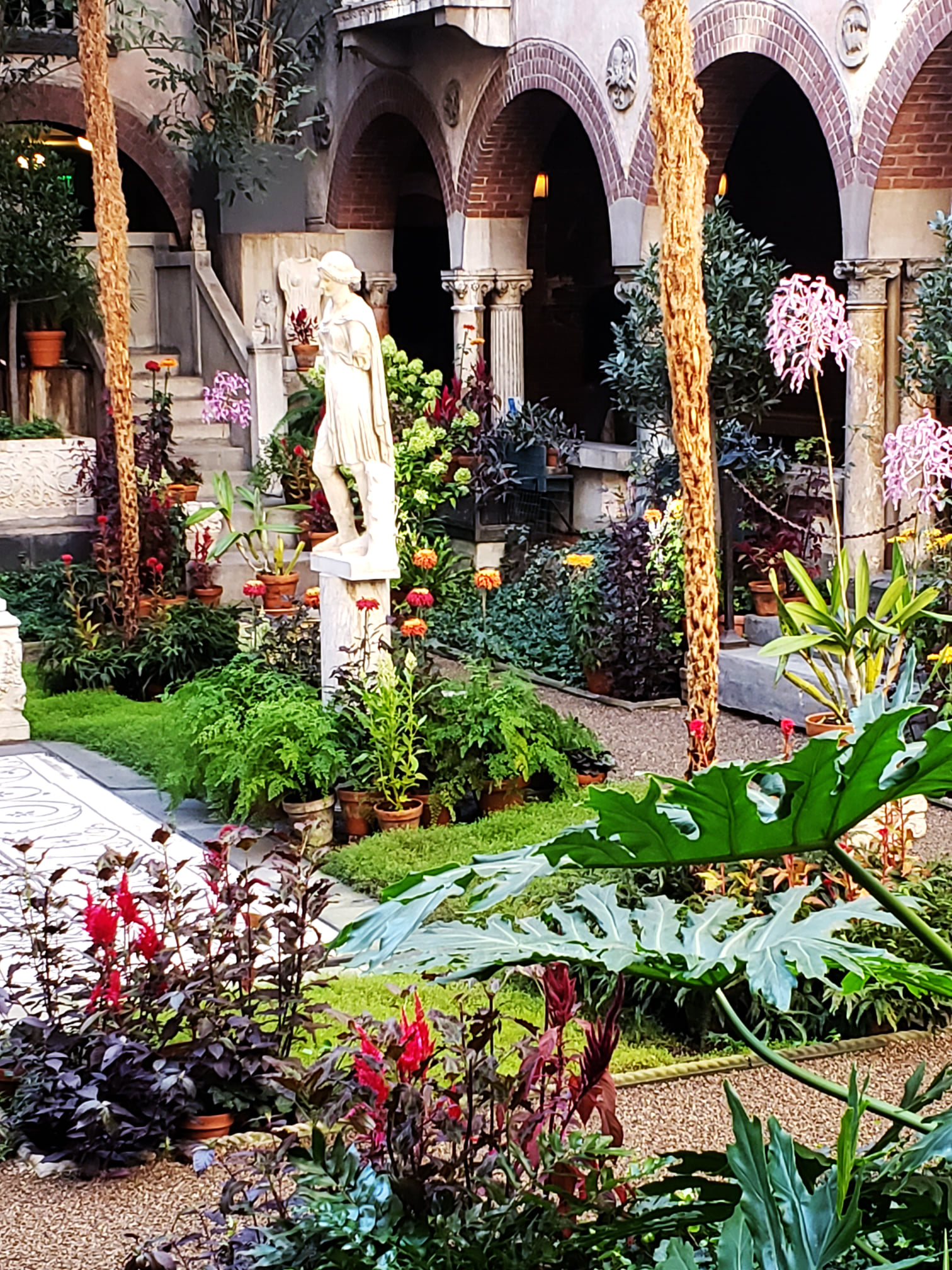
On our 49th wedding anniversary, friends took us out to Mela, an upscale and only surviving Indian restaurant in our neighborhood. During Covid, many of the cheaper Indian restaurants that have been here for years, have folded. Sadly, they didn’t have the deep pockets to hang on. As the virus has receded, we have begun entertaining again Our first houseguests in two years, arrived from Canada and stayed three days. It was good to sit down for meals together, chat long after our customary bedtime and visit yet more art shows with them: A collection of six Titians at the Isabella Gardner Museum.
Courtyard at Isabella Gardner Museum
and Albert Pinkham Ryder, one of the innovators of modern American Art, at the Whaling Museum in New Bedford.
Flying Dutchman, Albert Pinkham Ryder
Our day in New Bedford finished with a walk on Horseneck Beach in the late afternoon sunshine.
An upside of the pandemic is we’ve become more comfortable with Zoom. Gerard has continued his memoir with the help of a virtual writing group. He’s made tremendous progress during the last three years, in spite of his dyslexia. He’s fortunate to have the ability to be fully ‘present’, whether painting a picture, writing, or working on the house. My mind suffers from the the more common dilemma of darting off into the future or dwelling on the past. The real solution to quiet the mind is meditation, and with more time on our hands at home, we’ve increased our practice. But not being a yogi, I can’t meditate all day long. Keeping my mind occupied with the NYT crossword puzzle and Spelling Bee is constructive and satisfies my love of words. Reading remains my favorite pastime, going back to devouring stories under the bedclothes with a flashlight at six years old, and walking into street lampposts on the way to school with my head in a book. After a long history of reading groups where we kept having to remind ourselves to discuss the story, I’ve joined an excellent group of senior women on Zoom (the addition of close captions to the screen has helped my ability to participate). Diving deep into short stories compels me to read between the lines, looking for hidden meaning. This has given me both a new respect for short stories and an opportunity to bond with the other women as we share our lives, woven into the discussion.
Wellington Street
Winter is now arriving, the leaves have faded and fallen, carpeting the sidewalk. Halloween is this weekend and the cold wind turns our thoughts toward the warmth of India. The country is opening up again and issuing tourist visas. A few of our friends hope to go as early as Christmas, but I doubt we’ll be joining them. In part, because I’ve reached a point where addressing my hearing loss has become a priority. Although I can manage quite well with female voices one-on-one, I want to be able to hear men again (most of all Gerard), and deal better in small group settings. My initial experience with hearing aids was disappointing. Perhaps because I didn’t give them a fair chance. The only alternative is a cochlear implant. During the long wait for a reevaluation, I joined online hearing loss and cochlear support groups where I was given encouragement. But once again, the evaluation was a let down.
When we met with the surgeon, he wasted no time in cautioning me against the implant. “It should be your last resort.” The implant would destroy the little hearing that you now have and if it’s a failure, you’ll be worse off than you are now. This made sense. So I need to try hearing aids again, this time with a more positive attitude. An encouraging new development in hearing aids is the capability of switching to a remote microphone. When Gerard clipped the microphone to his shirt pocket, I could hear him much better. Whether I choose a hearing aid or a cochlear implant, I know success depends on training the brain to the new reality which will require patience and perseverance. When they said my next appointment for a “fitting” was six weeks away, I said, no sooner? There’s a staff shortage – even at MGH! It seems no one wants to work anymore.
Next Spring, if it’s in the cards, we hope to visit England. I want to see friends and family again (with three new babies to hug). So if we can’t meet with our British friends in India, perhaps we can see them in England.
From India we’ve received personal reports of the second wave of covid sweeping the county with a vengeance. Our family in Delhi has suffered tragic losses: first Bhushan’s brother-in-law, then Kamal’s older brother, and also a dear friend in Bangalore. Death is sometimes welcome, sometimes inevitable…and sometimes a complete shock. To suffer three losses within the family certainly falls under the heading of a shock. Shruti wrote, “We wish we could meet our loved ones and comfort each other.” We share the same desire.
From left, Swarn, Kamal, me, Bushan, Ravi
Our friend Rajiv was more fortunate. His partner, Marina, wrote from England that he caught covid while traveling from Gokarna via Delhi to the state of Uttarakhand. He’d already had one vaccination, and during the journey had five covid tests – all negative. He thought his cough was from traveling and climate change. Then he tested positive and was immediately put in hospital. With few cases in that state the hospitals were working as normal. Later, transferred to a “luxury” hotel, he was checked twice daily by a doctor, then released.
Meanwhile, in Varanasi, people have described the drastic situation. Covid is rampant and the sick are desperate for medical care and oxygen. A business owner complained people are dying due to the collapse of the medical system. “Money is useless; you cannot buy oxygen or a hospital bed. Every one is in the same condition for death…pray for us”
Another friend, a semi-professional photographer sent a link to a BBC News article: Covid in Varanasi: Anger rises as coronavirus rages in Modi’s constituency https://www.bbc.com/news/world-asia-india-56969283Hisphotograph of the major cremation site beside the Ganges leads the article. “The prime minister and the chief minister have gone into hiding, abandoning Varanasi and its people to their own fate,” the article quotes.
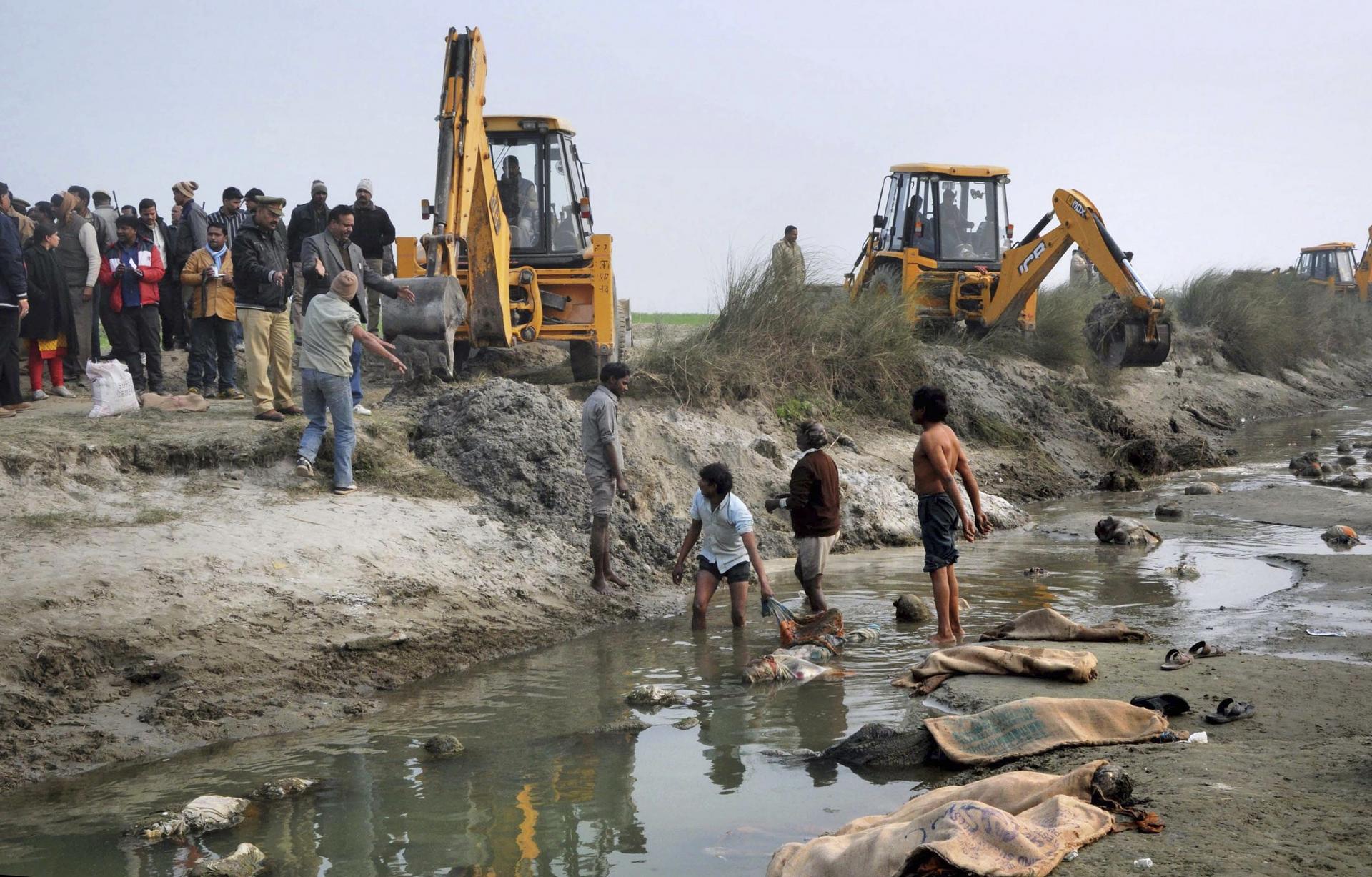
Uschi, who we met many years ago, in Varanasi, also wrote in reference to the overloaded cremation sites and skyrocketing cost of wood. “Now the Ganges has become the graveyard of the Pandemic, for those who cannot afford to be cremated.” Their loved ones hope the Ganga will liberate their souls. Nets have been spread throughout her waters to capture the bodies.
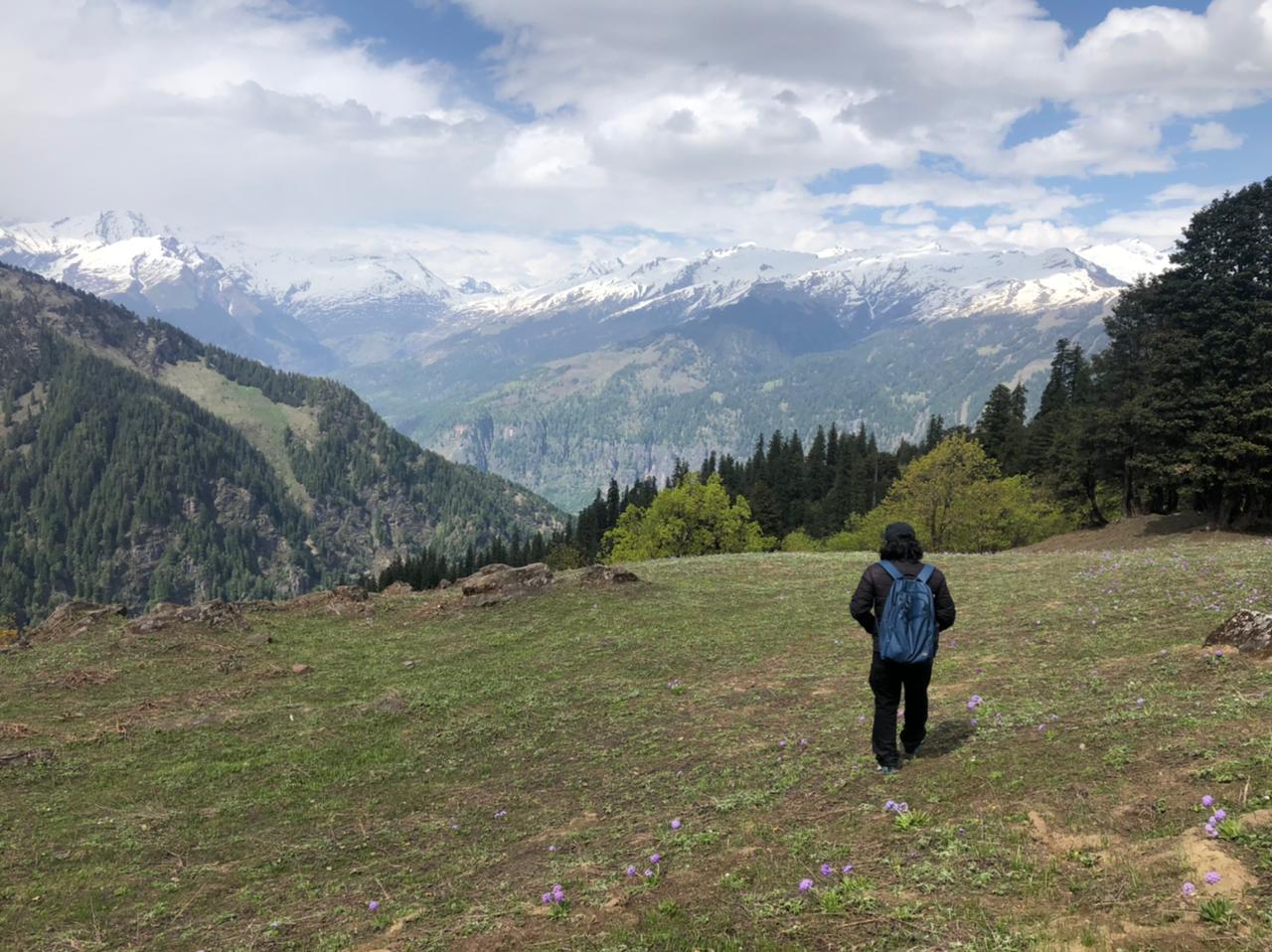
Up in Himachal Pradesh it’s a different story, sparsely populated covid has not taken hold. Katinka, an English woman, has been in India throughout and stayed in Varanasi until covid started to rage. She retreated to HP where she’ll stay there for the foreseeable future.
Anita and Sulata, whom we met several years ago in Nagar, and later visited at their home in Vrindavan, are also now staying in the mountains and enjoying the quiet of lockdown.
“We have an abundance of nature, can go on hikes and treks and have a lot more freedom to move around.” Sulata wrote. But it’s not so good for the locals who rely on the tourist industry. Only essential stores are open and with no interstate buses running, Sulata feels marooned from the rest of the country. “It’s hard to really know what’s going on up here and there are no reliable Indian news sites.”
Anita in the mountains
At the other end of the subcontinent, Auroville has been in lockdown since the end of March, with strict sanitation, social distancing and quarantine for those returning from abroad. Officially, they declare no covid. Frederic, who’s been living there for the last five years, reported fifteen active cases mild or moderate, without need of oxygen. But no visiting tourists from Bangalore, Chennai and Mumbai means no opportunity to sell their products in the market. It also means locals are no longer needed to support the tourist trade. Frederic wrote of an Indian friend, a carpenter working in Auroville, who built Frederic’s furniture. He recently died of covid at 65. “He was tired of life after many years of hard work to feed his family and then the death of his son. But I will always remember his smile.” Frederic said.
In Auroville, taken by Frederic
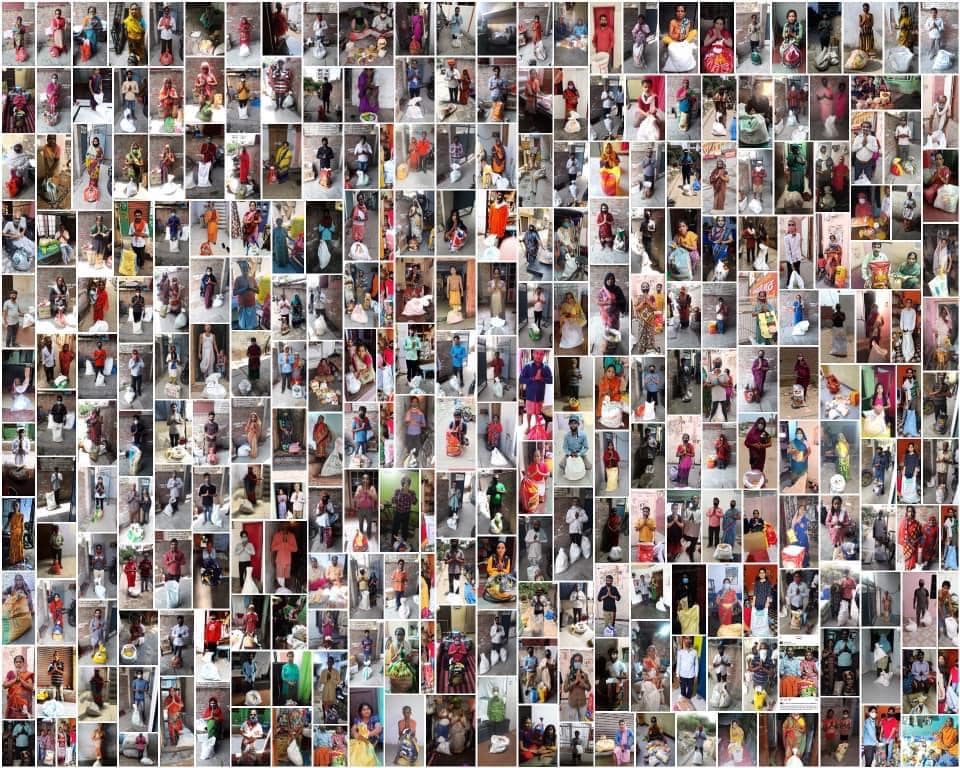
A neighbor on our street took a luxury yoga tour in Rajasthan and made a personal connection with the guide. Now many in the group are sending money to the extended family to help them through this crisis. Likewise, Uschi, is organizing distribution of food to poor families in Varanasi. She has a wealth of contacts in the west through her yoga tours and export clothing business. Marooned in Germany with her son, Uschi is working with Rakesh, her business partner in Varanasi to distribute the care packages. 75$ provides basic food supplies for a month with a cash supplement for perishables. Hopefully, this will aid them from not falling into further poverty. So far been able to reach 800 families and plan to extend to 1,000. Rakesh takes a photo of everyone who has received a care package.
As the tragedy of India unfolds it deeply disturbs me. In the midst of so much suffering in our adopted country, thank God for those that we know who are making personal efforts to do what they can. The impact of covid in India affects me as if it were my own family….it is my adoptive family. I should have similar empathy for people in all countries suffering from this disease, but the strongest pull comes from India.
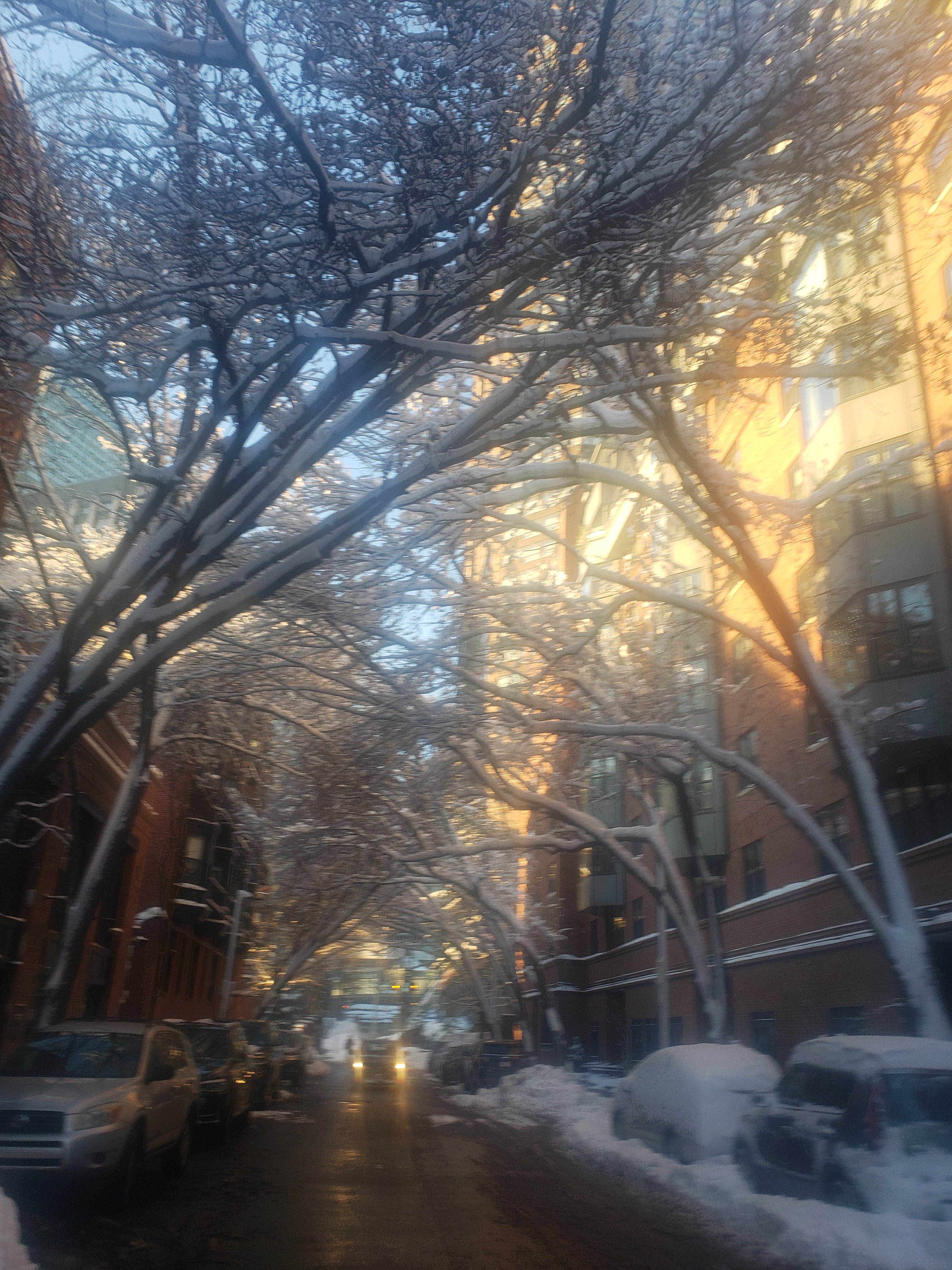
Just before dawn I hear birds singing. The robins and the cardinals are back, the cat birds will soon follow. In the garden, clumps of snowdrops adorn the barren land, while the lilac is beginning to bud and the forsythia is about to pop. The winter wasn’t so arduous…no long periods of unrelenting cold, no stumbling over hard-packed sidewalk snow. Ironically, New England was more fortunate than Texas that suffered from an unprecedented cold spell that froze water lines and shut down the electrical grid. But in Boston, I was still able to ride my bike whenever the temperature was above 40F (4.5C). New England can surprise us with an April snowstorm. Twenty-four years ago on April Fools Day, we took occupancy of Wellington Street during a huge storm that brought down trees. Now the sun is higher in the sky and we’re definitely on the threshold of Spring.
We were offered the one-shot Johnson and Johnson vaccine and only momentarily hesitated. Was J&J as effective as Pfizer or Moderna? Whatever, we’re happy to be done with it. The vaccination hasn’t made a huge impact to our lives; we still wear masks outside and haven’t gone out to eat. I feel a little more comfortable going grocery shopping and more willing to lean in toward the cashier to try and hear what she’s saying.
Our experience in Covid is typical, spending most of our time in the home. It’s given me a new appreciation for our comfortable house and the neighborhood, where we can still find the unexpected.
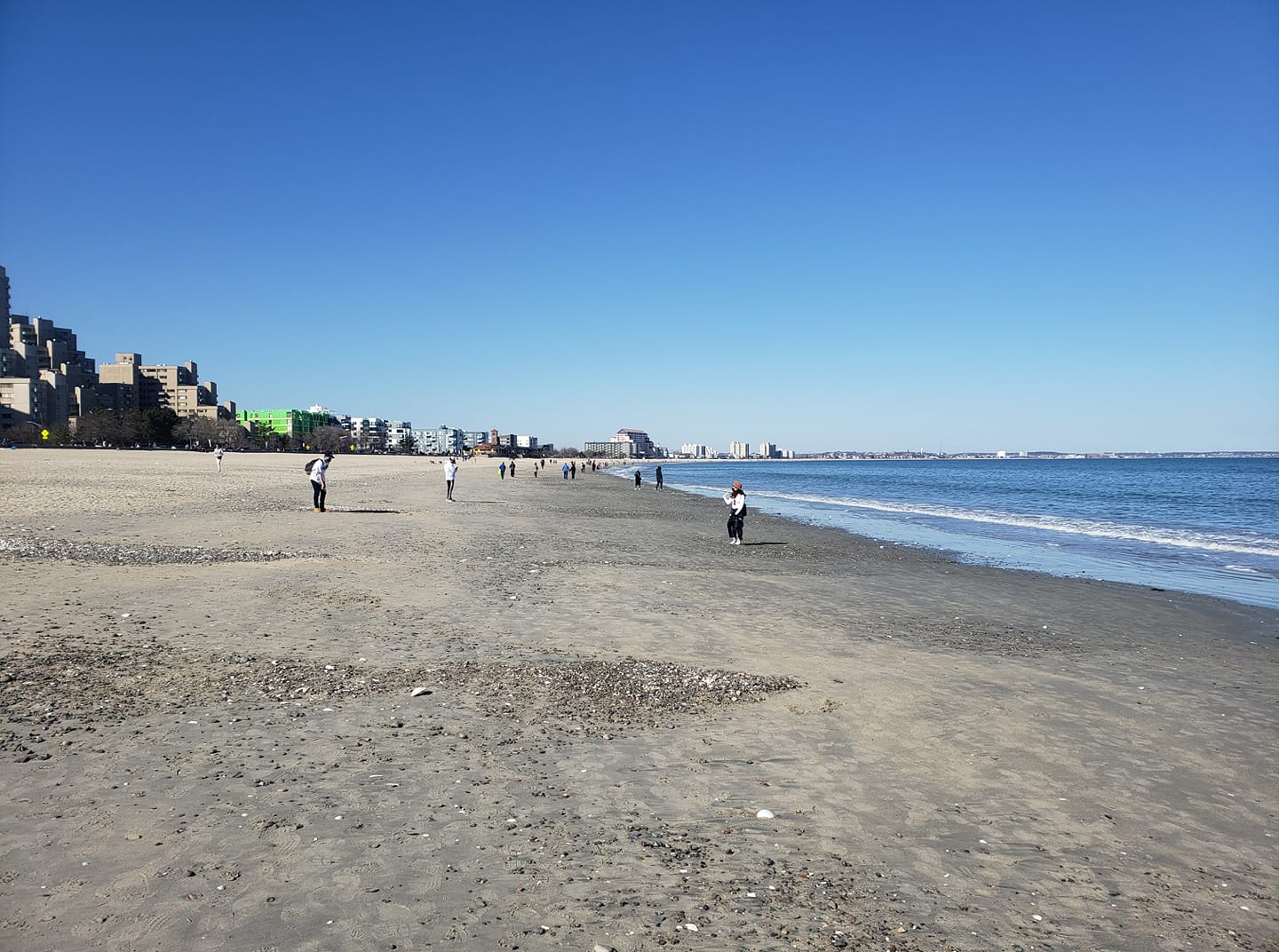
That said, both of us are looking forward to expanding our horizons.On an unseasonably warm Sunday afternoon, we rode the subway to Revere and walked the beach. It felt great to feel the sand under our feet and smell the salt air. The amusement park neighboring the beach has long gone, replaced by tasteless high-rise condos. I suggested to Gerard we could move here and enjoy cheap ocean view property. He pretended not to hear.
With my limited hearing, scaled-down interaction during Covid has not been a sacrifice, and now I’m feeling apprehension about becoming socially engaged again. Gerard, of course, is ready to resume his chatty lifestyle talking to any and everybody on the street! His time, however, has been filled with rewriting his memoir. A friend, a published poet, has kindly taken the time to read and provide some major editorial suggestions, which he will incorporate.
I’m not a big fan of Zoom but it has enabled me to communicate with friends in a way I no longer can. An external speaker attached to the computer helps but perhaps more is the fact I can see faces without masks. Every two weeks, I participate in a zoom reading group organized by a local senior center. So far, every short story picked from the New Yorker has been thought-provoking. The news from England is two of my nieces are pregnant with scheduled deliveries the very same week of September! So I’m busy knitting again.
Even though we didn’t go to India this year, we’re staying in touch. Last September, India was overtaking the US to become the country with the highest covid caseload. Four months later, in February, numbers plummeted inexplicably. Has the prevalence of so many other diseases boosted Indian immune systems? As in other parts of the world, infections are now rising again, particularly in Mumbai and they’re poised for another lockdown. How quickly Covid could spread through a slum!
Over the years, I’ve read some excellent books giving focus to the Indian slums – City of Joy, Shantaram, Behind the Beautiful Forevers. A recent novel, I recommend is Djinn Patrol on the Purple Line by a journalist, Deepa Anappara. She addresses the huge number of missing children – as many as 180 an hour. Her heart wrenching story is told through the eyes of a 9-year-old boy who lives in a slum, abutting the railway line. See NY Times book review Who Cares About a Missing Child?2020/01/31/books/review/djinn-patrol-on-the-purple-line-deepa-anappara.html
Our friends in Varanasi and Himachal Pradesh post Facebook pictures making it look as if nothing has changed. There isn’t a mask in sight. But the economy has suffered a 24 per cent drop during the peak of the pandemic. The country remains closed to tourists. An English friend who managed to stay in Varanasi after the virus hit, recently traveled down to Gokarna, where she found twenty other westerners who like herself had decided not to leave India. For the risk they took, the benefit is they have the run of the beach.
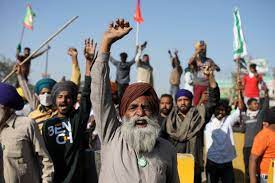
In Delhi , the family tell us the major disruption has been farmer protests caused by Modi’s attempt to eliminate government subsidies. Four months ago, farmers, primarily from Punjab arrived on their tractors to clog the main strets of the capital.
Back in the US, politically things are quieter. The orange thug has left the stage…momentarily, but the immigration crisis on the Mexican border, the murder trial of George Floyd and conspiracy theorists continue to fuel the smouldering embers of discontent.
Looking out my kitchen window, watching our garden slowly come back to life, I feel optimistic.
As we flew out of India last March, I had a premonition we might not be able to return again the following January. We had little idea at that time how serious coronavirus was and how deeply and long it would impact our lives. Waiting for the plane to depart, our last night in Orchha occupied my thoughts. The town had gone into an abrupt lockdown, the temple closed its doors and the streets emptied. In a pool of streetlight, a small group of beggars sat outside the temple, while our new friend from the Indian military, volunteering with the temple priests, handed out dal and chapatis. The usual hubbub of pilgrims and street vendors had already disappeared into the quiet night. I took a last photograph and silently bid Orchha goodbye. The mood was decidedly melancholy. The next day, we were back in Delhi and franticly searching for a flight to Boston. had to let go of my fantasy of hiding out in the Himalayas, and we boarded one of the last flights out of India.
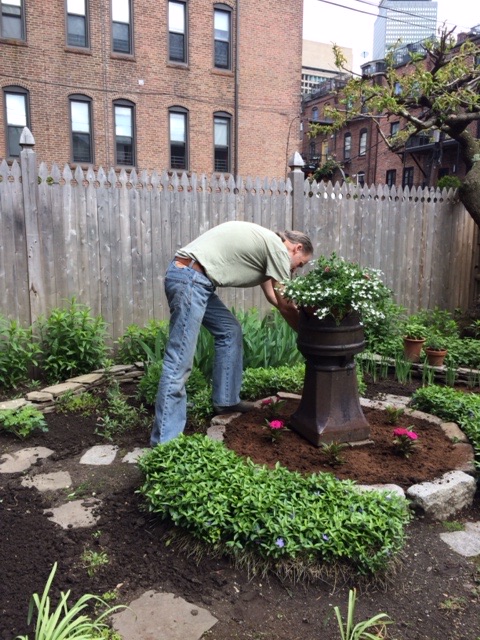
We returned home to a new reality of social distancing, mask wearing and grocery store queues. But spring was coming and the garden became our refuge. We nursed it back to life, planted anew and weeded. Gerard rebuilt the stone wall and leveled the paving stones.
We lingered over breakfast, drank chai in remembrance of India, and from time-to-time entertained friends sitting six feet apart on the patio.
While self-quarantining, I paced the empty alleys of the South End. Soon I felt confident to ride my bike in the empty streets of Boston and discovered new bike paths in and around the city: beside the Charles River and around the vast, now empty, university campuses of Northeastern and Boston.
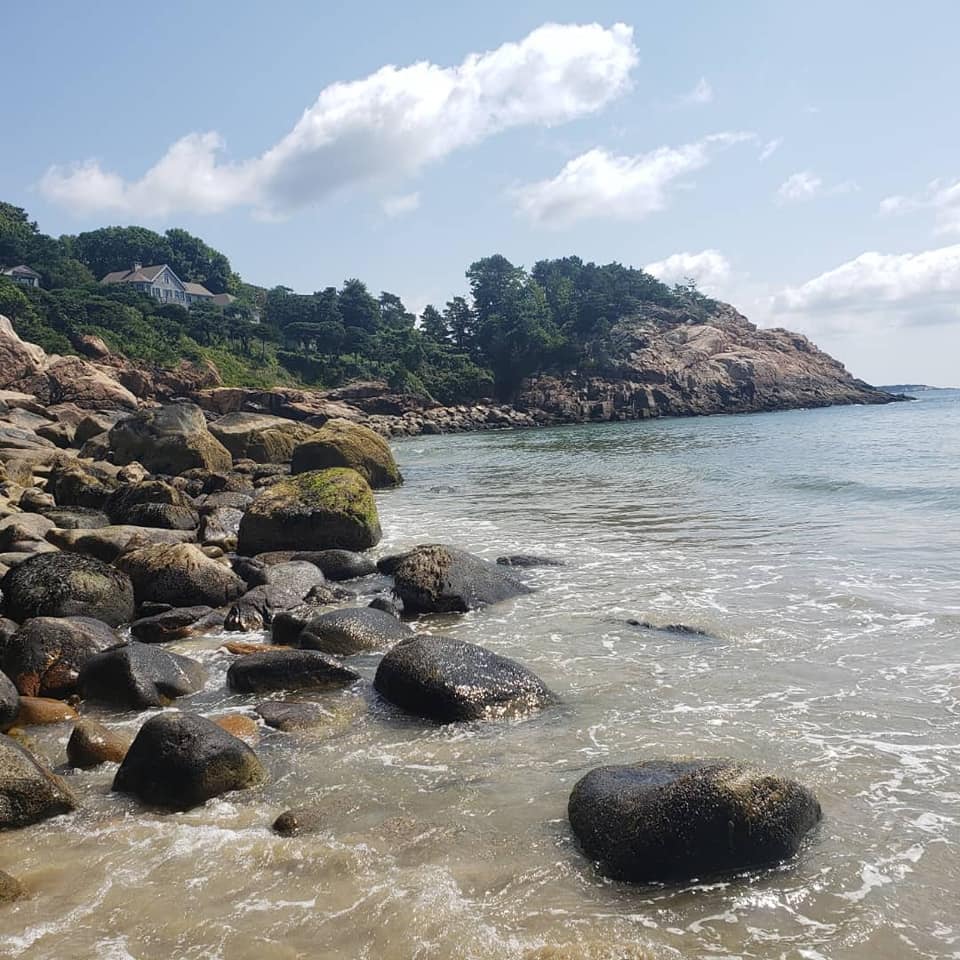
When summer came, I could not longer go to Manchester by the Sea; the town had closed the beach to non-residents. Boston harbor became an option; I swam wary of pollution and keeping my head well out of the water. On a sunny weekday, more often than not I swam by myself, looking back toward the city and marveling at my secluded private lagoon. (On the weekend, the crowds arrived and I stayed home)
The social restrictions have not bothered me as much as others. The pandemic has helped me to rein in my restless nature and find a new contentment in a quieter life at home. I never really liked the using the telephone and now, with my hearing loss, I’ve rediscovered the joy of writing letters. Growing up in England, letter writing was expected and something always enjoyed. I lost touch with it through the convenience and universality of telephones. Social encounters, consisting of only one or two people at a time, are easier, although masks and social distancing exacerbate my hearing loss. With the deepening political chaos I’ve spent more time reading the news, national and international trying to make sense of the insanity. And now that winter’s arrived, I’ve taken up knitting again after a long hiatus.
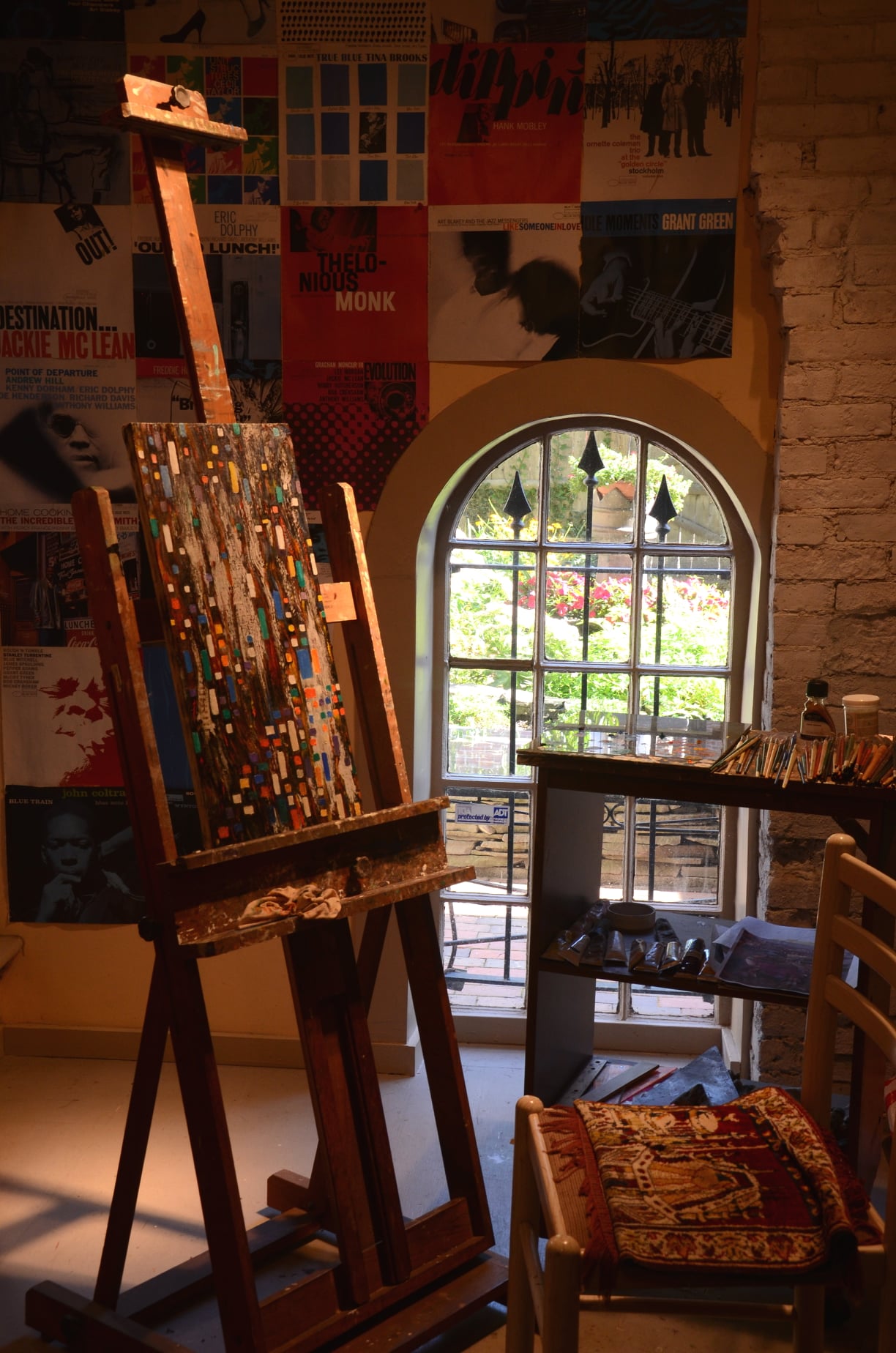
Gerard, who never has a problem occupying his time, stays busy with projects: house repair, furniture refinishing…and painting pictures when he finds time. He’s recently completed two that I especially like. Now, he’s returning to a rewrite of his memoir during the cold dark winter months. He’s never at any loss for words on the telephone, but he misses socializing, whether a casual street encounter, or a prolonged coffee shop conversation with friends. Neither of us have suffered in isolation – fortunate we don’t have to go out to work, have a lovely house and each other for company.
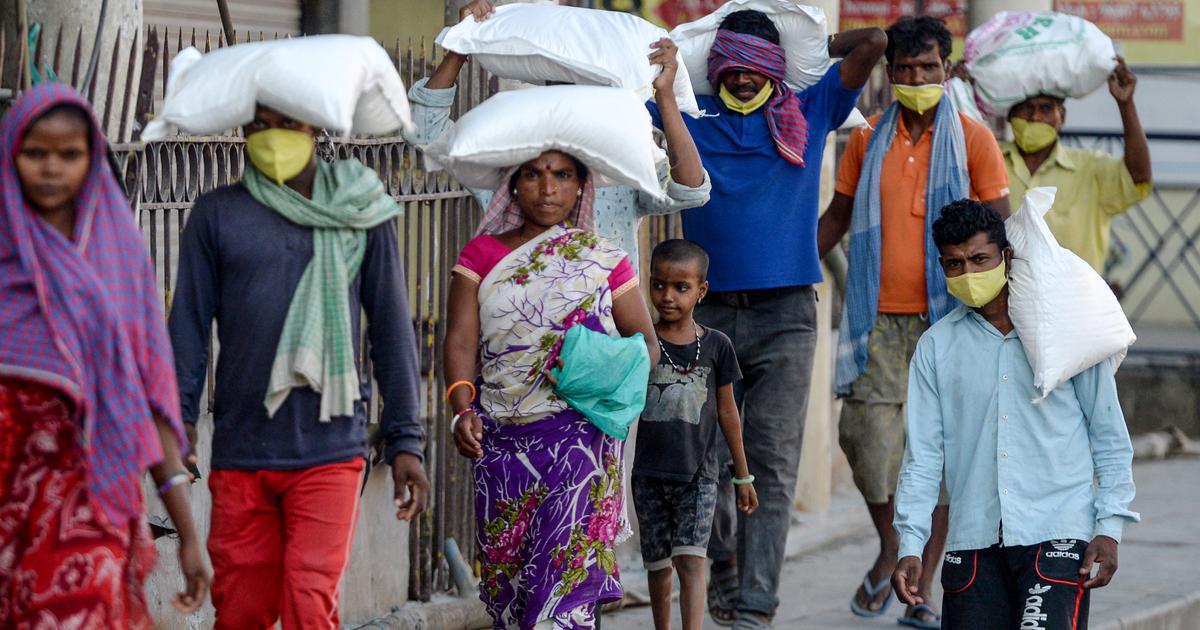
India is never far from our thoughts. Back in March, Modi ordered India’s lockdown with less than four hours’ notice. “Forget what it is like stepping out of the house for 21 days. Stay at home and only stay at home,” he ordered. But he mentioned nothing specific about the daily-wage earners—mostly migrant workers—who make up 80% of India’s workforce. Factory hands, delivery boys, cooks, painters, rickshaw pullers, or vendors standing by the roadside, selling fruits and vegetables, chai and flowers. Migrant women are indispensable as maid servants for the middle and upper class; daily they arrive to wash clothes, sweep floors, cut vegetables and make chapatis. With the pandemic, their income, in an instant, disappeared. We’ve seen horrifying pictures of these migrant workers, fleeing the shutdown cities. With bags perched on their heads and children in their arms, walking down highways in a desperate attempt to return to their villages hundreds of miles away.
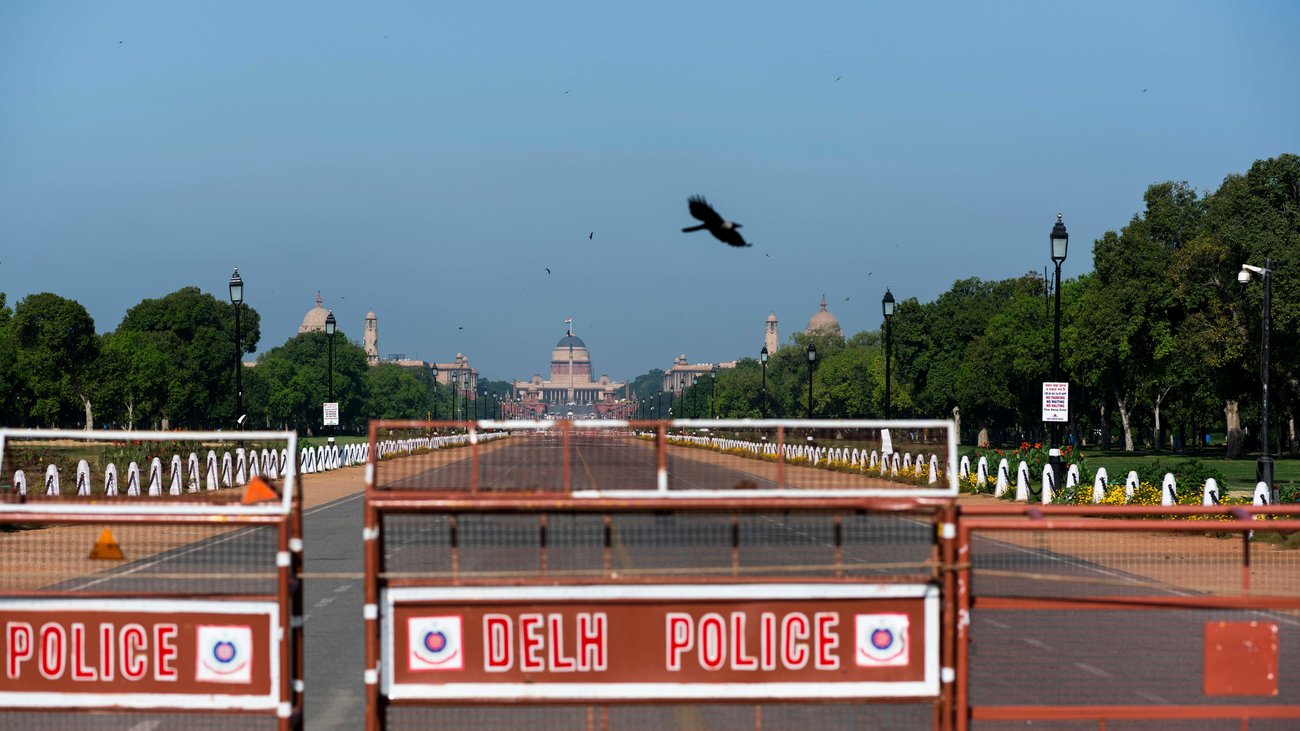
Meanwhile, back in Delhi, with few cars on the road, there is one silver lining: the sky has become clear and blue, something rarely seen in one of the most polluted cities in the world.
A crow flies near Rashtrapati Bhavan, the presidential palace in New Delhi, on April 2. Air quality has markedly improved in India’s capital since the country’s coronavirus lockdown began last month.
In the days following the shutdown, we heard stories of foreigners who didn’t get out in time. A friend sent us a video of some English tourists fleeing Varansi to make an evacuation flight in Dehi. The trip was far from smooth, the van driver fell asleep and went off the road, there was a long wait for another van, resulting in just missing their plane. I was envious of American friends, one a Krishna devotee, the other a travel guide, who were both able to remain in Himachal Pradesh. In the mountains, there’s been little evidence of covid. Two other old friends, have both become permanent residents in Auroville. Covid infections have stayed low and their lives seem to be continuing as normal within the confines of the community.
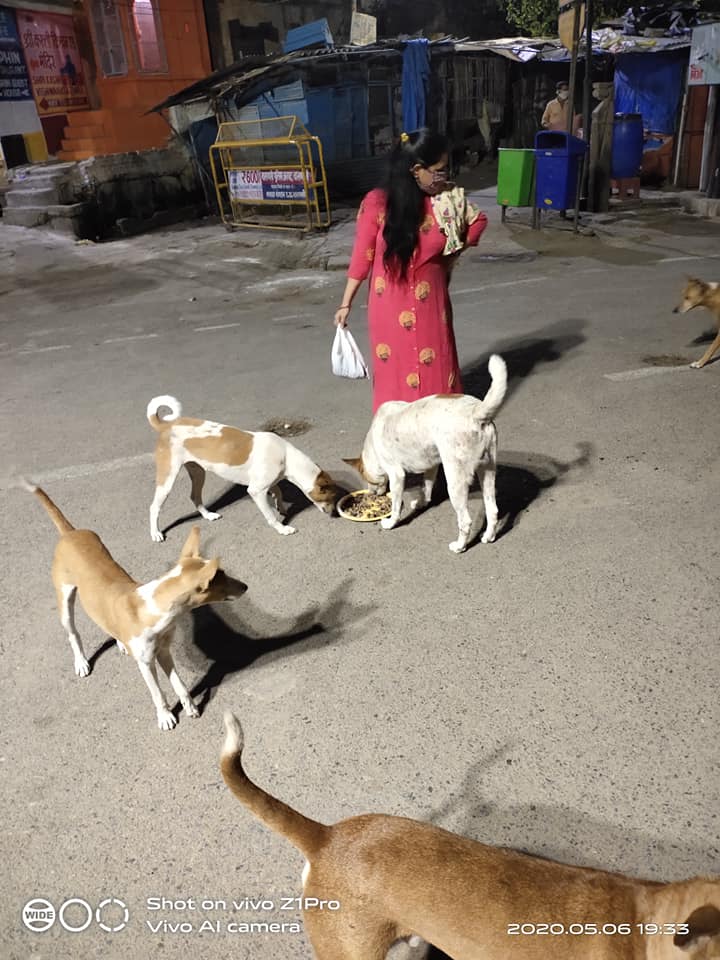
We’ve also kept in contact with our Indian friends. Their stories are quite different. Our hotel in Varanasi, Shiva Kashi, has been closed since March and Sanjiv, the manager, is trying to hang on until they can open again, probably not before next summer at the earliest. Shree Cafe is likewise closed. Santosh, his days freed up, is taking photographs of the shutdown city. Sadly, the demolition work from the Golden temple to the banks of the river still continues with a hideous pontoon mooring to offload tourists arriving by boat. His wife, Seema, has fed the stray dogs and cows on the street almost nightly and sponsors community youth activities – coaching football teams on the ghats, holding competitions.
Rajesh appears to be back at his bangle store near the Golden Temple (though we may be wrong) while still writing beautiful poems. In the photographs, few are wearing masks. In Orchha, our Kashmiri friends were forced to close their jewelry store, but couldn’t get a flight home to Srinagar. We’re still waiting for the final outcome. So many of the Indians we know rely on the now nonexistent tourist business. The Indian government is not issuing any tourist visas and this is unlikely to change as long as covid continues to surge.
Back in the US, the political mess has provided a constant distraction…or irritation. It’s felt like an emotional roller coaster. For a moment, I believed trump was going to leave the stage and he’d no longer dominate my mind with so much negativity. But that’s not trump; good news or bad news, he still continues to take center stage. After the storming of the Capitol, I feel America has deteriorated into a state of complete lawlessness — a banana republic. Wintering in India, we’ve missed recent inaugurations. In hill station, Ooty, we tried to watch Obama with a group of westerners but the TV had terrible reception. Four years ago, we happily ignored Trump’s sign-in as we sat on the beach in Agonda.
As Biden will be inaugurated in a virtual and low key ceremony, trump will orchestrate his ‘triumphant’ departure from a military air base in Maryland…but no one will be watching. It’s easy for me to compare his departure to that of Richard Nixon in 1974. But I like to think Nixon redeemed himself by having some remorse. He later admitted: “I let you down. I let the country down.” I can’t imagine trump will ever feel any similar responsibility.
At present, I’m on overload: too much trump, too much pandemic, too much distrust. Keeping our heads down, we hope for the best. Missing all of you that we will not see in India this winter, best wishes for health and happiness in 2021.


























 A Small Case Across India