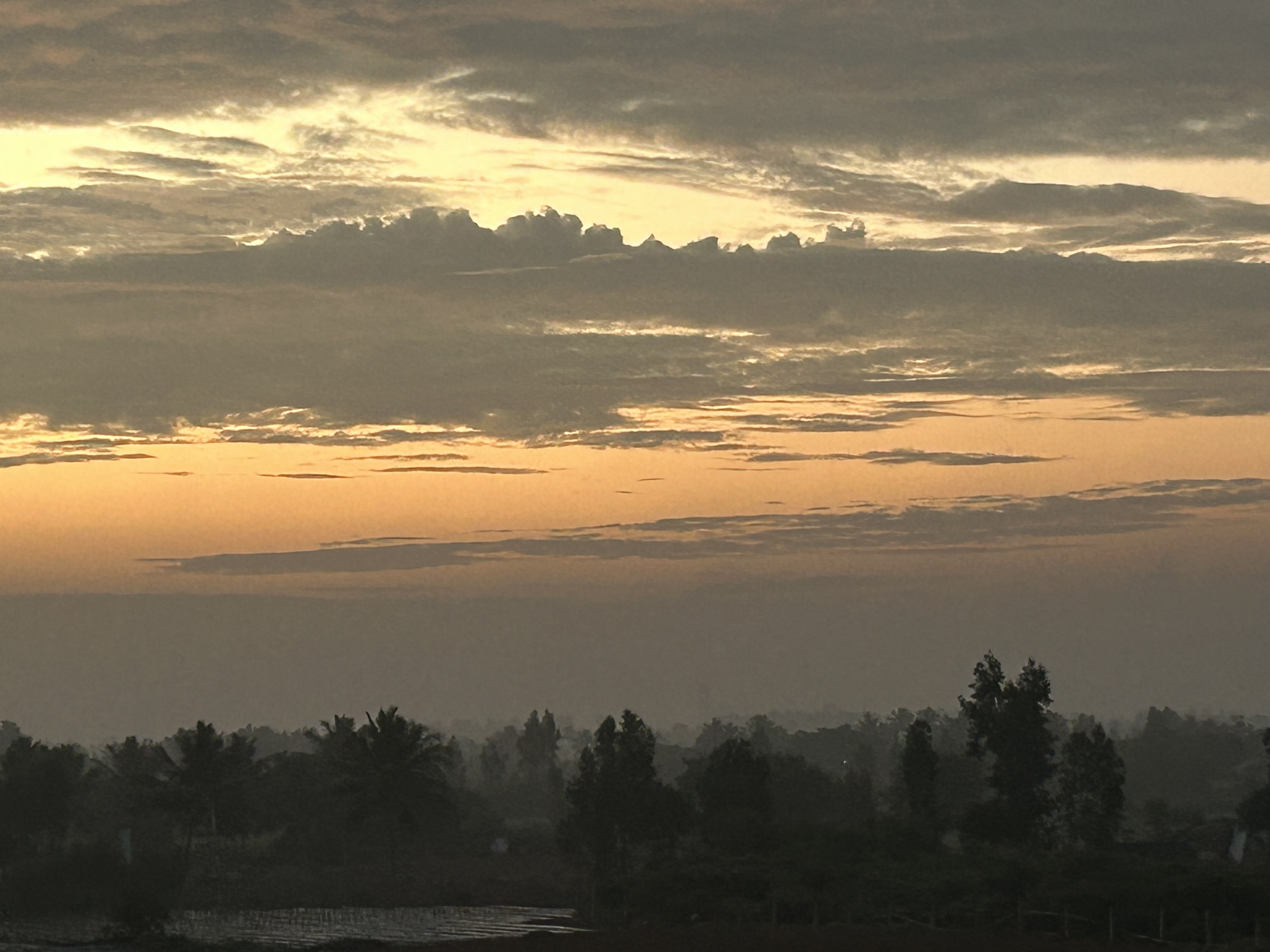
Dogs? I don’t hear any Barking Dogs!

After a rewarding ten-day meditation retreat at a small ashram in the country outside Bangalore, a taxi took us the two hour drive to Bangalore railway station where we caught an overnight train direct to Gokarna. We arrived at 7 am quite refreshed from an unusually good night’s sleep.
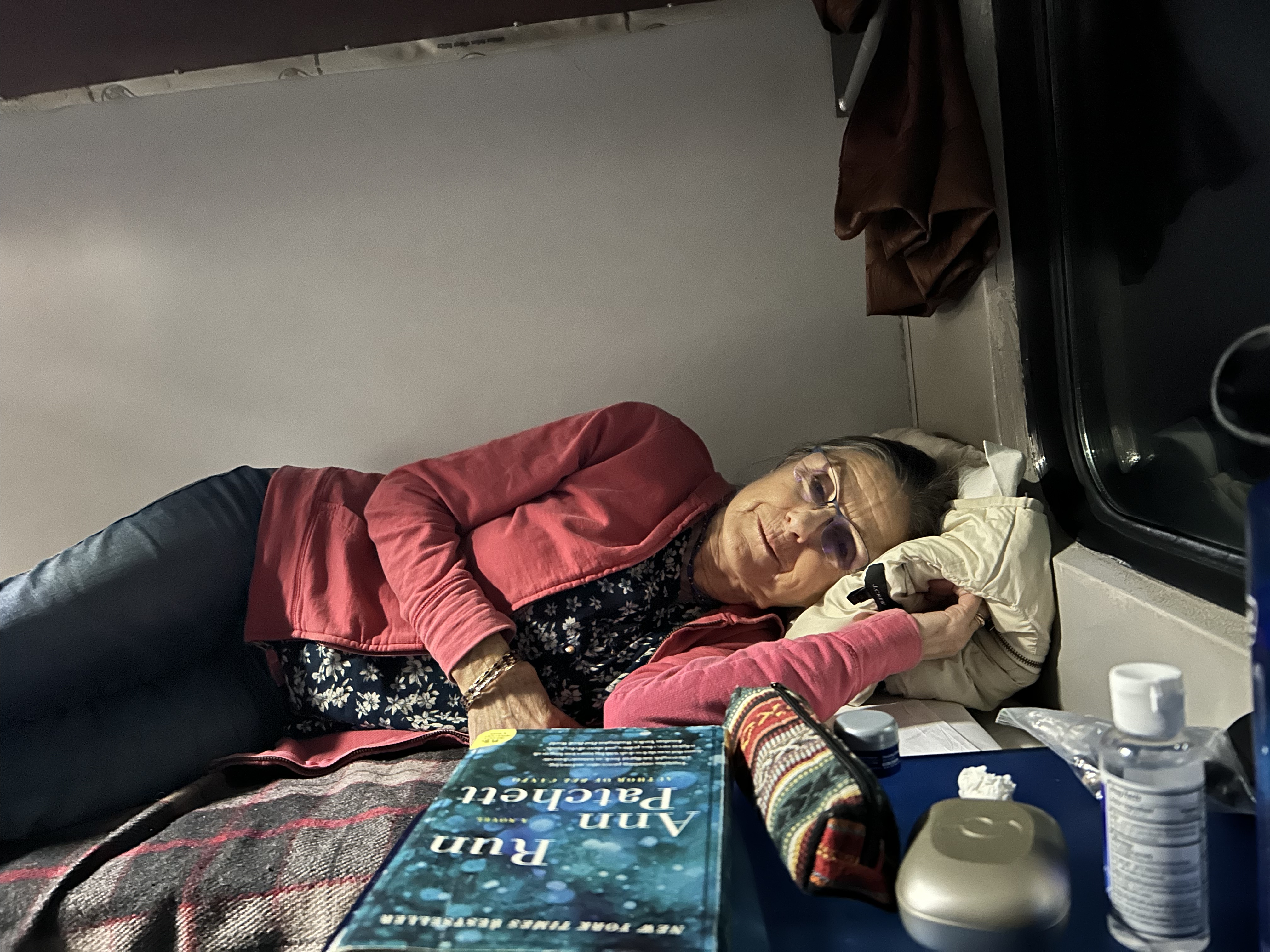
Gerard was looking forward to the train ride, his preferred mode of transportation ,and it didn’t let him down. The train left on time, and even I was impressed by the cleanliness and comfort of the Panchaganga Express. As usual our 2AC compartment was chilly but quiet: no snoring sleepers or wailing children. Marina, our English friend and already in Gokarna, had messaged us saying she thought her partner’s sister, Anita, was on our train and included a photo. Sure enough, we woke to Anita peering around the compartment curtain, and though we hadn’t met before she was easy to recognize from her photo. Anita’s an interesting woman, part Indian/part English, living in CA and married to an Algerian. She speaks seven languages fluently and has been a United Airline hostess for many years. The taxi ride to our guesthouse flew by as we got to know each other. And I was very happy to see Marina, our London friend, again.
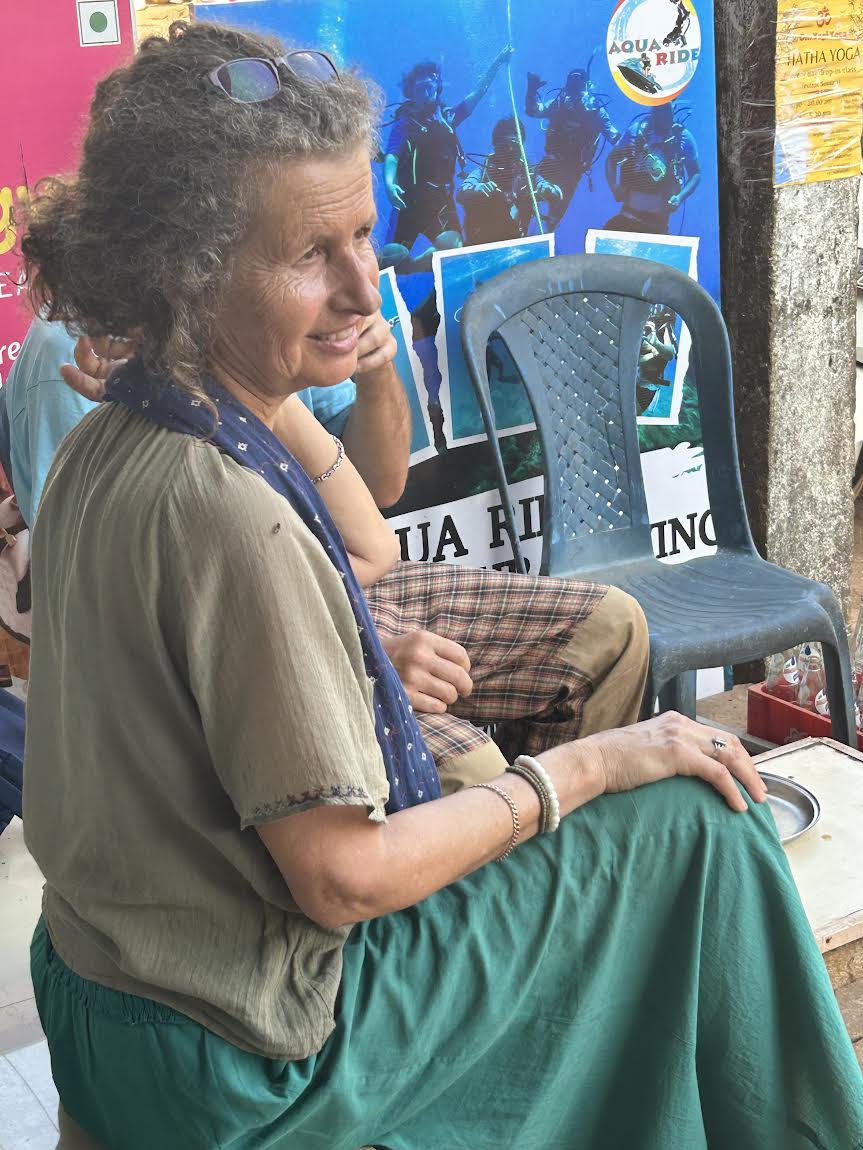
We reserved the same room as last year. The guest house has only a few patrons and two are longterm regulars. An interesting addition is an Indian family with two small children who has set up housekeeping in a room at the top of the stairs. The father is a masseuse who we pass on the way to the beach. “Oil massage today, Madam?”

Dropping of our cases, we went straight to our breakfast stall down the road. The young owner greeted us warmly and immediately served up chai and idli. His sister makes the best samba we’ve ever had (a spicy vegetable stew with chickpeas) and coconut chutney eaten with steamed rice patties. An idli plate is a substantial South Indian breakfast. Since opening last year, the boy’s business has grown and he’s able to make enough to shut up shop at 10 am and pends the rest of the day preparing food for the following day. Unfortunately, his small premise holds only a couple of tables, barely enough to support the influx of customers. This gives us the opportunity to meet a variety of people. Today a portly Swedish gentleman shared our table. He used to be a vegetarian chef, now retired. He says Sweden is perhaps 20% vegetarian. Living almost in the center of Stockholm, he has his housing paid for by the government because he has no bank account. Of the $900 he gets in social security each month he manages to save $300. In Sweden, it doesn’t pay to save for retirement!

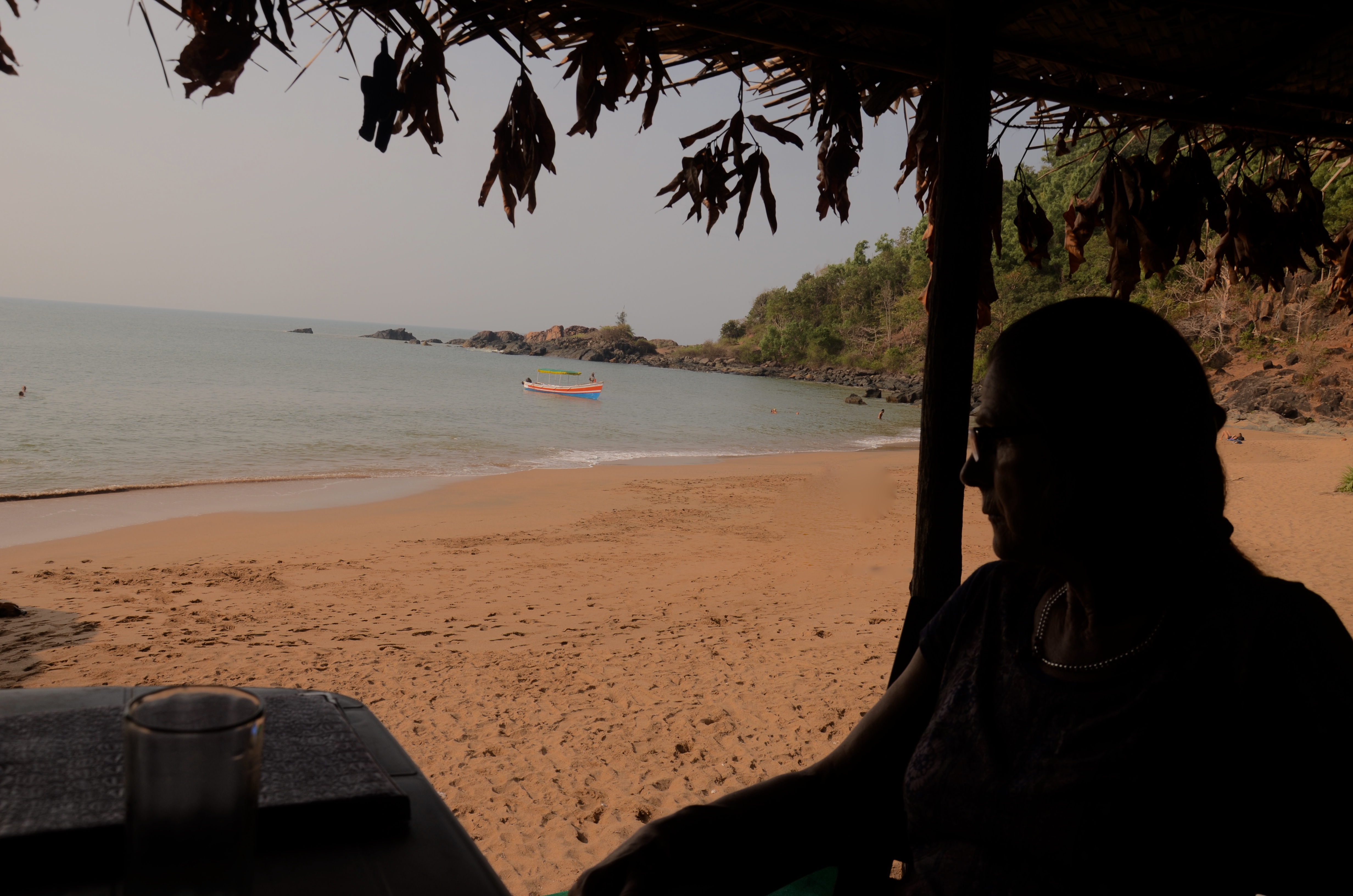
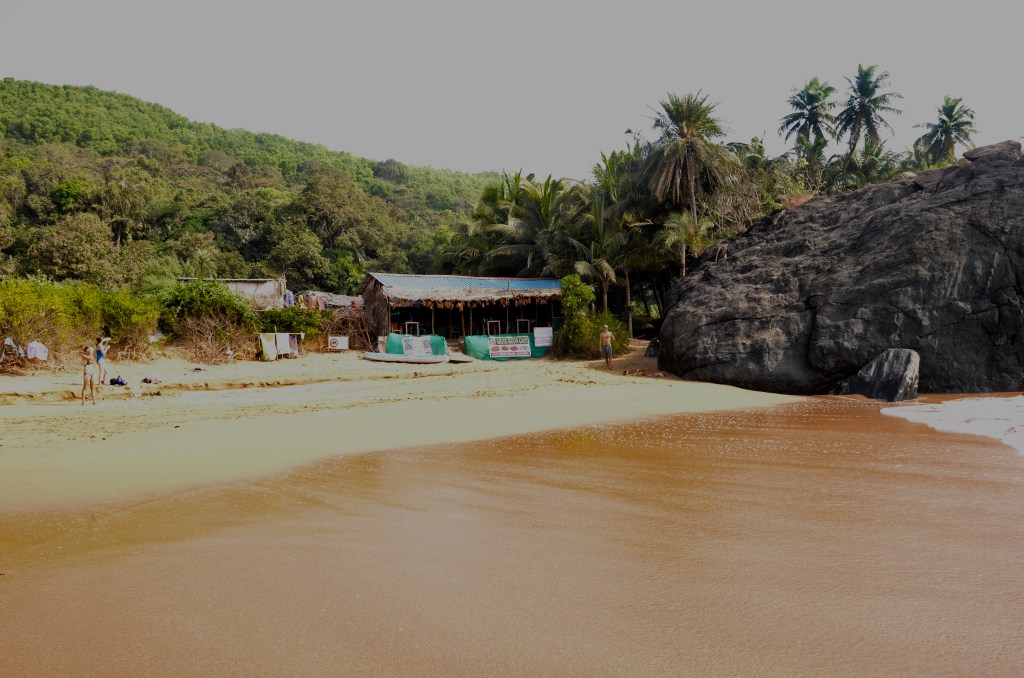
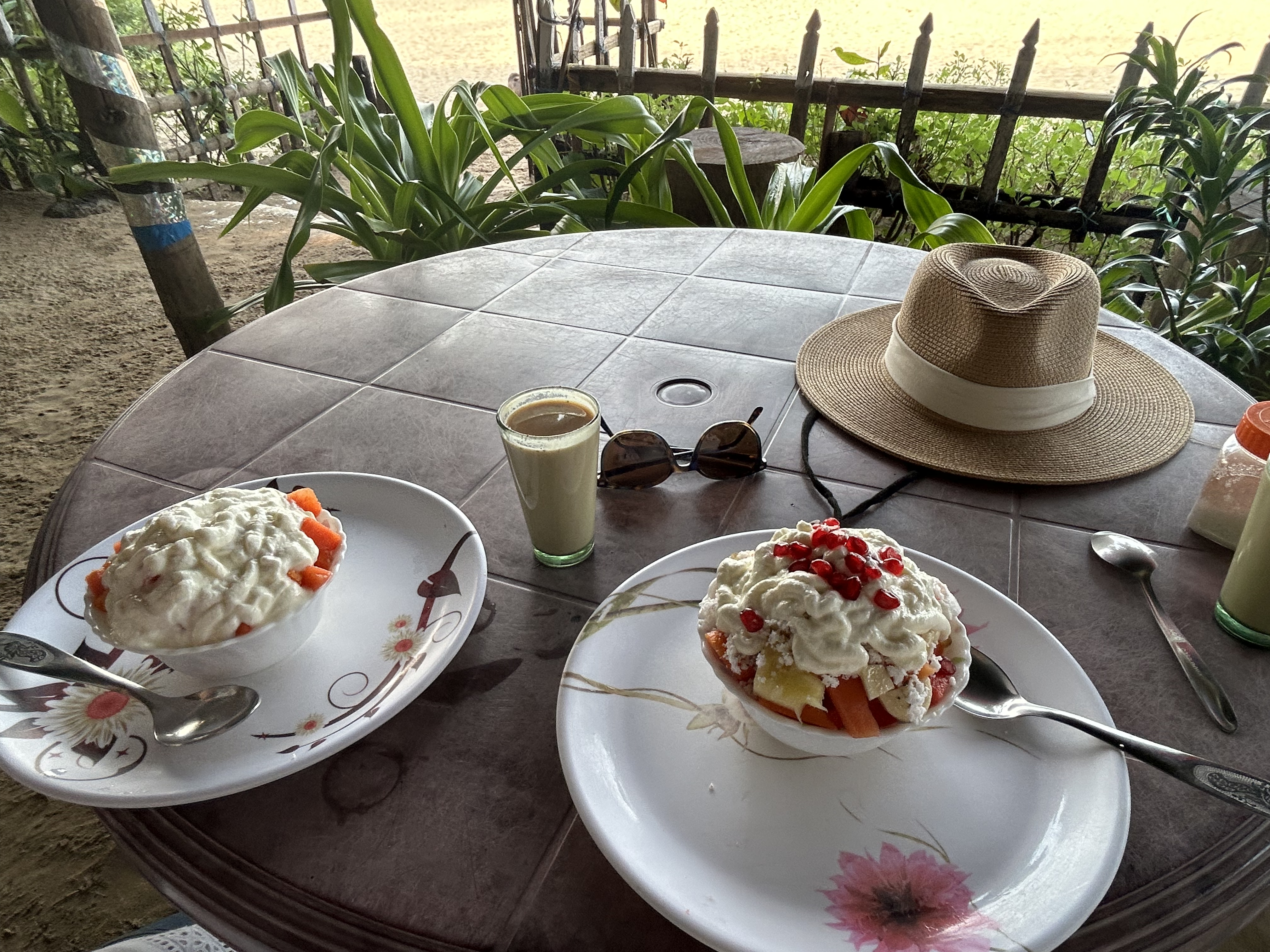
We hustled back to the room, put on our swimsuits and went straight to the beach. At a quick glance, the beach had hardly changed since last year. The sea was typically warm and clear. I swam until my hands wrinkled. At our favorite beachside cafe, Shankar and his wife gave us another friendly greeting. Curd and papaya followed by a glass of strong masala chai.
Back in our dusty room, Gerard spent a couple of hours scrubbing the place down, hung the washing line, pinned the mosquito net across the window, and then we unpacked. Now the room feels like home.

Except for the wild life! We’re surrounded by birds, animals and insects. I love hearing birds chirping in the early morning (thankful my reverse slope hearing loss doesn’t extend to high frequency sounds), until their song is overpowered by the cawing of a raucous craven and the shriek of the chipmunk. How can such a small animal make such a piercing noise? And of course there’s the dogs. This time, below our room a Labrador puppy is an addition to the guesthouse dogs. Easy to train, says Gerard. But nobody does anything about this puppy’s shrill and constant barking – particularly as we’re about to go off to sleep. And then the neighboring dogs, part domestic, part wild arrive and add their howl. Dogs in India as everywhere are highly territorial. In the middle of the night there can be an outburst of ten or more dogs barking at once. A benefit of hearing loss is I don’t usually hear the dogs.
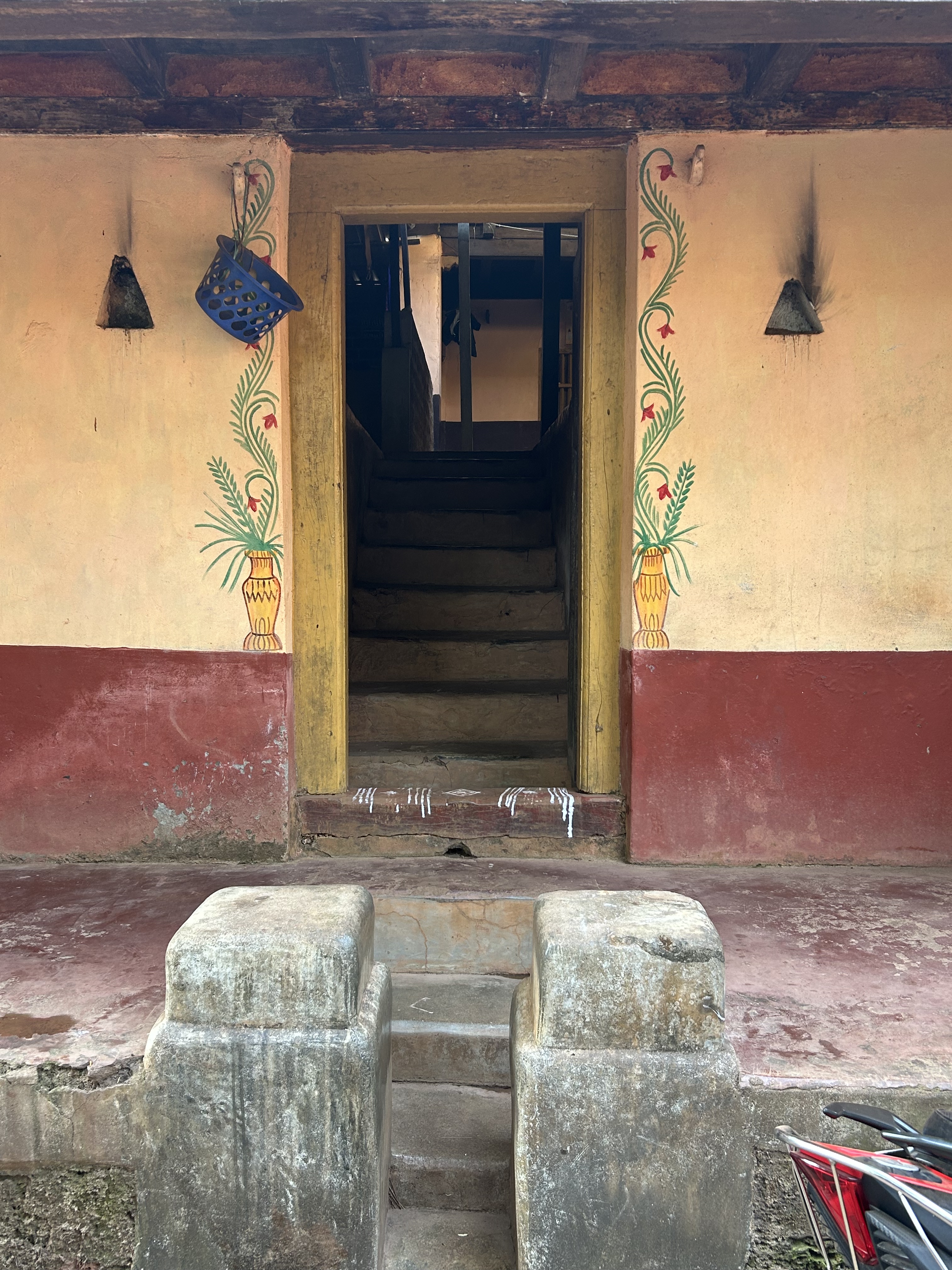
The day after we arrived we made the 30 minute excursion into town for fruit, rice cakes and peanut butter. With the exception of increased traffic, the town has changed remarkably little since last year. No new restaurants, the same tourist cheap clothing shops, and stalls selling offerings for the pilgrims to take to the temple. While there may be fewer westerners, there does seem to be many more Indian visitors in town, but it’s a long weekend celebrating one of many Indian holidays.

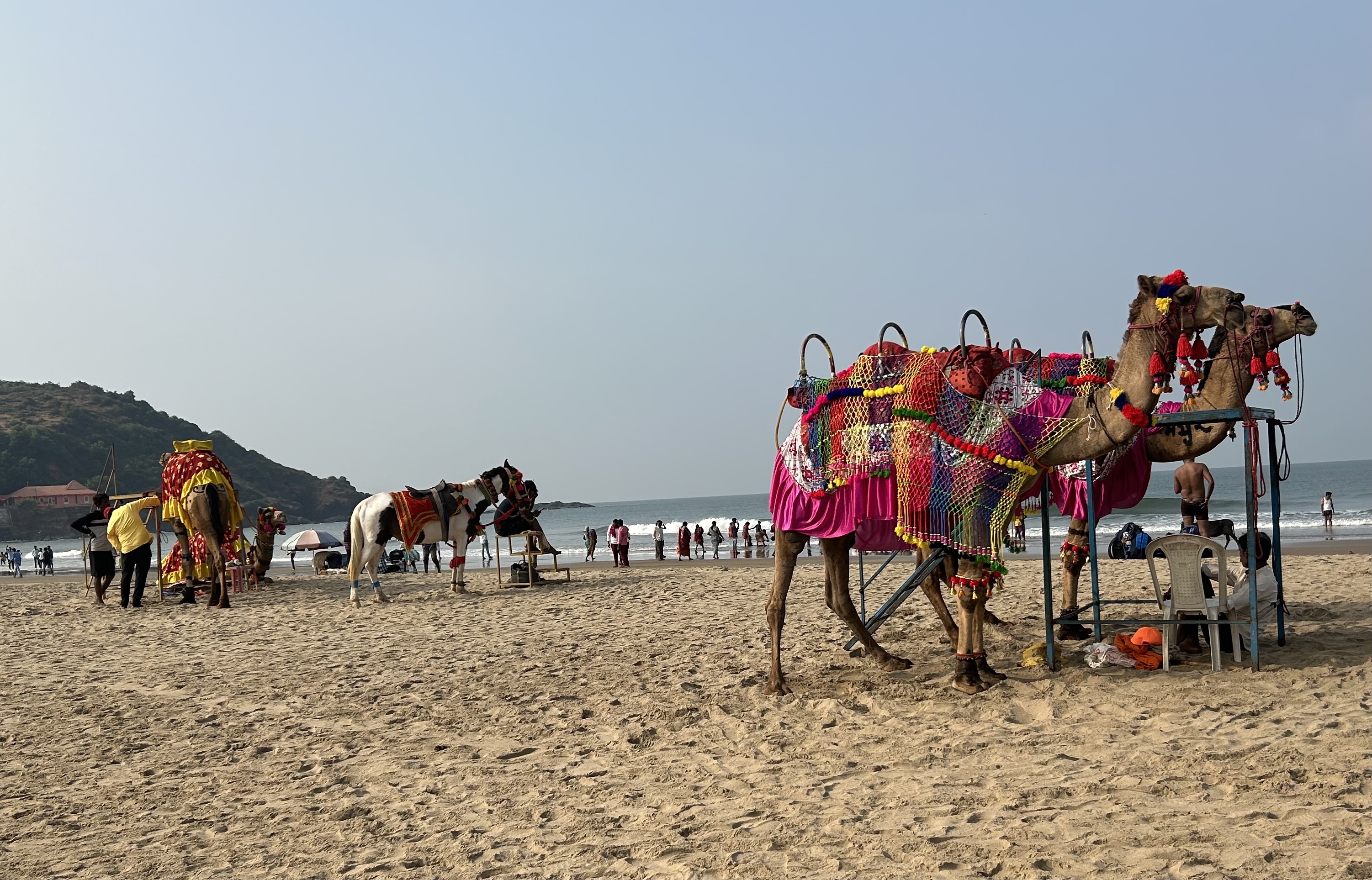
No one can explain exactly what it is and usually resort to: “It’s an Indian holiday.” At the end of the beach near the town, there’s ample amusement for the Indian pilgrims/tourists, including camel rides and ice cream vendors on bicycles.
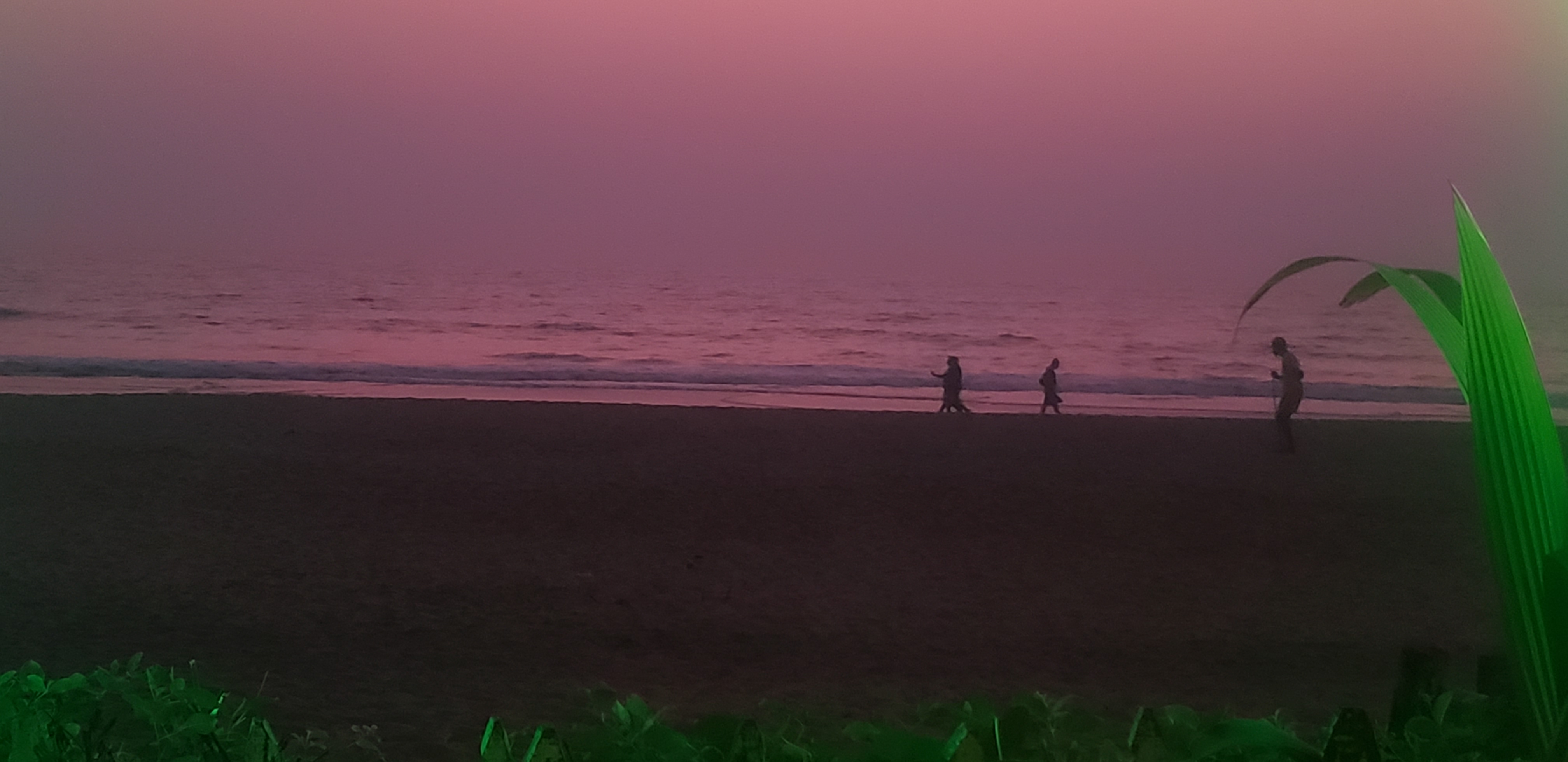
We have a choice of restaurants on the beach for dinner. After several days we returned to a favorite from last year and there was the couple we knew sitting at their usual table with a prime sunset view. Daniel is American but left in 1969 and landed in Israel just as the War of Attrition broke out. He freaked out and fled to Norway where he married and still lives. In the richest country in Europe they enjoy a good lifestyle, but have been coming to Gokarna for many years for four months at a time. Leaving the US the same time as Gerard and staying for similar reasons, he has some interesting stories.

Eclipsing our joy of being at the beach was the news that our good friend, Arthur, had suddenly died while we were at the retreat. One of Gerard’s oldest friends, they met on Beacon Hill in Boston back in 1966 and he has written much about their relationship in his memoir, Beyond Black and White. Although Arthur moved to Florida, he and Gerard remained in contact, the more so during the last decade when they would talk by phone at least twice a week. Arthur was the first of Gerard’s friends I met in 1973 and I immediately loved him. Gerard’s been in constant contact with mutual friends and helped write the obituary and a speech to be read at Arthur’s funeral. None of which has helped him deal with reality. That will come in time.

I also lost a good friend shortly before we left. Unlike Arthur, Chris had struggled with cancer for over six years and we knew it was highly unlikely she’d survive before we returned. Fortunately, I had the opportunity to say goodbye to her. I was expecting to play the role of cheering her up, as she lay paralyzed from the waist down in a hospital bed. But instead she was surprisingly animated. Our visit was full of light and joy. After we left, I looked up at the winter sky which was clearing after a night of rain, and watched a large bird slowly circling. I felt a tremendous peace. Chris died a few days later.

Gokarna: Friends at the Beach

Two warnings are pinned to the guesthouse wall. One is ridiculous: “Swimming on the beach is not safe.” Hello? Have you ever tried swimming on the beach? The other is more ominous: “The owner will not be responsible for any drowning in the sea.” Undeterred by occasional rough seas, I swim twice a day, and then walk the long stretch of sand, appreciating the moment.

I enjoy the simplicity of our lifestyle; it unclutters my mind, which likes to seize on the busy minutiae of daily living back home. I may not always like the Indian meal served, but it still beats the time and mental energy devoted to cooking and food shopping. Every day, I look forward to my idli and dosa breakfast. A young Indian has just started up his little dhaba and serves us with enthusiasm.

Gerard enjoys leaving Wellington Street far behind. Oddly, he does not seem to miss painting just as I don’t miss biking, knowing they will be waiting when we return. When he’s not swimming with me or socializing, he’s busy completing his memoir which he began writing exactly four years ago in India. His favorite tunes encourage him when the writing is difficult. Mosquitos and sand flies have found his skin irresistible and he’s had to contend with a slew of itchy, inflamed bites. But two weeks into our stay the bites are reducing. Dare I say the insects are loosing interest, moving on to the next tasty newcomer?

With many of the establishments here preferring to cater to Indians now, the old time travelers congregate in just a few cafes up and down the beach. Some of us question if we’ll come to India again whether put off by traffic, pollution, plastic waste—everyone agrees that the subcontinent is drowning in a sea of plastic–or Modi. 1.4 bilion create a heck of lot of waste! Gerard and I try to do our bit by bringing a portable water filter to avoid contributing to the mountain of plastic bottles. The otherwise beautiful walk through the vegetable gardens to the beach is marred by litter. To avoid looking at it for a month, Gerard got a gunny sack and picked it up. But where to dispose of the full sack?

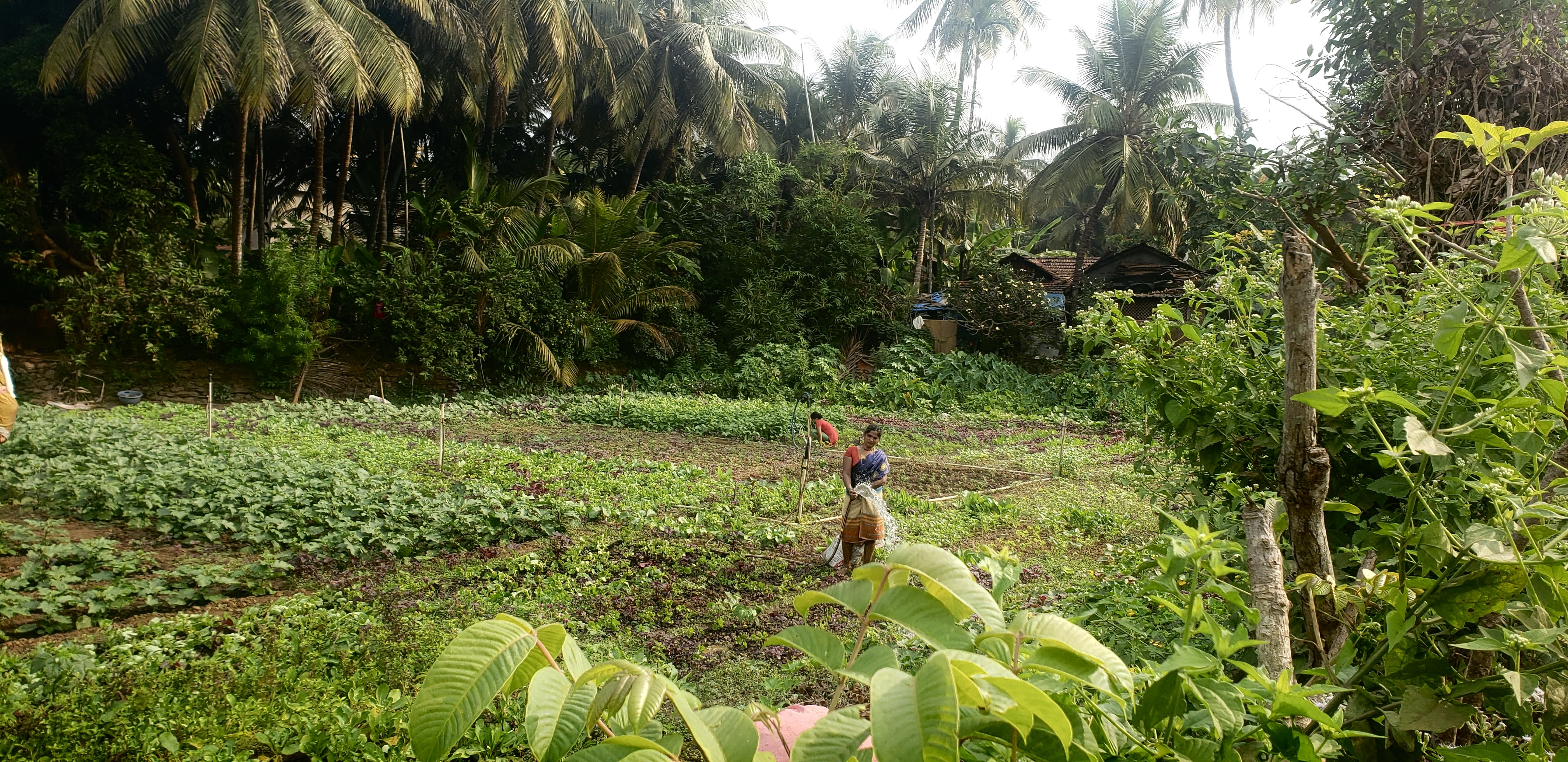
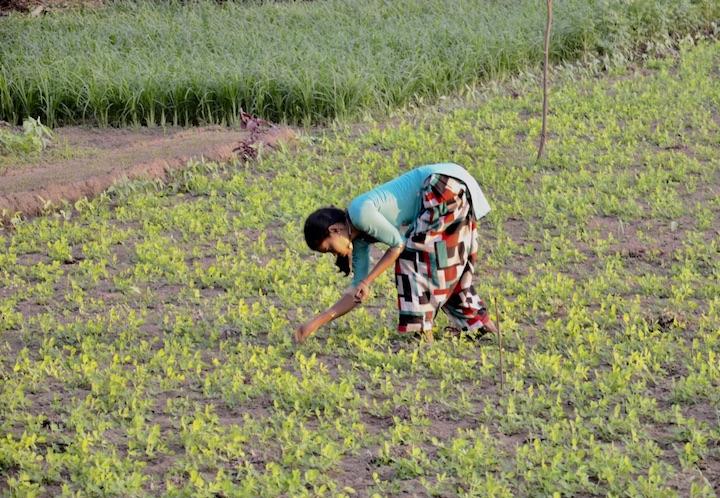
Walking through the vegetable fields we notice that each little garden has its own shallow well. So close to the sea, surprisingly these wells are not polluted by salt water. With the rich soil, the baking sun and plenty of water, the vegetables seem to grow as we watch them. Too bad not enough of them find their way into the restaurants.
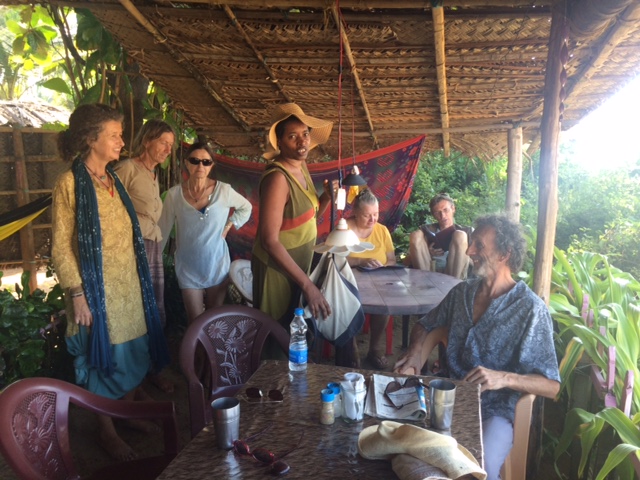
Our friend Marina is a social magnate; after twenty years in Gokarna she knows the old timers and easily makes new friends. At one point, there’s nine all from her area of north London. We’re sad to see Emma leave after her brief three-week holiday. She doesn’t understand those who complain about the new influx of Indian tourists crowding on to the beach (mostly on the weekends). She looks at the long stretch of sand and says, “To me, it’s bliss!” She spent her childhood summers in south Devon and we both agree that there’s no comparison to the sardine-packed people on the beaches of Torquay and Paignton.

Although I get frustrated in trying to follow the group conversations, it doesn’t overwhelm me anymore (given the occasional meltdown). This is our third visit to India since I lost my hearing, and I’m relieved to find it has gotten somewhat easier. I know my mechanisms to avoid hearing fatigue – and when I take a mental break and space out for a while, I return to the conversation to find surprisingly the same topic is still being discussed. I don’t seem to have missed much!

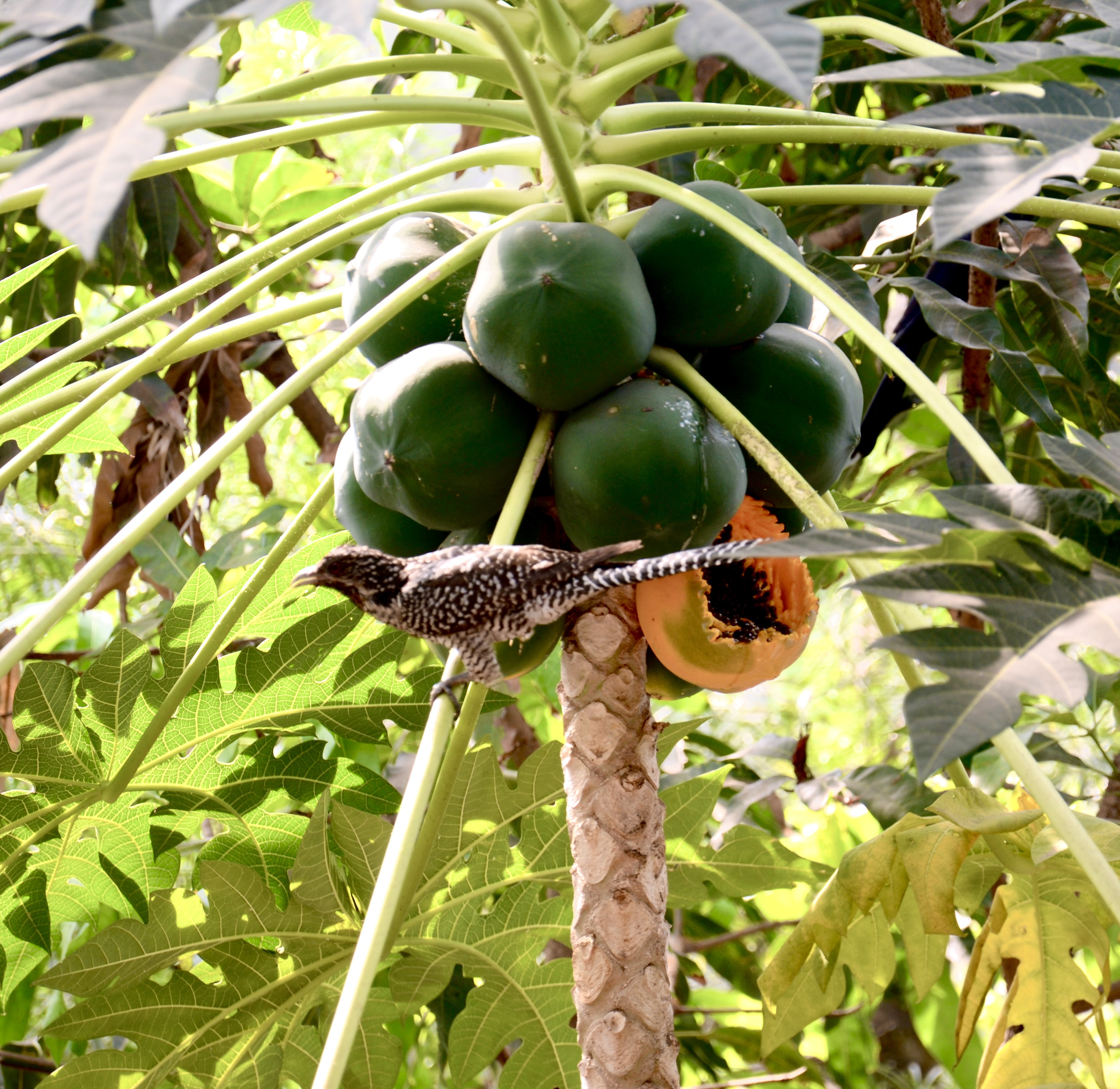
We wish we could identify the exotic tropical bird songs that I’m so grateful to hear. North London Tina’s a bird person and can recognize when Gerard provides a great imitation of a call. One is the Koel bird that we watch from our balcony in a papaya tree picking away at the fruit. Tina must be almost 80 and has traveled solo in India many times, which I find inspiring. Again, I wonder if I would have the resources to do it alone.

Our German friends, Marion and Yergen, insist that we accompany them to Kudlee Beach, a pretty sheltered cove we first visited three years ago. The descent to the beach is crowded with Indian tourists, the more so because it’s Republican Day weekend. Kudlee now caters only to Indians; several old buildings are demolished and undergrowth cleared at the near end of the beach to make way for a large luxury hotel. Rented dinghies, water ski launches and other plastic flotilla pepper the water. It’s beginning to look like Paignton! How many beautiful beachfronts are there left in the world that haven’t been ruined by over-development?
French Frederic, who we first met in the Himalayas ten years ago, took an overnight bus from Bangalore to spend three days with us. A resident of Auroville, he was on his way back to France to renew his visa. We have a special bond with him and are able to pick up where we left off four years ago in Varanasi. Swiss Peter, who visited us in Boston last summer, came down from Agonda for a few days as well. Both Gerard and I are flattered they made such an effort to visit us.

Back After Three Years

“Yes, I remember you,” the restaurant manager in Gokarna said with a half-smile. Coming from a man who, despite Gerard’s efforts, would not engage in conversation for the whole month we were here before, this was a warm welcome.

We hadn’t given much thought to another winter here. In fact after returning from a challenging time in California, trying to hear in noisy restaurants or even groups of friends, I’d told Gerard definitively that I could not handle India again. Just a few days later, Melissa, our longtime house sitter, emailed us to say she was available this winter. That did it! We’re going! I said ,visualizing the beach in Gokarna, the ghats of Varanasi, the snow-capped mountains in HP and the friends we’d have the chance to reunite with along the way. I was determined to handle my hearing loss in India as I do in the U.S. Clearly, the benefits would outweigh the difficulties.
But I do need help to get by in chaotic India. At the airport, a frustrated customs official asked, me, Do you speak Hindi or English? Later, a young Indian tried to strike up a conversation, then realizing my predicament, assured, “You’re not missing anything,” and high-fived me. Easy for him to say, but without Gerard I don’t think I could do this on my own.

We arrived in Delhi at 2 am, Even though the airport is now no different than any other airport in the world it’s still a shock for us to walk through duty-free that is predominantly alcohol. As we predicted our hotel did not let us in despite our reservation and claim of 24-hour check in. We eventually found another where the manager woke up long enough to give us an inflated price. After inspecting the room, Gerard bargained with the sleepy manager for a reasonable rate. In the morning, I looked out the window on a large colorful umbrella with a sign saying ‘Baba Masala Tea.’ A white-haired gentleman pounded out fresh ginger and cinnamon sticks in a mortar and pestle to make the best chai in the neighborhood. Just when we need it, a chai wallah appears.

We were interested to see how India had changed in the past three years. It’s too early to know, but in the airport we couldn’t help noticing posters of Modi’s nationalistic agenda, with his ridiculous slogan: ‘1.4 billion people, one dream.’ The continuing strife between Hindus and Moslems begs the question: what is the one dream? We were surprised to see so few long term travelers like ourselves in the Pahargunj area of Delhi. Consequently, many of the shops catering to tourists have disappeared, returning Pahargunj to Indian consumers.

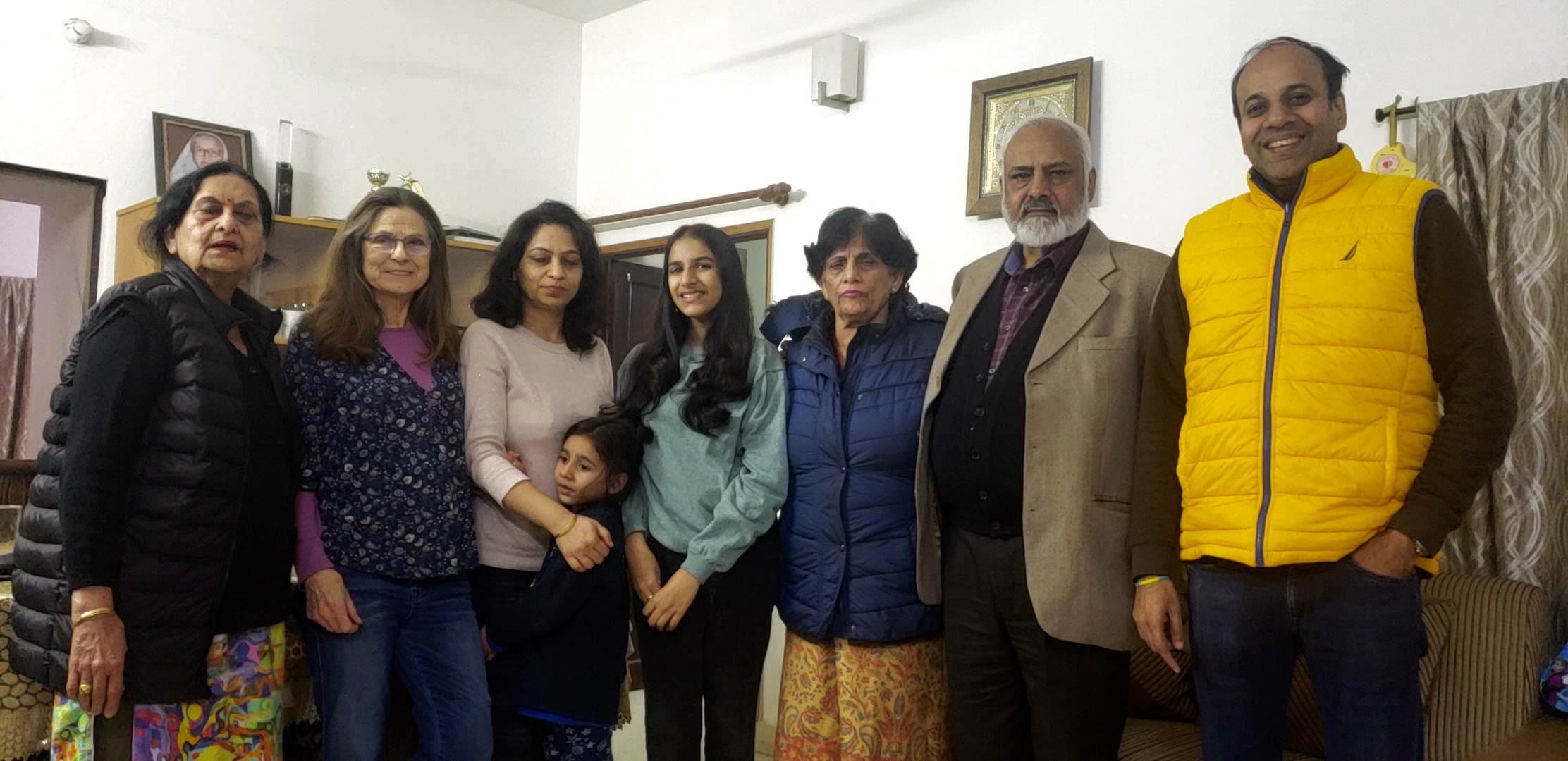
On our way to see the family in Gurgoan we were impressed by the metro, still running like clockwork and unusually clean for Delhi, unlike the buses and trains which are constantly breaking down. It was wonderful to be in their company again and we were surprised at how the children had grown. Five-year old Tanya’s cheeky personality has emerged, her English better than her Hindi, her mother says. And Simrita has grown into a gracious fourteen year old. She took me shopping in the nearby market. Sympathetic to my hearing loss, and lack of Hindi, she guided me through the process, reminiscent of how I did the same for my blind father many years ago.

The family knew it was Gerard’s birthday and Simrita wanted to bake Gerard a surprise cake. After dinner she disappeared into the kitchen and proudly emerged some time later with a freshly baked chocolate cake. Shruti stuck her knife in and said it needed more cooking, so Simrita returned to the kitchen. Soon after we heard a loud crash followed by sobbing, Simrita had turned the cake on to a glass plate and dropped it on the tiled floor. At Shruti’s insistence, she eventually appeared and placed the cake with embedded glass shards in front of Gerard, and we sang ‘happy birthday,’ before the cake was trashed.
The two-hour pre departure requirement for our domestic flight to Goa, was no overkill. The long line of passengers at check in (that would challenge anyone with claustrophobia) the interminable walk to the departure gate, and finally a bus ride to board the plane on the tarmac at least a couple of miles from the gate. Nevertheless, the plane took off on time! Gerard, with his love of trains and disdain of airports, couldn’t help mentioning how much easier it would have been to board a train and enjoy a more pleasant, if longer, journey. The following day, when our two-hour train ride to Gokarna was delayed by two hours, I had the satisfaction of pointing out the incongruity of waiting the same amount of time as the journey!

We struggled to book our room online and the internet pictures failed to meet up to reality. But after we’d moved the bed to face the window and Gerard got to work with his rag and disinfectant, the room became our home at the beach.

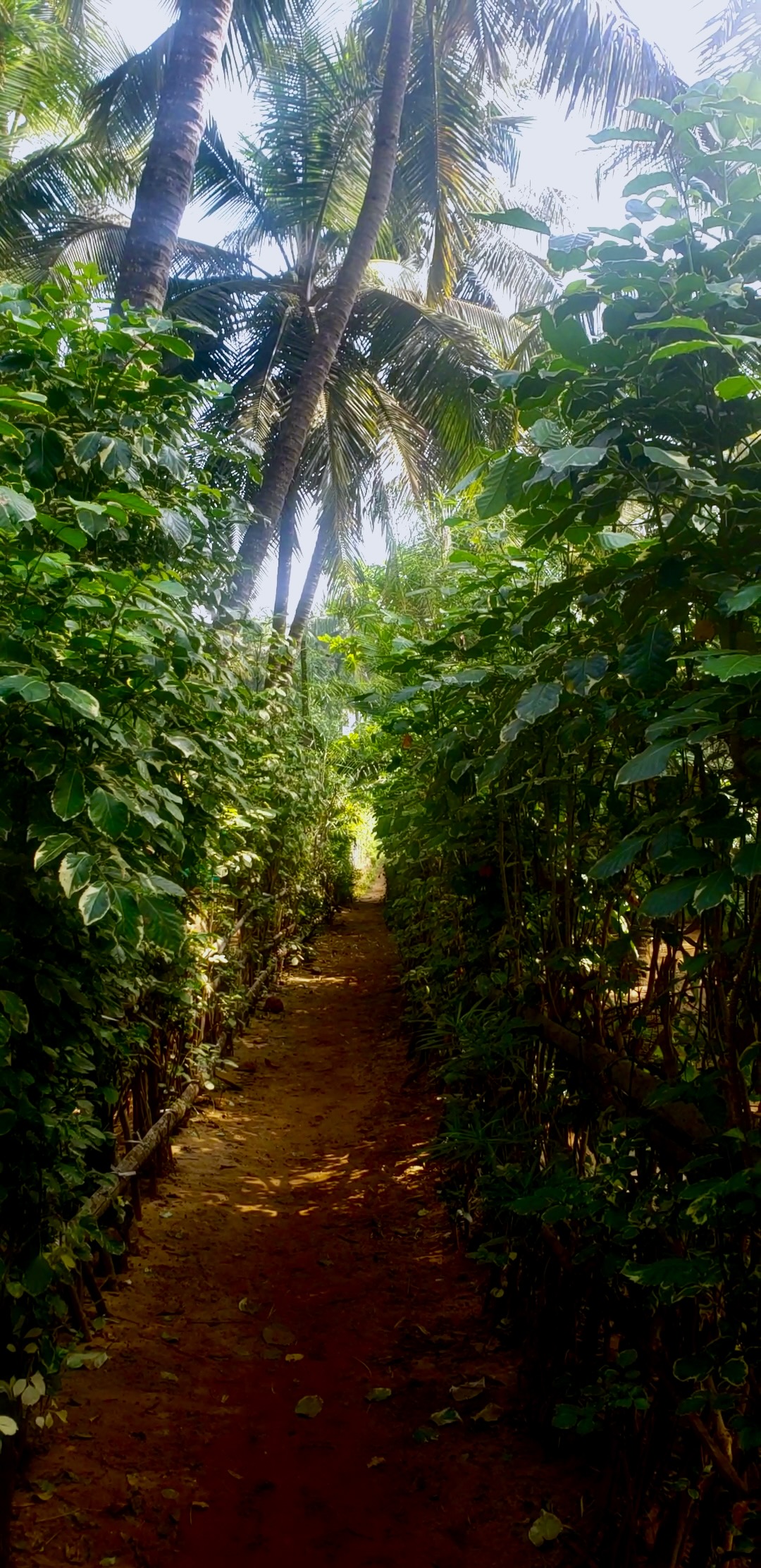
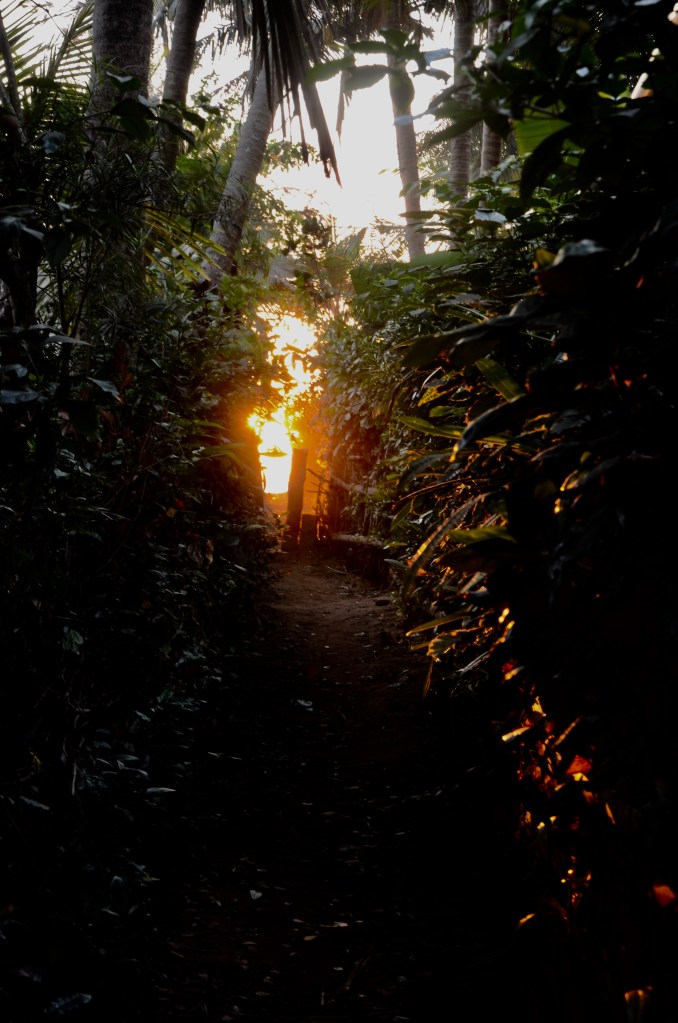
As it turned out, pre-booking paid off. Friends have told us it’s hard to find a place to stay because guesthouses are now only renting to affluent young Indians who come on the weekends. The owners can double the price and not bother to rent the rooms during the week, telling tourists like ourselves they have nothing available. Our guesthouse is only a three-minute walk from the beach, through vegetable gardens. Palm trees shelter our balcony from the heat of the day while allowing the amber glow of the late afternoon light to filter through.

Thinking of friends who couldn’t return for health or economic reasons, or chose not to (avoiding Russians), we’re grateful to be here. On our arrival, Frederic one of our oldest Indian connections, was already waiting at our guesthouse.

Christmas under the Bedsheets

Happy New Year to all our blog followers. We will miss our friends in India for another year, and sympathise with the local merchants who must be suffering due to the lack of tourism. A good friend who managed to get back to Gokarna in South India says the pilgrims and Indian tourists don’t make up for the loss of another season without westerners. Four-week visas with one week quarantine are not appealing to travelers of our ilk.

Two western friends still in India, live in the Auroville community, which has grown exponentially since its beginnings in 1968. Covid has had little impact to life there. But once again Auroville has erupted with internal conflict.

This time, over a road project to connect the four different zones within the compound. The consequences of this ‘progress’ include the destruction of the forest, its planting begun over 50 years ago. The opposing point of view is ‘leave well enough alone’. Our friends say that if the divisiveness continues, they’re prepared to move on.

Losing a loved one around Christmas adds insult to injury. Two good friends just lost their mothers, stirring up memories of my own mother’s passing at Christmastime when I was eight years old. After her death, we never had Christmas at home again. From then on, my father, brother and I spent the holiday with relatives. I celebrated beneath the bedclothes, singing carols and creating the Christmas I’d lost. One clear Christmas Eve, spotting the evening star for the first time, I was convinced I was seeing the same star that guided the shepherds and kings to the baby Jesus. (Growing up in England, the sky was rarely clear enough to see that star!) Since my mother’s passing, His birthday for me has also been associated with death. And I can imagine my two friends who’ve recently lost their mothers will have similar feelings.

With all the calamity in the world right now, it’s easy for me to miss the beauty that’s right in front of us.

At dusk, the other night, Gerard and I walked through the Boston Common and Garden to see the Christmas lights. How magical the city can be! For a moment the world lost its sorrow in the reflection of the twinkling lights.

Lots of Friends and Longer walks

Our friend Odella, arrived four days ago, fresh from NYC. She didn’t take long to adjust. Tall and poised, she towers over the short South Indians. Finding her own way around and uninhibited in asking people what they were eating, where she could find a good cup of coffee, is there a good yoga class etc. she quickly showed her independence. She’s been to India a couple of times before but not traveled extensively. Our connection with her is through Lewis, her husband and old friend ours. A jazz musician and professor at Rutgers University, we only see them when Lewis gets a music gig in Boston.

Our German friends, Marion and Jorgen, love to walk and persuaded us to visit the neighboring beach, Kudle. A pleasant walk through the jungle. The beach is picturesque and reminded Gerard of Greece in the late ’60s.

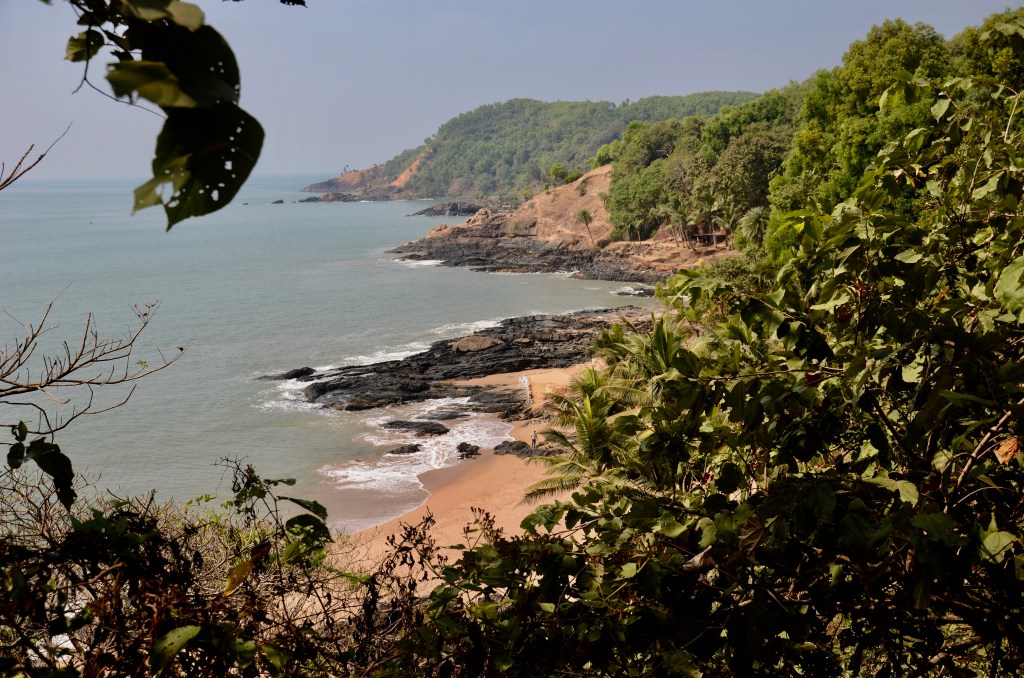
A few days later, we were enticed to take a more adventurous hike to Half Moon Beach and beyond. It was more strenuous but a beautiful walk through the jungle. Half Moon Beach is only accessible by foot, keeping it an unspoiled and secluded cove. Hot and sweaty we dove immediately in the water, followed by chai at a single chai shop.

Moving on to the second destination, Paradise Beach, was nothing short of treacherous. Climbing over the jagged rocks along the water’s edge made Gerard nervous. I focused on where I placed each foot, I made it without incident. Good for the attention! Paradise Beach did not live up to its name – a scruffy beach with coarse sand, a hangout of modern-day, young hippies. Exhausted from our rock climbing we collapsed on the sand and were soon joined by stray dogs.

The long walk was not finished; we still had to get to the neighboring town through more jungle and rice paddies to catch the next bus to Gorkana. On the ride back, Marion asked, if we had known what the route had in store, would we have agreed to come. Gerard admitted he wouldn’t have minded missing the climb over the rocks to Paradise Beach, but loved Half Moon Beach.

After such a long and treacherous hike we should have known better, but we agreed to hike with them again, down to the end of the beach and take a bus back.

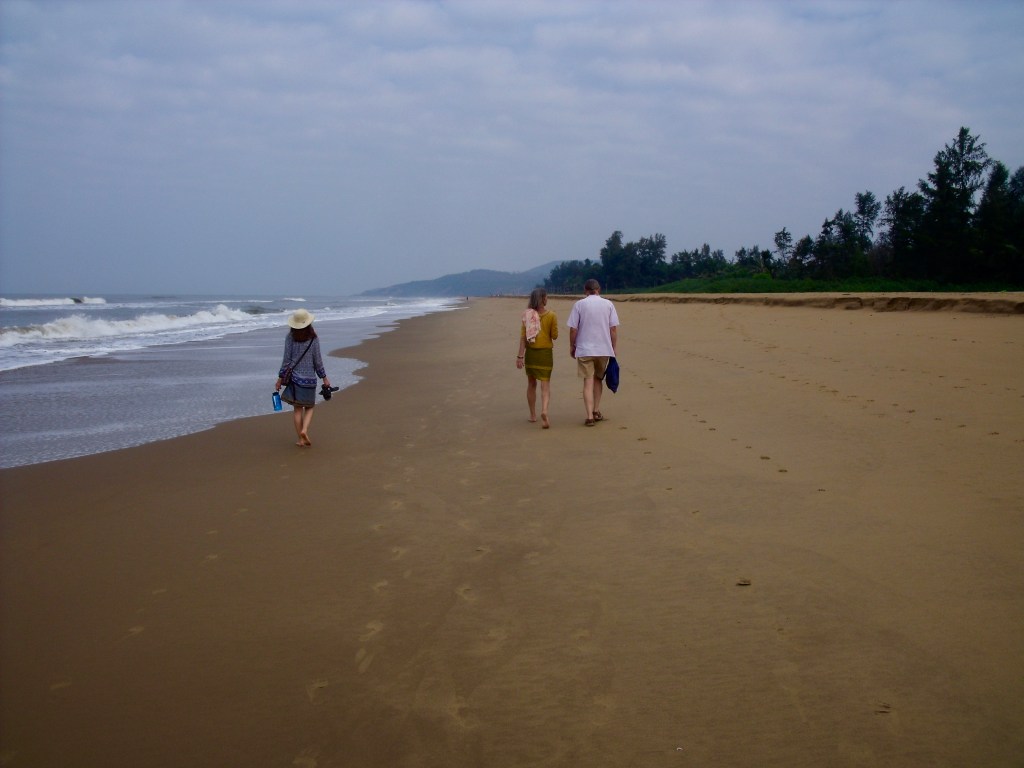
For the first time since we arrived in Gokarna, the sun was hidden behind clouds. The few beach huts and restaurants dwindled until all we could see at the edge of the beach was palm trees and tropical undergrowth. Passing fishermen preparing their boats, we suddenly came across a beautiful young Indian bride being photographed. No sign of the groom!

The beach was a good 6 km long and then we had to weave our way through lanes and beside fields to the bus stop – another couple of km.

A week ago, our Swiss friend, ‘six meter ‘ Peter and his Polish wife, arrived from Goa to visit us for three days. Peter is a professional violinist and has spent the winters in a rented house in Agonda for many years, practicing most of the day and performing at night gigs up and down the coast of Goa. He decided not to bring his violin to Gokarna but is clearly lost without it. At breakfast, his restless fingers repetitively drum the table. We’ll see him again in August when he attends a summer course at Berkeley.

A couple from Australia that we met in Darjeeling seven years ago are back in India, traveling for a year. Last night, they caught up with us here in Gokarna before we move on. We hope to see them again in the mountains.

One of the many things we find attractive about Gokarna is, there’s a significant older population here. Generally, they are people who’ve been traveling for decades, so we have a lot in common. We can spend too much time reminiscing what the world was like back in the ’60s, but it’s still more interesting than talking about Trump and Modi. The oldest we’ve met is an 86 year old woman from Scotland who is staying on the ground floor of our guesthouse. She’s beautiful and walks to the beach each day with a stick. Young and old, there’s always interesting people to meet: a young Frenchman using only analog camera equipment; a young girl who illustrates her own postcards and on hearing that I was from Totnes in Devon, leapt up and hugged me (her family live there); and Bernard from Geneva who likes Miles Davis!

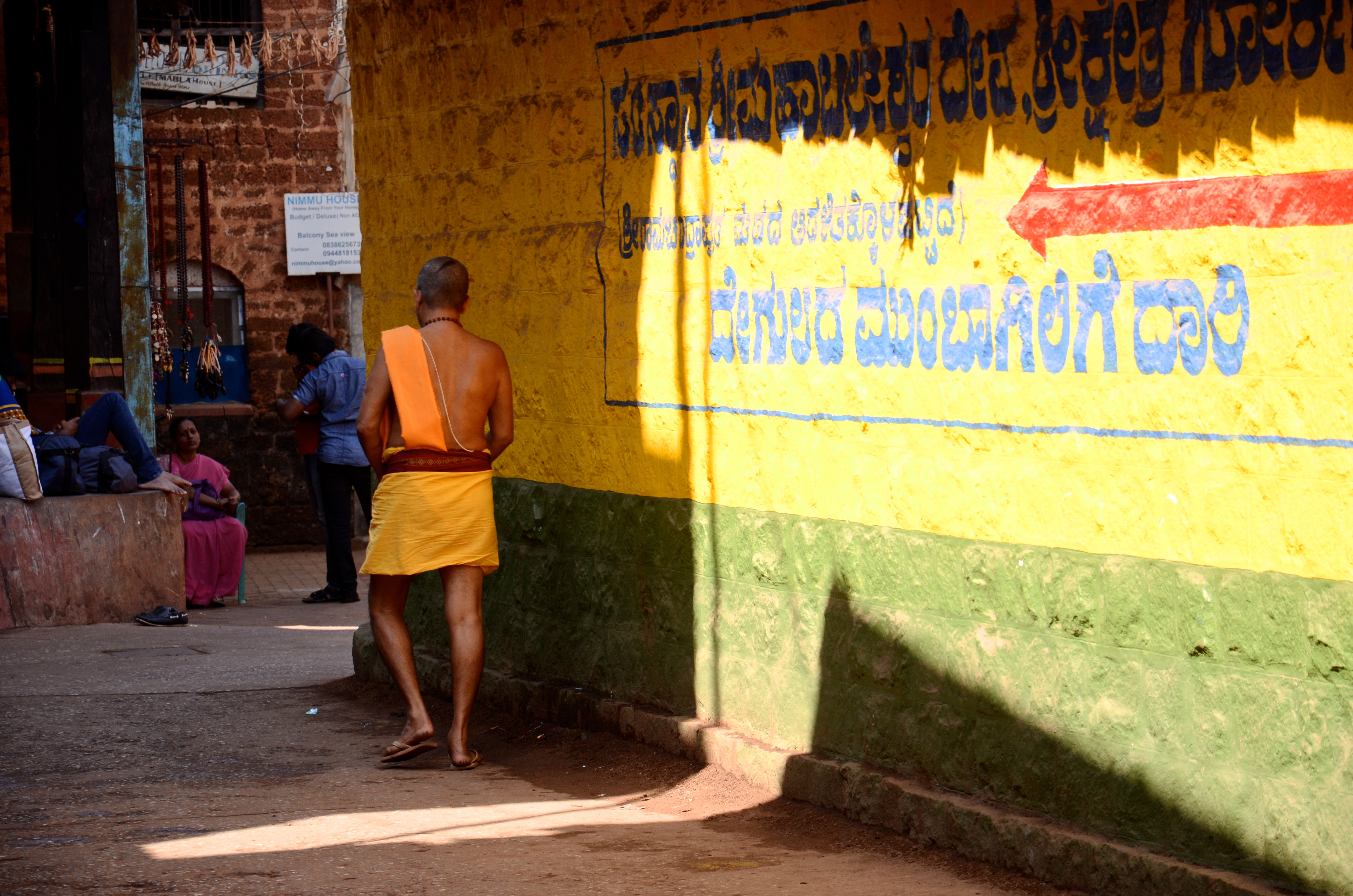
As mentioned before, Gokarna is a temple town. This weekend is one of many Hindu festivals. Which one? Who could keep track? The town is swarming with men wearing white cotton lungis and carrying offerings to the temple. One night leading up to the festival there was chanting, first by women, then by men, all night long. The din vibrates in my head. making hearing even harder. But if it wasn’t for the temples, the town would be overrun by beachgoers.

Gokarna: Shiva Worshippers and the Beach

india-2016-59

After nine years of spending at least a month in Agonda we decided to split our time between Gokarna, Gulijbagh and Agonda. We still have friends there that we want to visit. For those who remember, we made a day trip from Goa last year to see if Gokarna, just over the border into Karnataka, could be a possible alternative. Unlike most beach towns on the west coast of India, Gokarna’s major draw is not the sunbathing crowd from the west. It’s primarily a place of pilgrimage for Shiva worshippers. As the legend goes, Shiva was passing by on his way from Sri Lanka to the Himalayas when overwhelmed by the beauty of the area, he shed a tear. Where the teardrop landed, it created an abundant source of fresh water next to the sea.

dsc_0426

Meat and alcohol are not served and there seems to be little incentive to develop infrastructure for the beachgoers. Unlike Agonda, Gokarna has not become so commercialized that the local life has all but disappeared behind beach huts, sun beds and souvenir shops. On the other hand, for years Gokarna’s been a strong pull for hippies of our vintage and the present version, with its dreadlocks, tattoos and body piercing. (Where are the hippies from the 80s and 90s? I guess it was all disco.)

p1030133

Accommodation is not plentiful. We booked one of the few guesthouses posted online. On arrival, we were not thrilled but too exhausted from the 36-hour train ride to venture further. After reviving ourselves with a thali, we looked around to see what else was available and realized we had a good deal.

dsc_0423

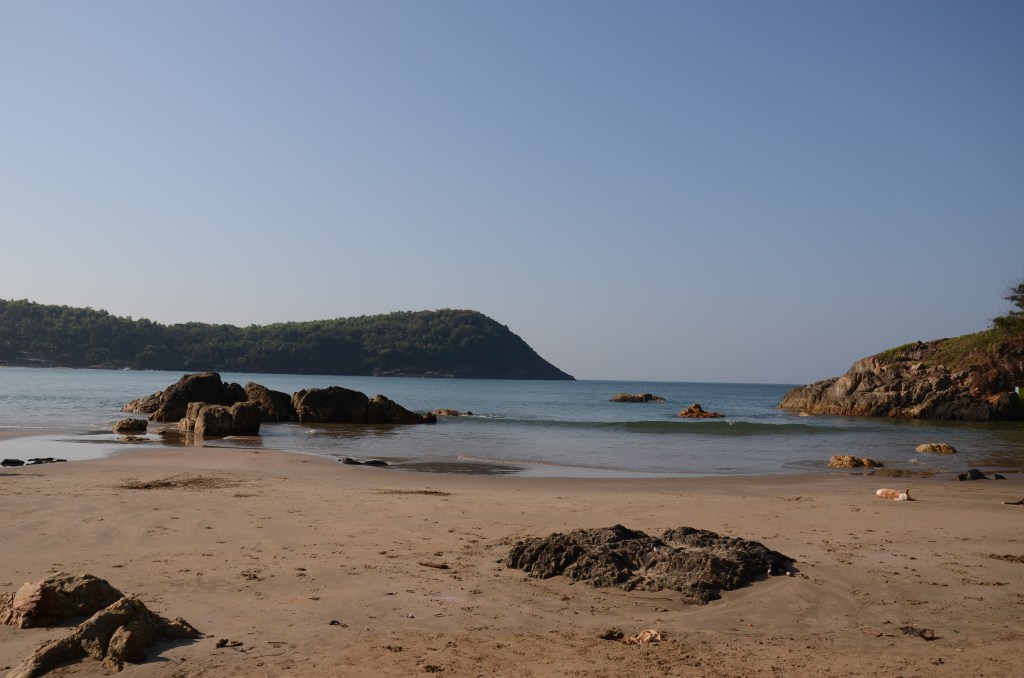
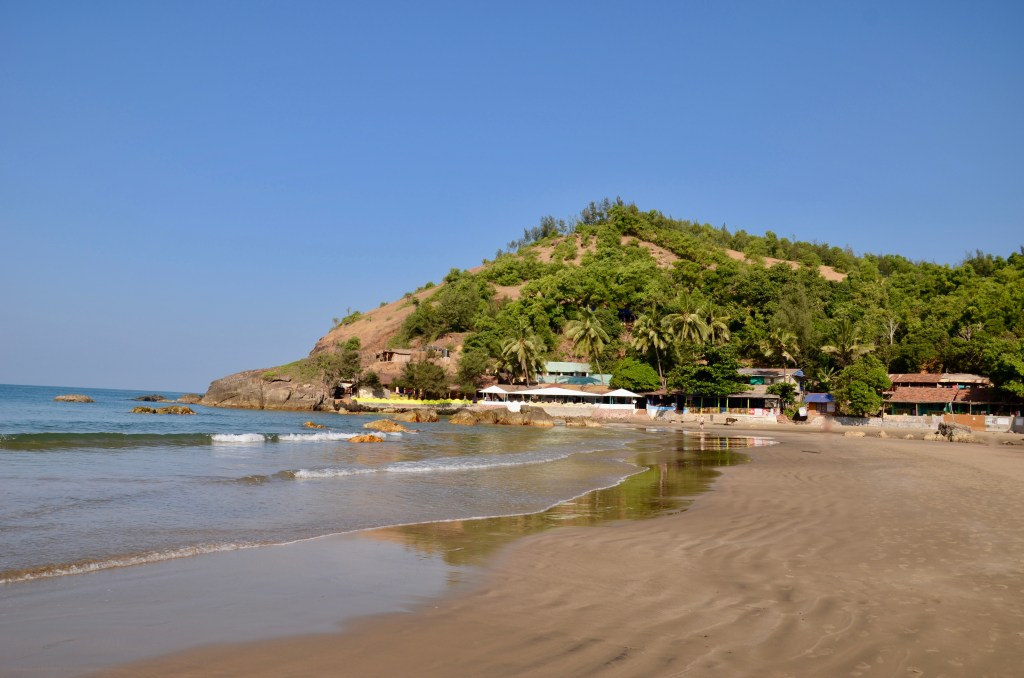
The town beach is certainly not as beautiful as Agonda but after walking 20 minutes away from the hubbub of the town, the beach became virtually empty and the water very clear. No sun beds cluttering the sand, and the few beach huts are hidden in the undergrowth bordering the beach. It’s appealing for us to be in India AND at the beach. Harder to find than one might think. Two or three restaurants serve good South Indian food at Indian prices. At most times of the day, they are packed with Indian tourists and pilgrims making such a din you can hardly hear yourself think.

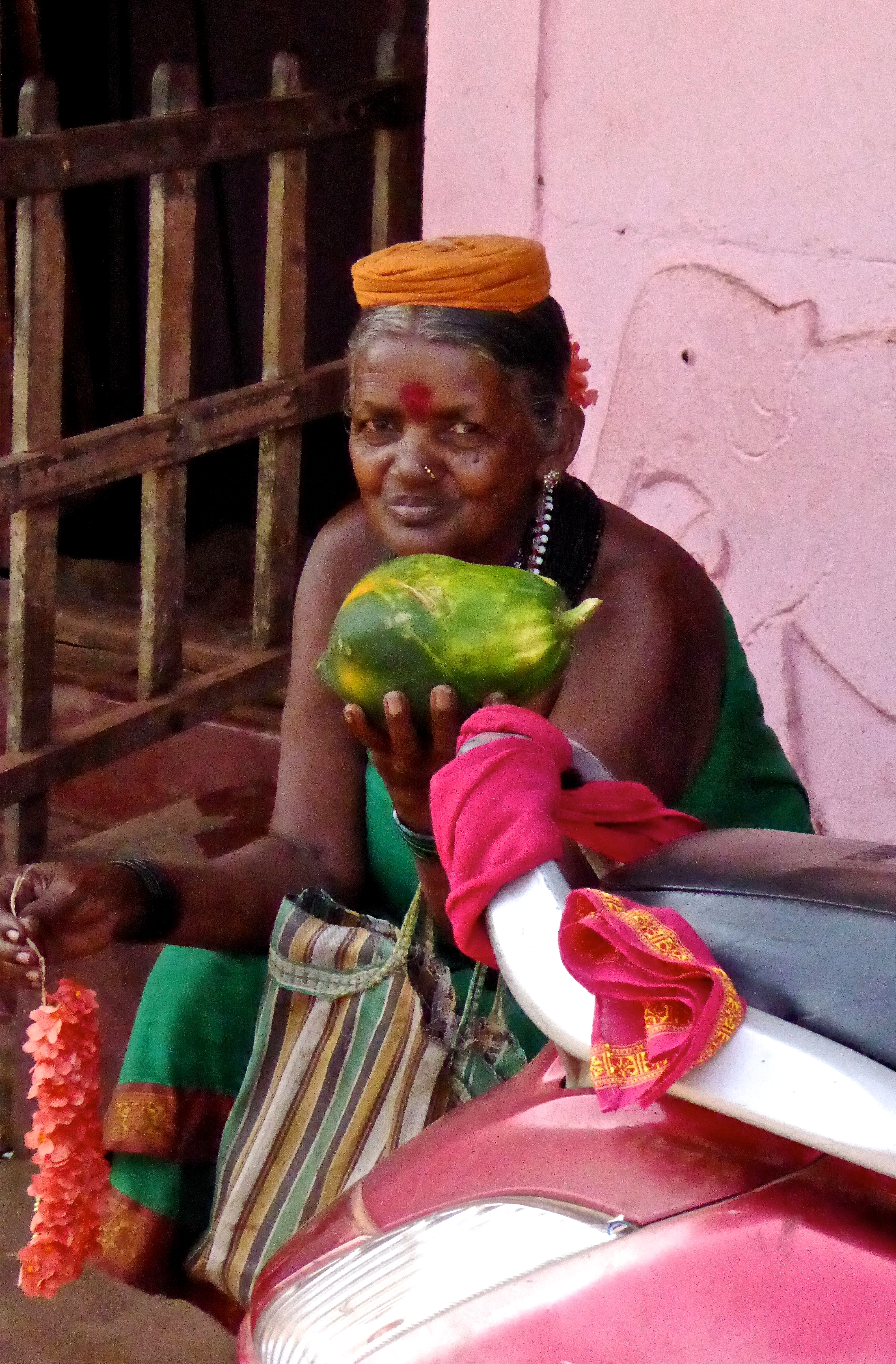
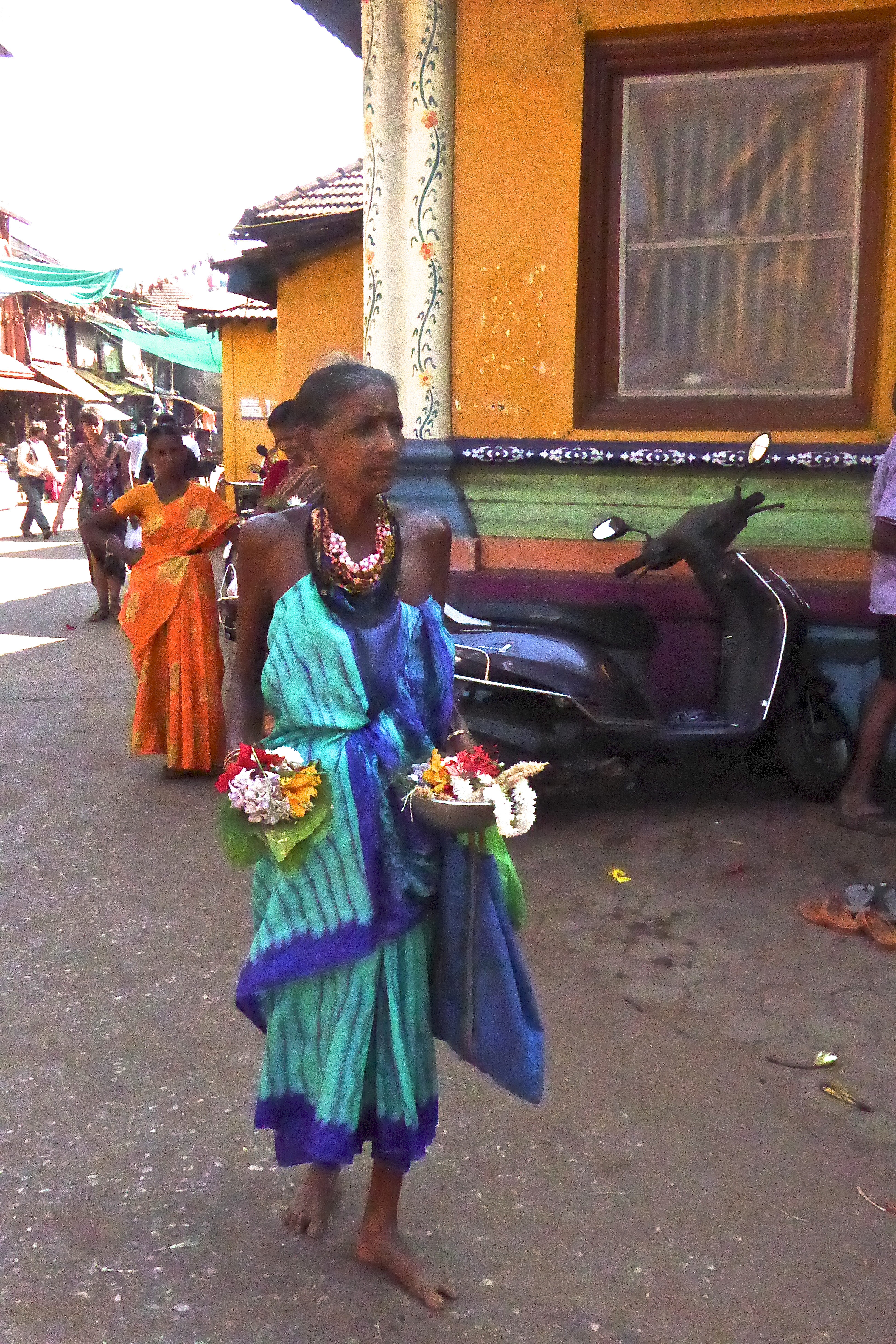
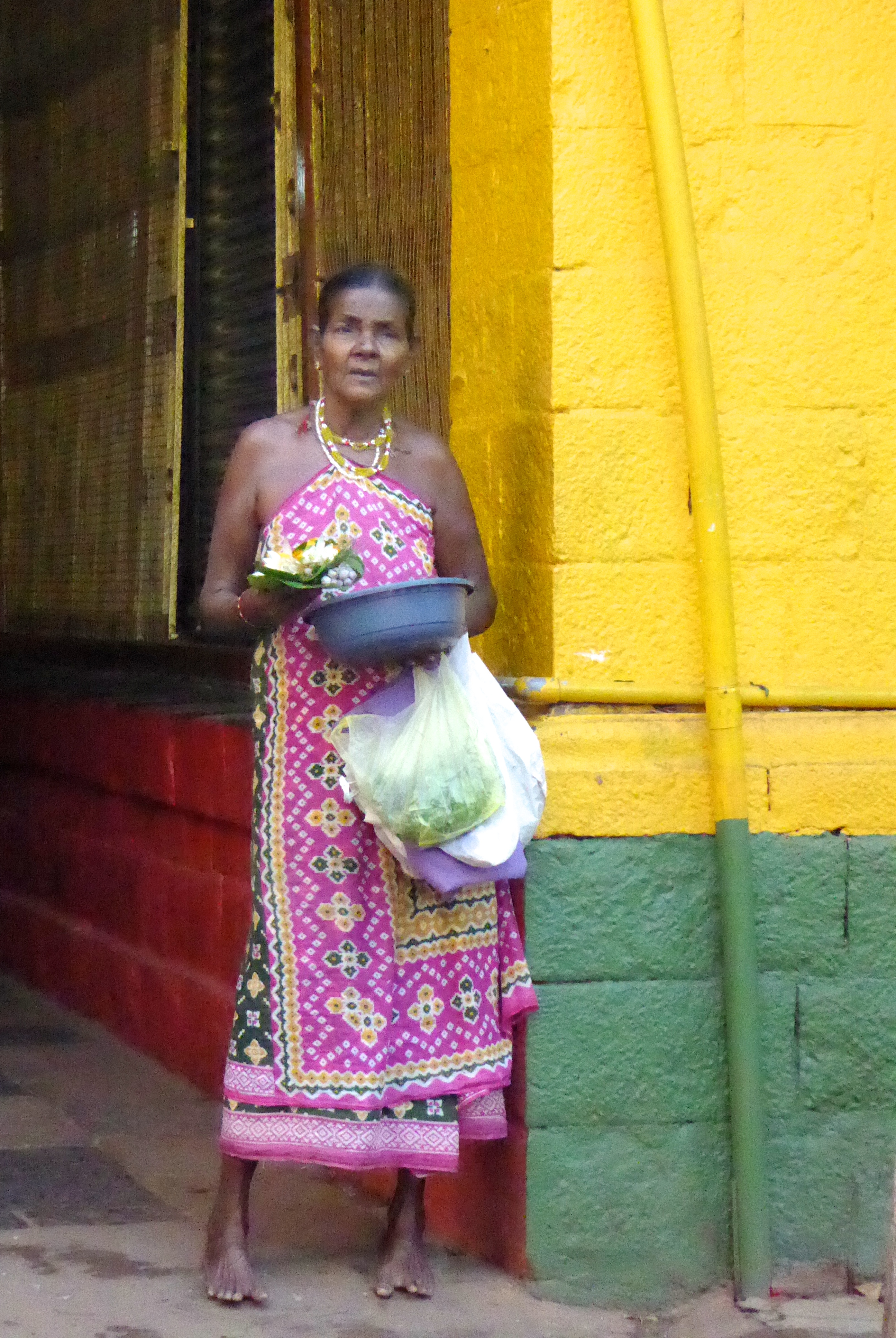
p1030120I respond to the religious fervor even though I can’t personally identify with Shiva worship. Such conviction and dedication are refreshing in today’s world of lukewarm faith. Even though I’m here for the beach, I like the diversity. As I make my daily pilgrimage to the sea down the winding main street, I pass two temples. Around them, the local women wrapped in a sarong pinned over their breast to numerous beaded necklaces, sell flowers, coconuts and who knows what as offerings. Then I dip myself in the clear sea water, giving thanks.
india-2016-55

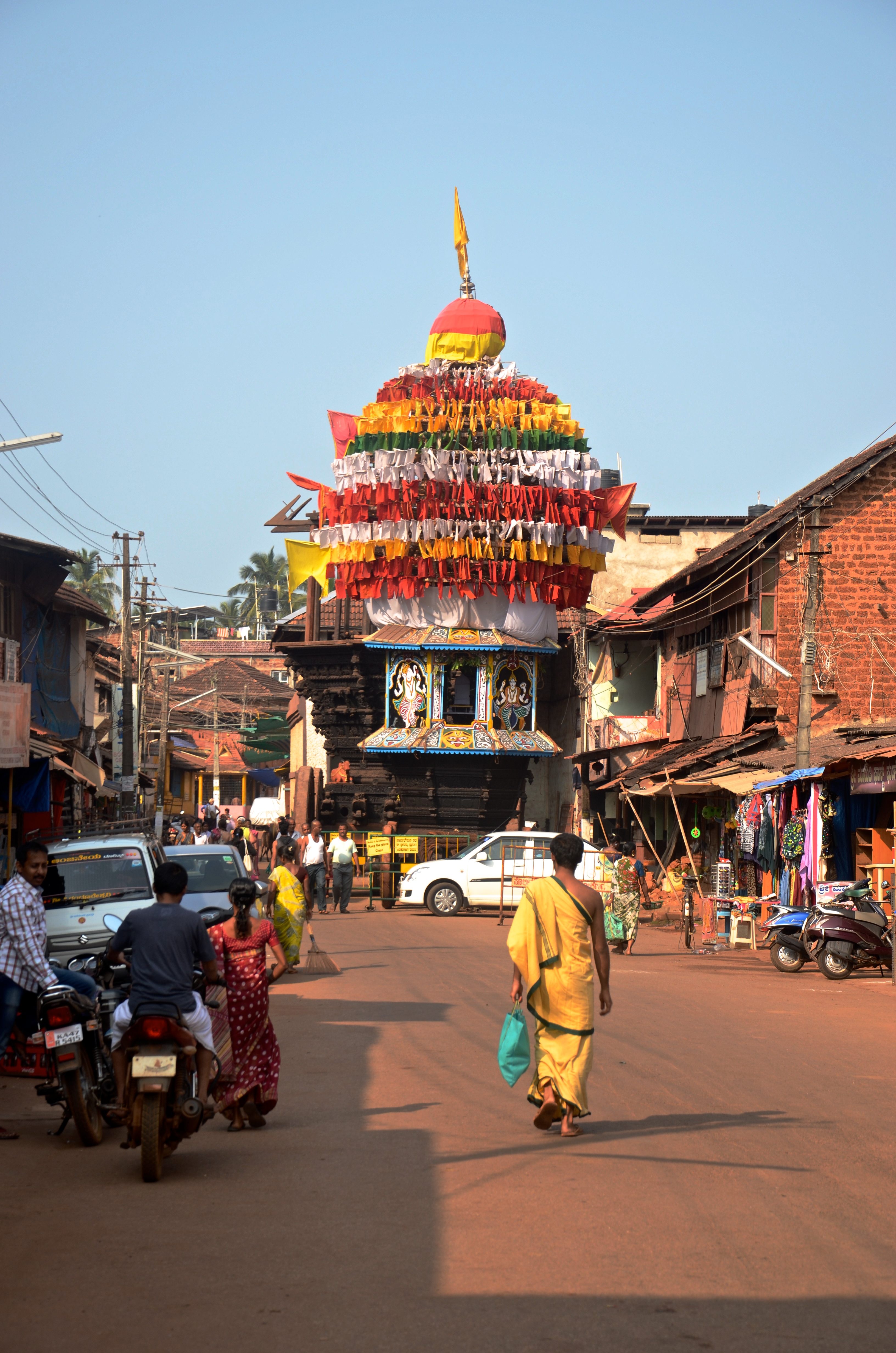
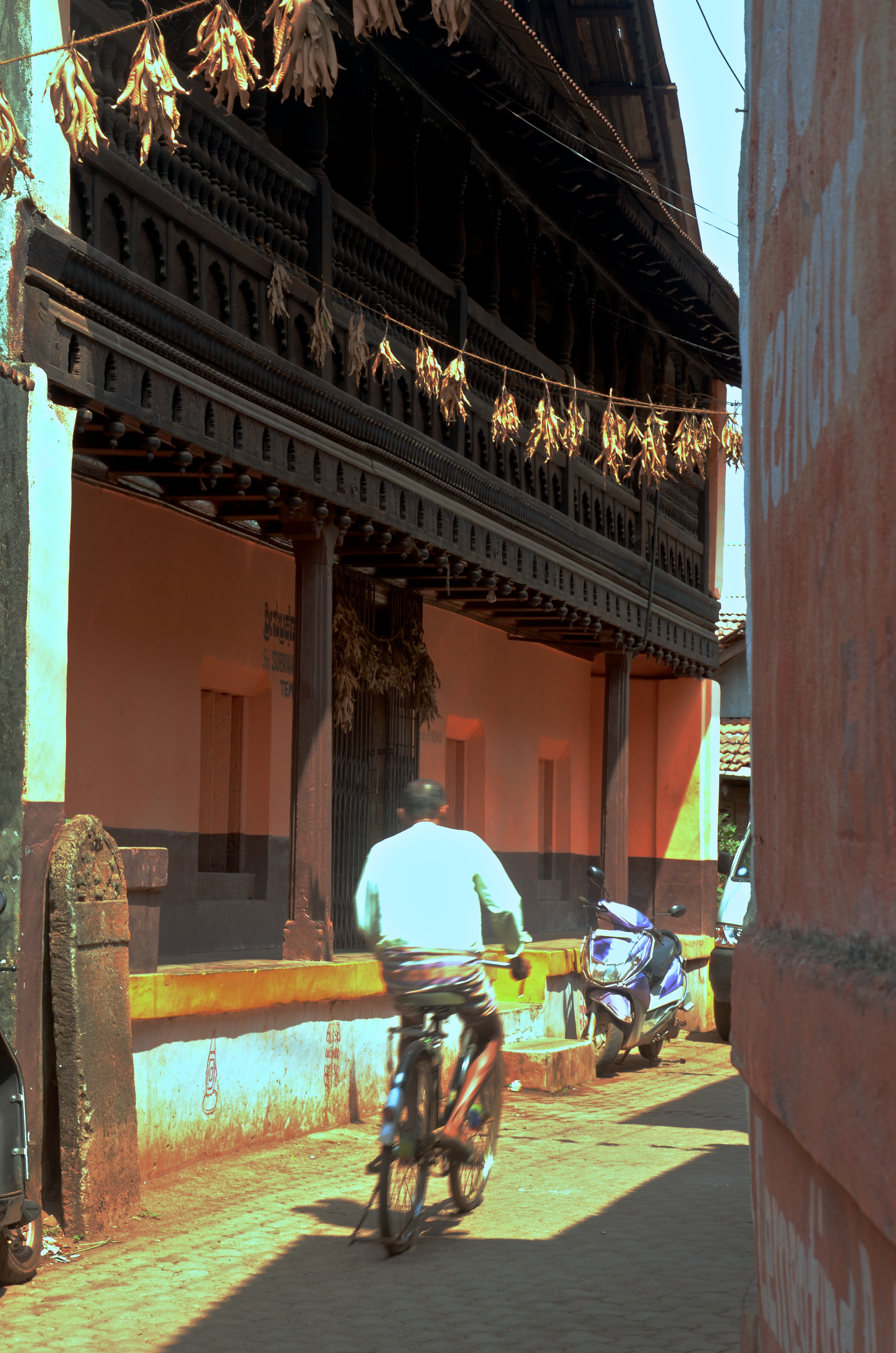
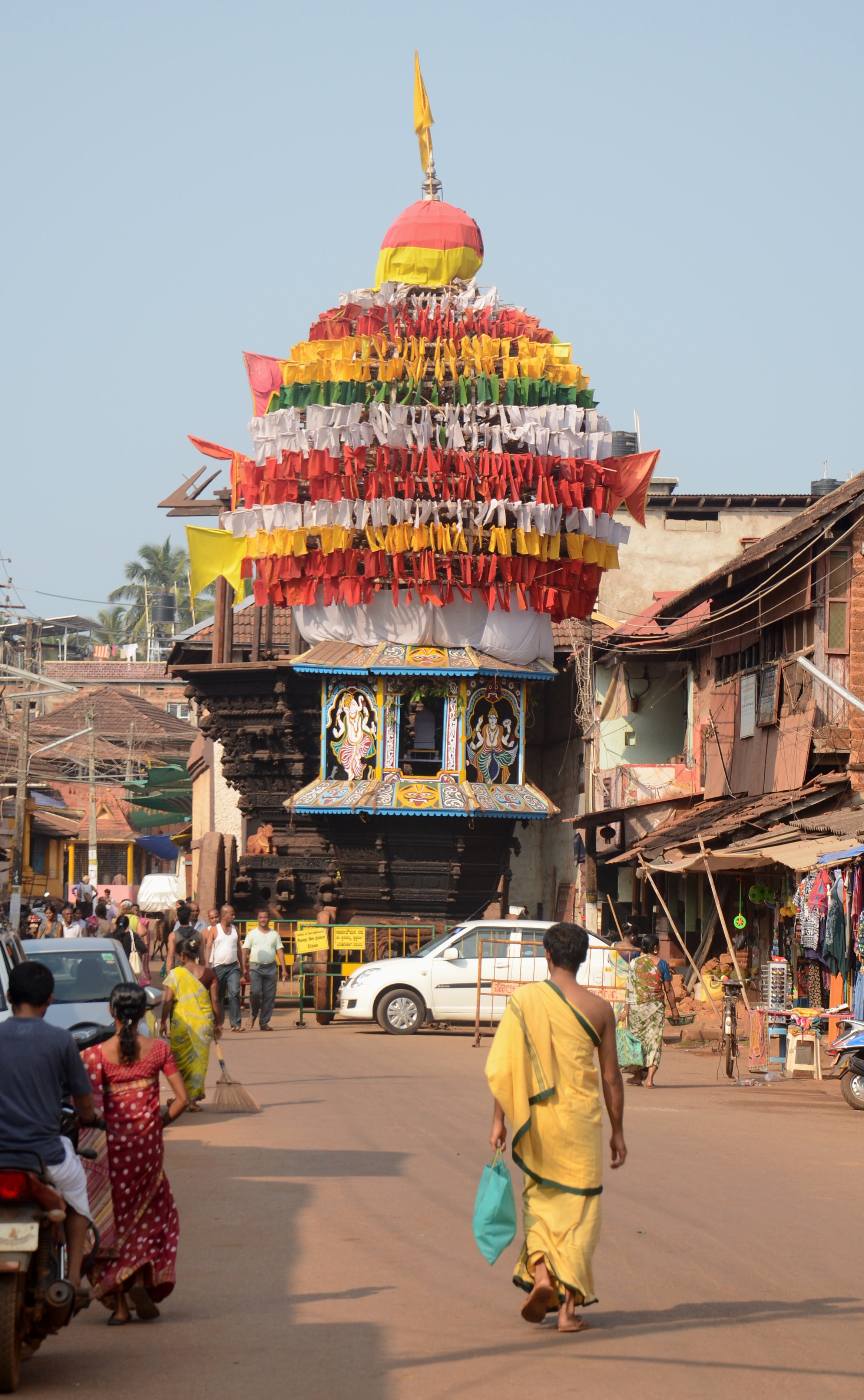
Beside the temple sits an old carved wooden chariot decorated with flags waiting for the next occasion to be hauled out; furrows in the street shows its path.

p1030154

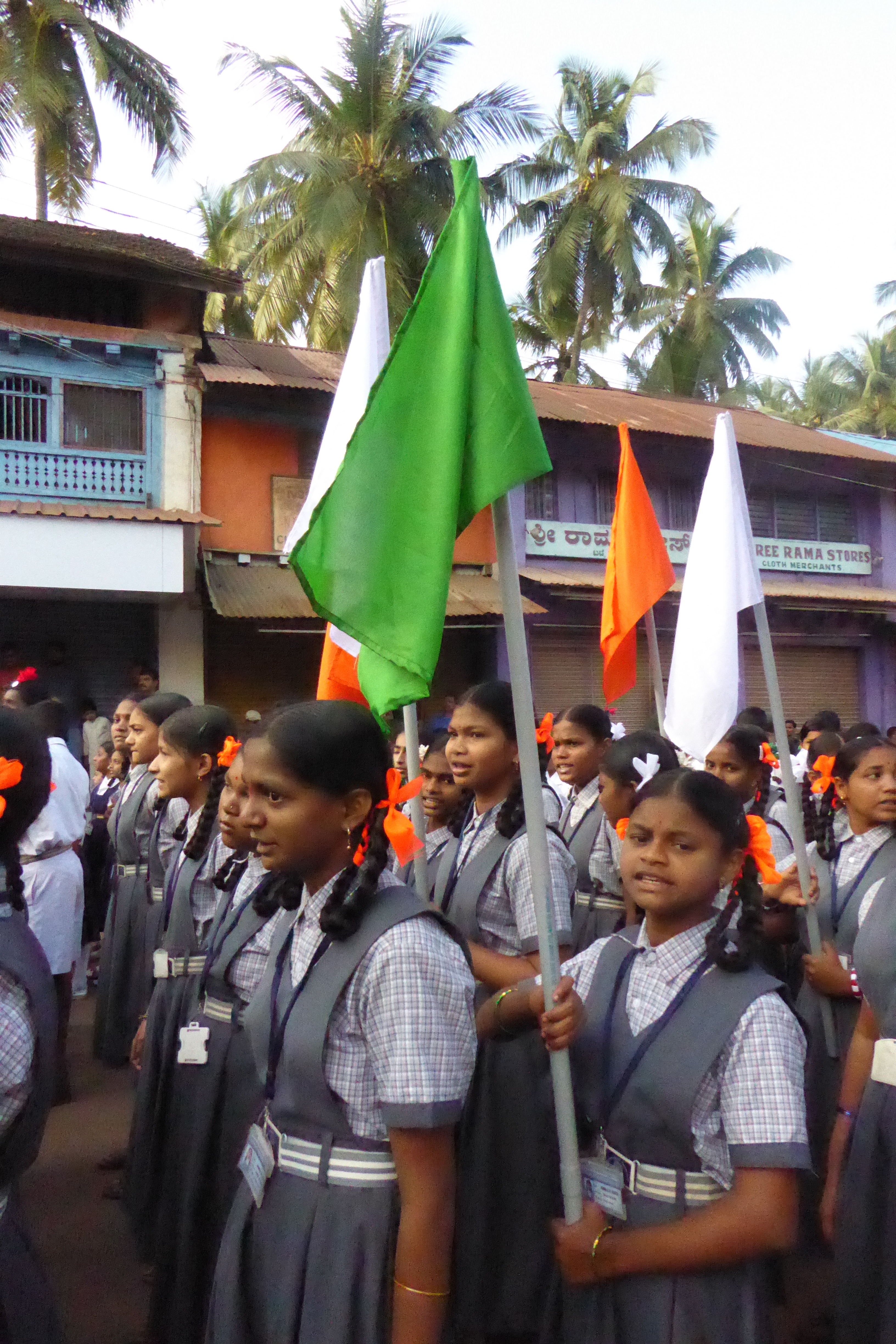
We had hoped Republic Day would be one such an occasion. But instead, all the school children in the district paraded up and down in their uniforms carrying flags and beating drums.

p1030180

The beach wasn’t as convenient as in Agonda, but the town was far more appealing. We plan to pass by this way again.

36 Hours…..and Counting

maxresdefault

I tried not to think about the 33-hour train ride to Gokarna. Although I’ve completed plenty of long distance rides in India now without losing it, anticipation of them still makes me anxious. Even at this age, I find it hard to sit still for any length of time. Granted, trains have an advantage over planes or buses; I can walk up and down the carriage, weaving around people spilling into the aisle – babies underfoot, large men stretching out, and so on. Reaching the end of the carriage, I can stand in front of the door open to the outside; feel the fresh air on my face, and watch the countryside fly by — if there aren’t three other people already standing in the door. When we pull into a station, I can risk jumping off for a few minutes, just time for chai in a paper cup, watching the buzz on the platform.

Much of the time can be spent sleeping, provided crying babies or snoring fellow passengers don’t disturb the fragile slumber. In this case, the 33 hours was spread across two nights and one day, hopefully, plenty of time for sleep.

Things started out well. The train originated in Bikaner, and boarding at 10 pm, we were the only two in our four-person compartment. An empty carriage, no curious Indians wanting to talk late with Gerard. So for the first night, we slept in peace with the compartment to ourselves. The only downside, it was very cold because we were still in the north and there was little heat on the train.

We woke in the morning to breakfast. Thankfully our train had a pantry car, not always a given. So my insecurity around food was not an issue. The boys took our lunch and dinner orders, and the meals turned out to be tastier than the average train food we’ve had. There may have been no real chai on the train, only ‘dip-dip’ tea — a tea bag and powdered milk. (What a disgrace in the land of chai.) But chai wallahs would board the train at major stations. Things were going quite smoothly so far. So what was the angst about?

dsc_0409

As we’ve mentioned before, one of the highlights of train travel has always been the people we meet. And this journey was no exception. At Ahmedabad, a young husband and wife with a three-year old daughter joined us. As is often the case, the wife could speak a little more English than the husband, but conversation was still limited. Nevertheless, they were so friendly. Vipin Dass is in the military near the Pakistani border in Gujarat, his family living with him. They were happy to be returning home to Kerala on a month’s leave. The little girl, Vidu, was cute, well behaved and not at all shy. The day passed quickly chatting with them. From time to time the boys from the pantry car would pass through, and the couple bought almost every snack, deep fried vadas (lentil patties), samosas, fried bananas, and then insisted we sample some. By the time the second night arrived, we were as comfortable as family, and they were insisting we come visit them in Kerala on our next trip. After Vidu threw a tantrum, which was not so surprising due to her sugar intake, we all went to sleep.

I woke up at 4 am ready to get off the train. Five more hours to go, but no problem. Breakfast, chai, chit-chat and then get down at 9.30. It had been all clear in my head. A fly in the ointment — we were already behind schedule. Vipin Dass had a printout and had been keeping track of the delay. Indian trains are notoriously late, so it was no surprise, but it fueled my anxiety. This morning the delay had grown to three hours and counting, as the train sat idling on the track. Signal problems, they say.

My latent claustrophobia was also kicking in. I’d had enough of being cramped on a train. When I told Gerard, his remark was, “Cramped? Go back one carriage to general seating and sit there for a while. And then we can talk about cramped. What is your problem?” No support whatsoever. The image came back to me of the scrum at Ahmedabad; people trying to cram into general seating, already full. Not a pretty sight. Maybe he had a point.

Finally, we’d left the last station before ours. We were getting close. But we still had a bus journey of who knows how long before we’d reach Gokarna. And what about lunch? Gerard always well prepared, decided we should stand by the door with our bags ready to get off since it was a small station. We said goodbye to the family but Vipin Dass insisted on coming and standing with us. Twenty minutes later we arrived. Vipin Dass carried my bag onto the platform and shook hands. As the train pulled out, I caught sight of the family waving from the window. We’d arrived. Now how do we get to Gokarna?


Dental work and Shiva temples

It seemed a good idea to go to the dentist in Goa. Friends had root canals, implants and bridges, all with success, and the crowns we both needed were an 85% saving. Hard to turn down. But like all coins, there was another side.

DSC_0219

Early Sunday morning, we arrived on time for the first appointment of the day and waited in the open balcony that served as a waiting room for over a half an hour. , but the dentist was on Indian time. Meanwhile the two young dentist assistants scurried around preparing for the day. While we waited, the girls would come out and look over the balcony for the dentist. Finally they decided they could risk it and order their breakfast from across the street. Coming back with newspaper parcels, they sat in the surgery eating pav bhaji (a potato stew) and fried puris. We visualised them sitting in the dentist chair enjoying their meal. Five minutes later we heard them washing off their plates and hands with what sounded like the water jet.

Finally the white-jacketed dentist and his assistant arrived and with an air of professional confidence, dare I say arrogance. Wasting no time, they fitted first Gerard for a mold and slapped on a temporary, and then did the same for me. I was told to get up. Waiting for the back of the chair to lift, I realized it wasn’t going to happen. With the blood all running to my head and dizzy, I managed to swing myself up out of the chair. As the world came back into focus, I realized the dentist had made no attempt to clean off the excess cement around the temporary. For the next half hour I was spitting out bits of cement. And in Gerard’s case, the temporary was too large and for the next week he continued to chomp into his cheek.

We went back the following week and an even quicker procedure was fitting the permanent. Mine seemed to fit perfectly but for some reason, the dentist whipped it off again and told me to come the following week for the final fitting. Gerard had a less satisfactory experience. The crown was so tight that the dentist had great difficulty getting it off, finally resorting to a pair of pliers.

During the following week, the conversation of dentists came up with a few of our acquaintances. Even though everyone was satisfied with the work in the end, we all had bones to pick. Gerard noticed the instrument tray had stains and was pitted by who knows what? But from out of the corner of his eye it looked even worse. As the dentist drilled away his mind drifted to what exactly is that on the instrument tray? Couldn’t they have at least covered it with a clean cloth?  (My eyes are not as fine tuned as Gerard’s, the more so without my glasses). Then we got laughing about the plastic cup for rinsing your mouth. Did they really change it after each patient? Even though we had a good laugh, everyone agreed in the end it all worked out.

On our last appointment, our crowns were fitted, and fine-tuned. Gerard would not leave until he was 100% satisfied with the bite, insisting on having it polished yet again after adjusting. In my case, I was content on the first fitting. Out of a five star rating, they get three stars. But I’ll still come back for teeth cleaning and examination next year.

Yesterday we took time out from our busy schedule in Agonda, to visit Gokarna. It’s surprising how much time it takes to get from our room to the balcony for breakfast…then to the beach shack for chai and then down to the water for a swim etc. etc.

DSC_0165

Gokarna has been long known as a place of pilgrimage for Shiva followers

P1000936

and in more recent years, it’s become one of the “destinations” for Gunja smoking hippies, living in shacks on remote beaches.

DSC_0206

Just over the border in the Karnataka, you’re most definitely back in India again. Goa of course is in India, but it’s Goa. We went for two reasons; one to see if it might be an alternative to Agonda, and two because our friend Oliver is staying there and we wanted to see him again.

In Orchha, two years ago on a cold rainy late December day, we were looking for a guesthouse as an eccentric looking man dressed in homespun was stepping around the puddles approached us. Gerard asked where he was staying and he led us to his guesthouse. Over the next few days, we slowly built up a friendship with this unusual Englishman from Devon. He’s an artist who’s been all over India capturing street scenes of every day life. The town was small so inevitably our paths crossed – Oliver would be sitting in a shadowy spot beside the temple sketching figures that he would later assemble in pen and ink. We were both drawn to his company and the cold damp days passed quickly. Agreeing to stay in touch, the fact that he had no email or cellphone meant that was not possible in India. Three months after we got home, a folder came in the mail of five prints of his recent work, including the one he’d been developing in Orchha. We’ve stayed in contact ever since through ‘snail mail’. This past fall he told us he would be spending a couple of months in Gokarna and included a very precise map of the three places where he would likely be loitering.

P1000846

So along with our friend Tatiana and two Russian friends of hers, we rented a car and driver and traveled the two hours to Gokarna in style. We left at 6.30 am and were there in time for breakfast. But first we went to Oliver’s hotel – he was out. So we wandered down the long main street to the beach, all the time with our eyes peeled for Oliver. Tatiana had been there a few times before and took us around.

P1000897

Gokarna is an interesting town because it still has a sense of authenticity and character that the beach towns of Goa don’t have. On the other hand, the beach is nowhere near as nice as Agonda

DSC_0174

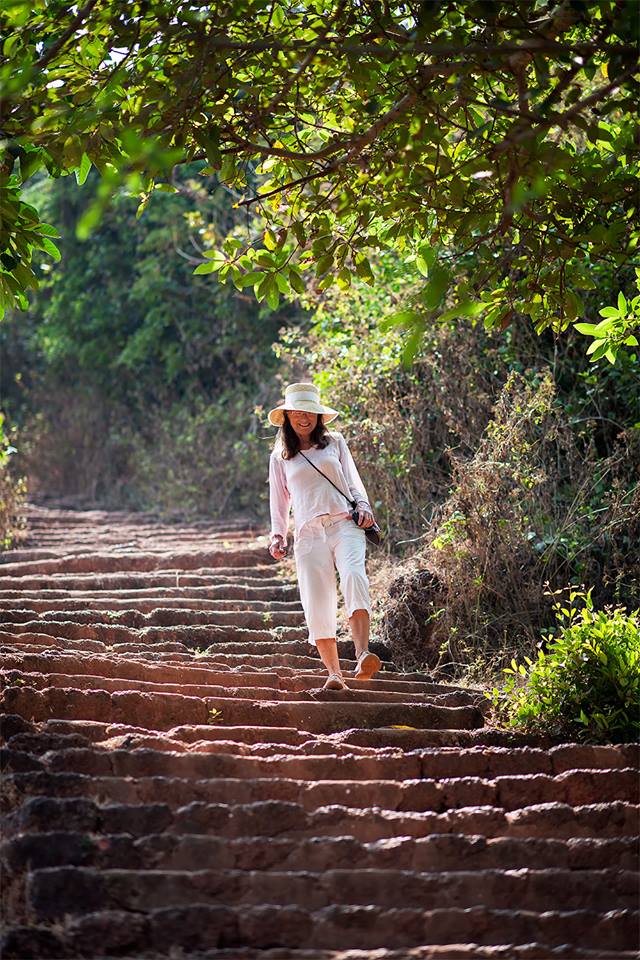
We visited a hillside temple overlooking the ocean

T3

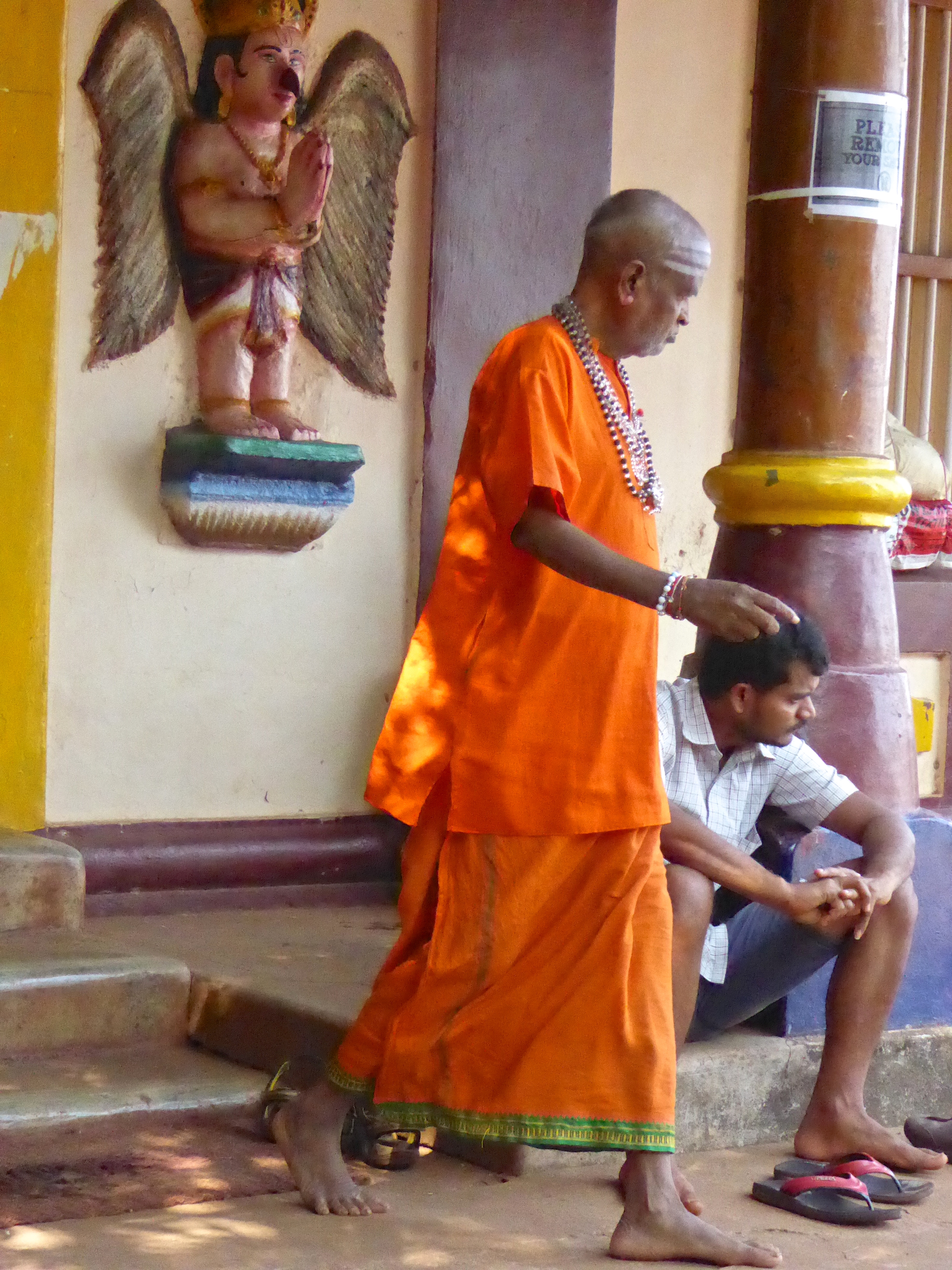
where we photographed what we thought was an old Sadhu, but when someone engaged him in conversation it turned out that he was an American — still an old Sadhu. Who know how long he’s been there.

P1000873

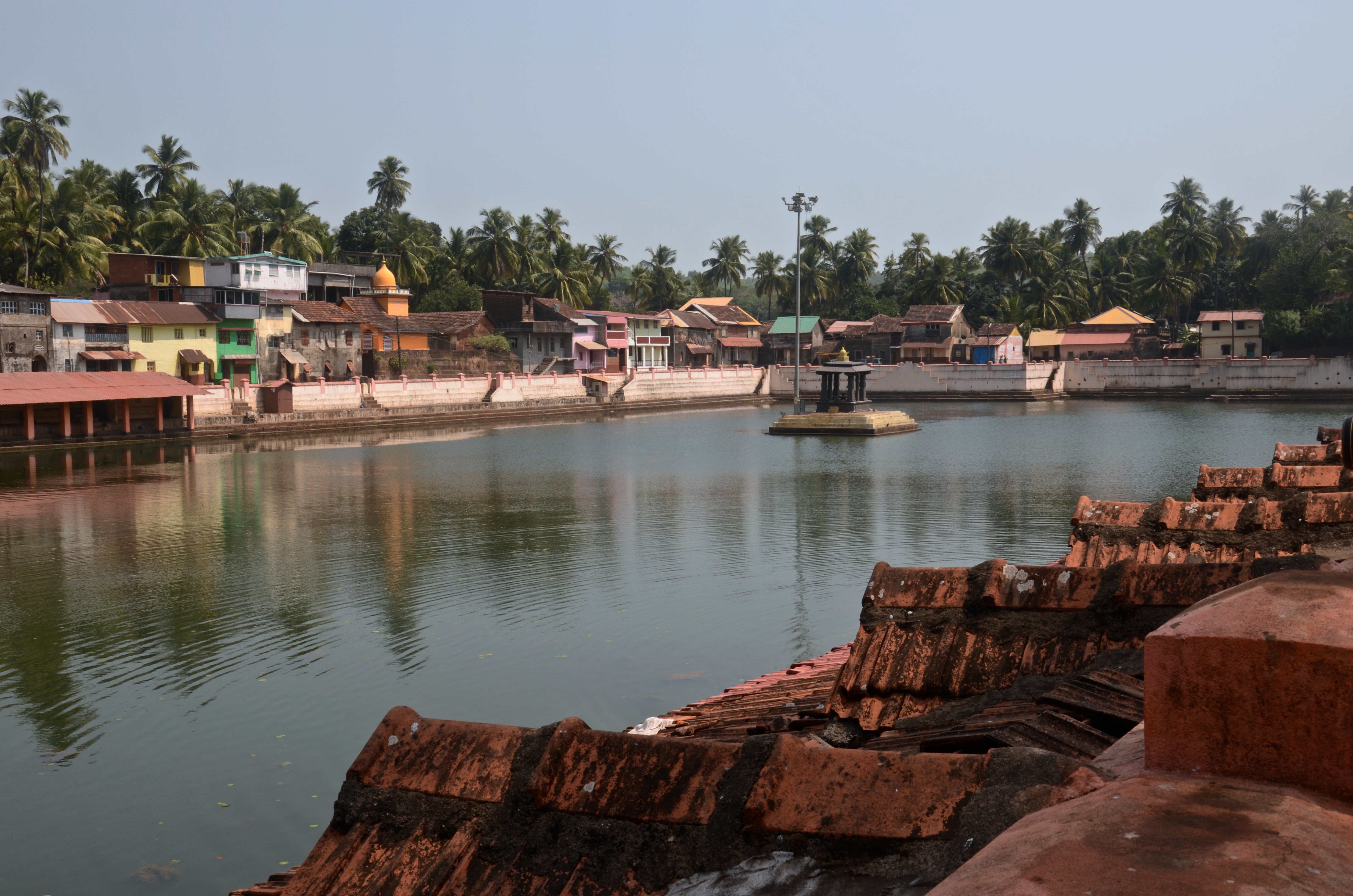
Tatiana took us to a peaceful water tank, we did some shopping and had lunch. Still no sign of Oliver.

DSC_0198Gerard walked back towards the car, while I did one final sweep of the designated spots – with no luck. It looked like I was not going to see Oliver again. But on the way back to the car, I heard a voice call out from a small chai shop – and there was Gerard sitting with Oliver. He’d found him!
There was hardly time to catch up. The Russians were anxious to get going. But we were still so glad to see each other. He promised to stay in touch by letter, of course, and would send prints of his new work. Oliver encouraged us to spend time in Gokarna. He’s been there for nearly two months and likes it. We’re now seriously considering it, not as an alternative to Agonda, but definitely an addition.

T4