Pushkar Revisted

Taking a rickshaw to the bus station in Ajmer we both agreed, now we’ve arrived in India. Women in traditional Rajasthani red and gold saris and scarfs draped over their faces, their husbands with multi colored turbans. The press of people, rickshaws, elaborately painted lorries, cows and dogs; a choke of fumes, a whiff of spice, flies converging on enamel bowls of sweetened curd and trays of milk cake, garish billboards advertising movie stars, politicians and gurus.

The bus we boarded for Pushkar was the most dilapidated tin can we’ve ever had the pleasure to ride in India. The sides no longer rigid, swaying back and forth with every bump in the road. Gerard looked at the back to see the cross members broken and gyrating as if they were doing the twist. All attempts to weld hand bars back to the ceiling had failed. The floor heaved as if an earthquake was about to erupt. As we worked our way over a small mountain pass, on each hairpin turn, the bus snapped and groaned as if it was about to fall into pieces.   We arrived in town grateful that the bus did not expire with us in it.

P1000182My father liked to say, “you should never go back.” He had a cynical streak/view of life and believed that you’ll always be disappointed a second time. Just like people, places will let you down. Gerard and I have proved him wrong over and over again. We go back to Varanasi and Goa year after year and are not let down. Rather, it improves as we become more familiar. But certain expectations inevitably form. I’d loved Pushkar the first time we visited last year. It’s a pretty town, sitting beside a lake surrounded by gentle hills and has a spiritual ambience
P1000222

But what I reminisced most about during the past 12 months was our guesthouse, Rising Star. Our spacious room, the family chanting around their household temple downstairs in the evening and the delicious home cooked meals served on the roof. So with a booking made we returned dragging our cases from the bus stop. The two brothers met us with long faces…”Sorry Sir, we don’t have your room for two days.” A girl was supposed to leave but got very sick and couldn’t move. They offered us the only vacant room – dark and damp on the first floor. We didn’t relish moving after two days or into a room where someone had been deathly sick. I felt let down and fearful there wouldn’t be another room in town, and for a while that seemed the case; the rooms we looked at were too noisy, dirty or overpriced. Finally we found the “White House”. And it was just that, painted all in white and very clean; friendly owners, good food, nice room. So once again, we’ve proved my father wrong…you can go back. But sometimes an adjustment is required.

P1000193

The first night here, right next to the hotel was a house performing funeral rites. The period of public mourning lasts for 11 days and fortunately for us this was the last. Friends and family assembled and loudspeakers, set up on the roof, blasted live chanters till after midnight. Surprisingly, we managed to sleep through much if it because we were so exhausted from traveling. The following evening a small nearby temple broadcast in a similar fashion more chanting till 11 pm. And of course in the early morning there’s always some temple near and far beckoning over loudspeakers the faithful to come and do their devotion.

Gerard asked our friendly waiter/cook at out roof top restaurant, “Why do all events, weddings, funerals, temples etc, blast from loudspeakers at ear shattering volume. Are they sharing with the community at large?”

“Not really. Indians are a loud bunch.” He replied. We reflected — the horn on the lorry playing musical tunes with horns, the ticket collector on the bus with his piercing whistle. Is it any wonder Gerard suffers from tinnitus?

The waiter continued, “ Everything in India is LOUD. Loud music, loud clothes — so much color, loud food — so much spice.” There must be more to it than that. Maybe it’s a matter of competing with 1.3 billion.

We’ve said it before; traveling in India is not only about India. Today, we ate breakfast with a woman from Croatia who was nine years old when the Yugoslav war broke out. Since visiting Bosnia for work, I’ve had an interest in that part of the world and had made questions about the war. As we talked, the only thing that was clear from her point of view was that the region in general is in worse shape now than before the war. She thinks it needs a single ruler to keep the lid on ancient grudges. But where to find such a ‘benevolent’ leader that actually has the citizens interests at heart? We couldn’t remember meeting a Croatian here before. Both of us were fascinated to hear what she had to say.

P1000166

Pushkar is a pleasantly relaxing place to begin our winter sojurn in India. Spending our last afternoon sitting on another rooftop restaurant above the lake, sheltered from the afternoon sun and fanned by a gentle breeze, watching flocks of birds silently circling the water. The sounds from pilgrim bathers below are hushed. The beet, carrot and pomegranate seed salad tastes even better with the view.

P1000174


Faded Frescoes and a Sacred Lake

DSC_0414Our Indian family gave us the usual warm welcome and we enjoyed our few days in Delhi together. Once again we’re in India when such a terrible act of terrorism occurs. These events only harden the party line for the Hindus: “See! I told you that all terrorists are Moslems. Even against their own people.” Over dinner with CNN in the background repeating the gory details of the Pakistani school massacre, the comments from the men around the table clarified the deep suspicion that the Hindus and Moslems have for each other. Everyone was shocked that the Pakistani Taliban could murder their own kinsmen and feared that it was only a matter of time before there was a similar act of terrorism in India.

P1010108

Three days later we set off by train for Nawalgarth, a “backwater” of Rajasthan not yet on the tourist map but remarkable for its concentration of old havellis with frescoes. The day began standing on the station in bone-chilling fog at dawn. Finally the milk train pulled in an hour late. I could barely lift my bag up the steep step on to the train – either I’m out of practice or my attempt to pack a lighter bag failed.

A short two-hour ride and we had traveled far from the modernity of Gurgaon to the border of Rajasthan. Getting down in a dusty little town we dragged our bags to a spot where our next bus would stop. The bus turned out to be a sleeper with two levels of “beds”. This time I needed assistance to heave my bag on to the bus and then up to the top level. Jostled and jolted, we went hours further as the land became increasingly wind blown and arid semi-desert.

DSC_0453

The area of Shekhawati once lay on an important caravan route before the rise of Bombay and Calcutta diverted trade to the south. Grown rich on trade and taxes the merchants spent their fortunes competing with each other to build the grand and overly decorated havellis that still line the streets of the region’s dusty little towns. Gerard saw a picture of Nawalgarth online and said, “Let’s go there!” Only catch, it’s not easy to get to. Typical! After yet another bus ride we finally arrived late afternoon and with some difficulty found our guesthouse. Since there’s very little competition, it was grossly overpriced, but did include a good breakfast with home made marmalade.

P1010153

The town did not disappoint – over 300 havellis built around the turn of the last century in varying stages of decay, although one has been restored and opened as a museum.

DSC_0437

Many of the colorful frescoes are still evident; some have been touched up albeit with a heavy hand. I fantasize how Nawalgarth must have looked100 years ago with so many grand houses with freshly painted frescos lining the streets and only horse-drawn tongas.

DSC_0468

Today large noisy diesel-powered rickshaws spoil the town. Everyone hates the noise and pollution. Hopefully it’s only a matter of time before like Delhi they have the sense to move to compressed natural gas.

A chance encounter with a young man qualified in acupressure was too good to pass up. I’d had a sore neck for over a month and Gerard a shoulder problem. For $12 we each had two treatments, plus one extra thrown in for Gerard’s plantar fasciitis. Neeraj had the gentle temperament and touch of a healer. He treated us in a little room in his family home, where his beautiful mother, as serene as her son, brought us chai in porcelain cups. We were treated like guests in his home. It was a great experience…and dare I mention, my neck has improved. Gerard’s shoulder issue is more problematic. Neeraj spoke no English but his brother, who is a writer and has translated material for the Discovery Channel, mediated for us.

P1010160The next day we took an early morning bus from Nawalgarth to Pushkar. After about 30 kms, when the smell of petrol became overpowering, the driver pulled into a bus station. A mechanic appeared with a cup of chai in one hand and tools in the other. After prolonged discussion around the motor the driver takes off across the scrub land and comes back two minutes later with a new fuel line in hand – another two minutes, it’s installed and we’re off again! This was supposedly the direct bus to Ajmer but no one mentioned we would be on a single lane meandering through every village and hamlet on the way. Finally we emerged out of the scrubland on to a proper highway but still going so slow even the camel carts were passing us. Then the bus came to a complete halt and we are shunted to yet another bus for our last ten kilometers.

It goes without saying that travel in India is a shared experience, especially on long bus rides. We’re all crammed in, windows that don’t open, seats that are no longer properly bolted to the floor, music blasting. Then we pull into a bus station – vendors push fruit and water through the windows, young boys climb aboard with platters filled with deep fried snacks, the man sitting next to us cautions us not eat them and offers to go get us chai. The young girl two seats in front amuses herself making faces at us…we still have 100 kms to go and more than half the bus needs a WC!

Our guesthouse owner offered to pick us up at the bus station and for no charge no less. As in Varanasi he feared that we would be diverted to another guesthouse before reaching his. Unlike our last accommodation, Rising Star is a great bargain – better facilities and a third of the price.

DSC_0601

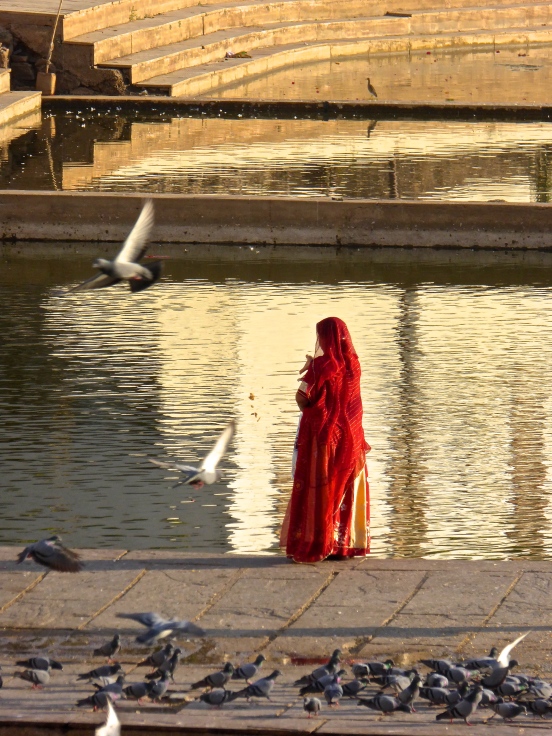
Pushkar is a “destination” similar to Rishikesh, Hampi, McLeod Gunj etc. We’ve known about it for a long time but have had little interest because of its reputation – lots of young Israelis getting stoned. (It’s a rite of passage for them to come to India after they finish their military service.) But this time, it lay so close to our route south to Gujurat, why not come and see for ourselves? Legend has that Pushkar came into existence when Lord Brahma, the Creator, dropped lotus flowers to the earth and where they landed water magically appeared in the midst of the desert to form a small blue lake. Now surrounded by temples and Ghats the lake is revered as one of India’s most sacred sites. Its waters are believed to cleanse the soul of all impurities, attracting pilgrims from all over the country. Perhaps because it’s nearly Christmas time and alcohol is not allowed in this sacred town, most of the tourists are in Mumbai or Goa to party. So the whole atmosphere is quite different from what we had expected. And the lake with its white-washed temples and Ghats for bathing pilgrims is enchanting.

P1010259

Being a “destination” there is a load of teashops and restaurants where you can sit and watch the colorful Rajasthanis pass by. More than ten years since we last visited Rajasthan I’ d forgotten the colors – the red and gold of the women’s veils, men’s turbans, a different color for each caste or region.

P1010255

P1010251One afternoon we walked on the Ghats surrounding the lake. As the sun shone through the arch of an old palace a young girl emerged out of the light, offering us her cup of chai. “Do you like tea?” Beautiful and well spoken, she was captivating. She was staying with her uncle who still lived in the old palace beside the Ghat. Pointing to an open turret above us she told us she slept there on hot summer nights. And Gerard said, “Like a princess?” We asked if we could take her picture. At first she said no, then she turned to her father some distance away and asked his permission. She insisted I should also be in the picture.

Back at Rising Star guesthouse every evening after sunset, the family performs their prayers. In the middle of the courtyard a shrine sits beside a large banana tree. Grouped around it, they chant a mantra. The little children join in – and the baby yells.

P1010334