An Oasis of Simple and Friendly People

DSC_0633

Several years ago, we came across a small town at the base of the Himalayas and spent a memorable week there, always planning to return. This year it worked out. Unlike most of India, this place has changed very little although it does seem to be prospering. There’s very little option for accommodation, so we decided to rent a room in the Buddhist monastery.

DSC_0695

I love everything about this room, even though we have to puff and pant up the hill. Large and spacious, wood floor and one wall that is mostly windows, with afternoon sun pouring in. We look out on trees filled with birds and monkeys. The latter are entertaining, but they’re also very destructive, pulling washing off the line, sneaking through the window to grab our bananas etc. A bit of hike to get here means it’s also peaceful and private; conducive to meditation.

DSC_0622

 We’ve tried to put our finger on exactly what it is about this town that is so appealing to us. Surrounded by hills on one side, terraced fields and hamlets on the other, it is very picturesque. The air is clean and there’s little traffic and horn blowing. The Buddhists and Hindus alike seem to walk around with a smile on their face.

DSC_0613

 We’ve mentioned numerous times how we’re attracted to the Indian people and their generosity. So it sounds like a broken record when we say the simple and uncomplicated life style of these villagers is so attractive. Numerous times in the past we ‘ve made comparisons to Morocco and here we make another one. In our first years in North Africa it was common to be invited into people’s homes for tea and even something to eat, without fear or reservation that there was a hidden agenda. We have found this kind of hospitality again in these mountains, and in the 21st C no less.
DSC_0673

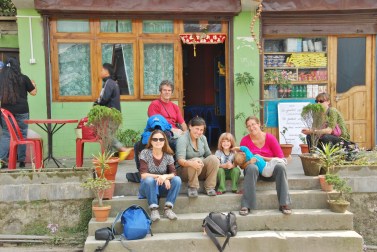
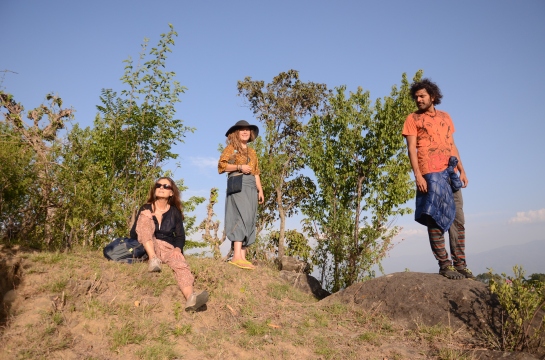
One day, we were walking through the fields of winter wheat accompanied by Varun, a Punjabi who grew up in India but has spent the last fifteen years in the U.S., and Megan, a dreadlocked girl from Thunder Bay, Canada. Stopping in a hamlet, a family invited us to come in and see their compound. Of course, this was mostly precipitated by the fact that Varun was conversant in Hindi. Many times we have been in similar situations but without being able to speak the language the experience was limited. One this occasion we heard about the farming, the milling of the wheat, and the fact that everyone in the area was related, 120 odd people. They were so welcoming and informal. The husband and wife were preparing subzi while we all sipped tea.

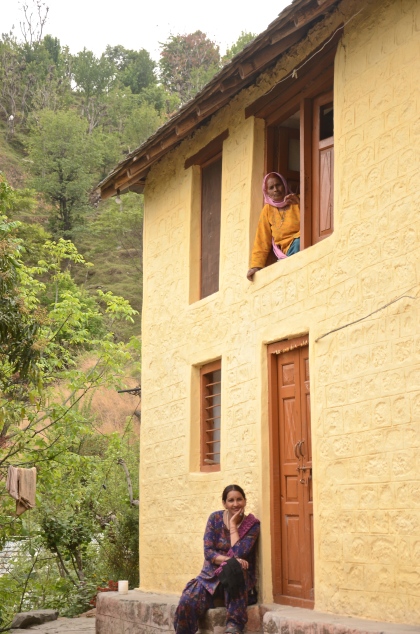
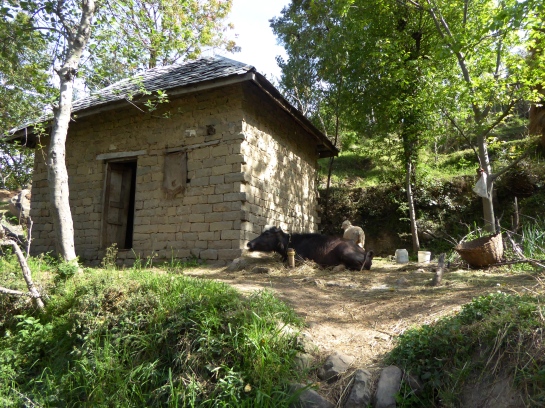
Varun is enthusiastic about reconnecting with India and said to us: “These village people are where humanity begins.” Gerard replied, “No, I think it’s the last vestige of humanity.” And as we all got caught up in the utter simplicity –their adobe house, slate roof, mud cook stove — it really was like a hundred or more years ago. Then suddenly the mobile phone rang, and we all fell back to earth.
P1010627

We first ran into Varun in Varanasi when he was in a quandary about where he should go next. Sikim and Nepal were first choices, but he loved Himachal Pradesh and thought of revisiting. Gerard and I both said that all three places had their attraction but of the three HP was a better bet. We suggested a few places to visit. He said goodbye without having made up his mind. To our surprise, the second night we were here, eating momos in ‘a whole in the wall’ restaurant, his smiling face peered in and he said, “I decided on HP. So happy to see you here.”

DSC_0638 He told us he’d been in Pushkar and now had a traveling companion, Megan, and they also were staying in the monastery. Megan had just come from Australia where she picked fruit for the last year, saving money to make her way back to Canada via India. The next day we had breakfast together and then they asked us to show them around. The fact they are so much younger than us and wanted to go everywhere meant we’ve ended up doing a lot more than we might have.
DSC_0637

We’ve done well to keep up with them. In fact, Varun commented that he’s never met people our age who are so ‘lively!” And for us, being with someone fluent in the language and customs means that we’ve been able to have a more intimate look into the life of the people we meet in these little hamlets.

DSC_0622

All four of us are drawn to walking out of town through the fields and each day we pick a new path. On passing a cluster of houses, some ancient, some modern, Varun inquires if the oldest building is adobe construction. Very quickly the conversation leads to an invite to see inside the house and meet the family. It’s nuclear with great grandmother (five years younger than me), mother, father, son and daughter–in-law, and young Hansu. 

DSC_0644

Varun keeps the conversation going while the chai is brewing. He also encourages me to practice my limited Hindi with these women. They’re amused and uncritical at my attempts. But Varun is right; if I stayed in this hamlet for a month I would be speaking Hindi.

DSC_0683

A neighbouring woman comes up to see what’s going on and sits down with us. Varun and Gerard notice how these young women, in their mid twenties, have such an air of sophistication. Even though they have little education, speak no second language, probably have never left the district, yet they have a strong sense of self.


DSC_0685

Then the neighbour invited us to see her home, a beautiful house painted in white and blue. Her husband works in Saudi Arabia and comes home for only one month a year. She has to manage all of the farming — the wheat, cows, sheep, and two young children. And she smiles all the time.After she proudly showed us her two cows, she invited us to come back anytime. We couldn’t think of a better way to spend an afternoon.

DSC_0678

The morning we began to tear ourselves away from this oasis of humanity we wanted to say goodbye to the families in the two restaurants we frequented. At “Welcome” they served us our usual radish parathas and curd and then rejected all our efforts to pay.

DSC_0668

Back at Khora Café for a last chai, again our money was no good. Hugs and handshakes and good wishes all around, we hope to return one day.

P1010644


City of Djinns

DSC_0539

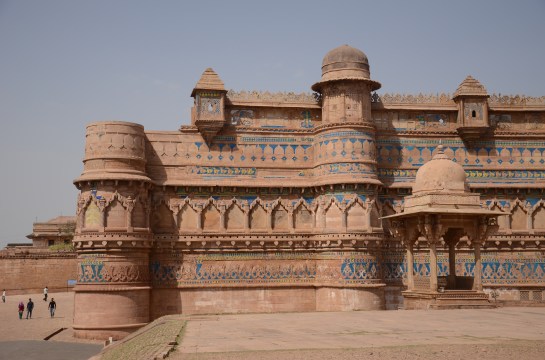
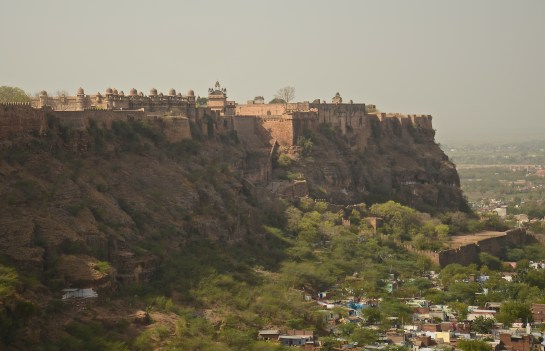
On the way back to Delhi we made an overnight stop in Gwalior to view the 18C hill Fort. Surrounded by sandstone walls, it encloses three temples and six palaces. One day seemed long enough and we planned to continue to Delhi early the next morning; but we had not taken into account the vagaries of train travel. Expecting to arrive in Gwalior at dawn, it was already midday when we finally got down, giving us only a few hours before the Fort closed. The hotel we had booked turned out to be unacceptable and our rickshaw rider had to take us to several alternatives before we decided an over priced but suitable one. After a quick lunch, we again set off in 95F heat to tour the Fort.

DSC_0520

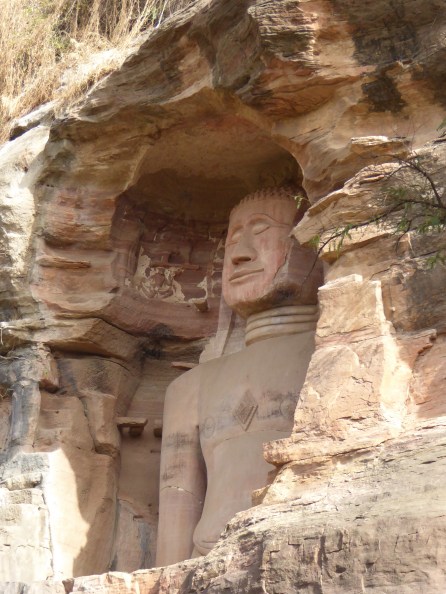
Equally interesting were Jain temples with statues dedicated to the Tirthankaras, teachers of the Jain dharma, carved out of the cliff below the Fort. Just enough time to see everything before night descended.

P1010582

Back in Delhi, our usual hosts, Kamal and Bhushan were visiting their daughter, Shruti, in Bangalore, so we stayed with her aunt and uncle who live one street over in Gurgaon.

IMG_3147 (6)

Swarn loves to cook and we were the benefactors. A well-appreciated break from restaurant meals. Gerard and Ravi talked a lot about painting; he’s semi retired and is taking up the brush. He’s a great enthusiast of ghazelles, poetry from the Mogul period, and Quawwali, which is the poems set to music. He’s particularly fond of Rahet Ali Khan, who first recorded when he was ten years old. I found it mesmerizing. If you’re interested here’s the link. Fast forward the first few mintues.  Ustad Rahet Ali Khan

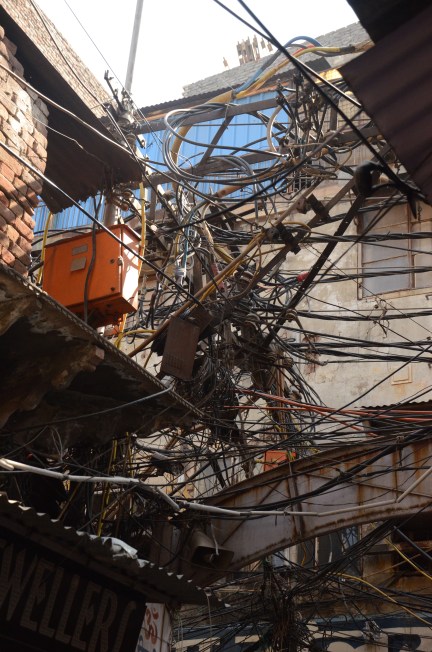
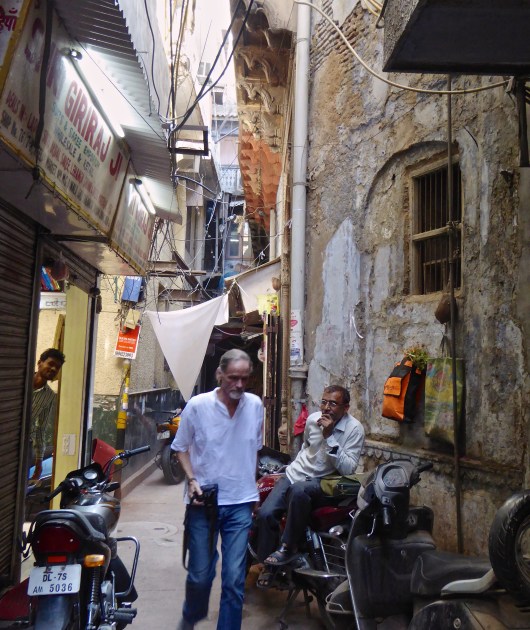
After reading William Dalrymple’s book on his love of Delhi, City of Djinns, both of us had renewed interest in exploring the Mogul city of Old Delhi and signed up for a three-hour walking tour. With only three of us, it was semi private and our young guide was well-informed and gave us tidbits of information that you wouldn’t normally come by: i.e. women wearing red and white bangles to indicate the first year of their marriage; ‘ear cleaners’ are identified by their red scull caps with a Q tip behind their ear. When Gerard comments at the tangled mass of electrical wires over our head, the guide commented that 80% of the connections were illegal. It’s got to the point that the electrical company cannot determine which connection is legal or not.

DSC_0575

The section of Old Delhi nearest the Red Fort once was famous for its elaborate haveli’s, occupied by families connected to the Court. Now only 500 remain, and out of that, only 17 are still ancestral homes. The rest are in very sad shape, used as warehouses on the ground floor, with cheap rooms for rent above.

DSC_0563

As our guide led us through the maze of back streets, Gerard felt confident that he could navigate on his own. But as soon as the guide left us, he was hopelessly lost. Even his compass failed in Old Delhi. My personal guide had let me down.

P1010602

Because of the Holi festival there was some delay in getting overnight bus tickets, ‘semi sleeper’ (this term is accurate because you really can’t sleep) to Himachal Pradesh, but it gave us time to spend with Swarn and Ravi and for Gerard to get over his lingering cough.

A new glimpse of Varanasi

DSC_0404

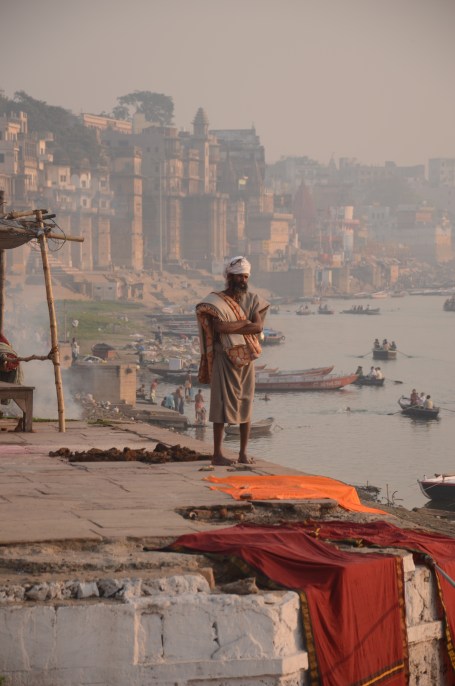
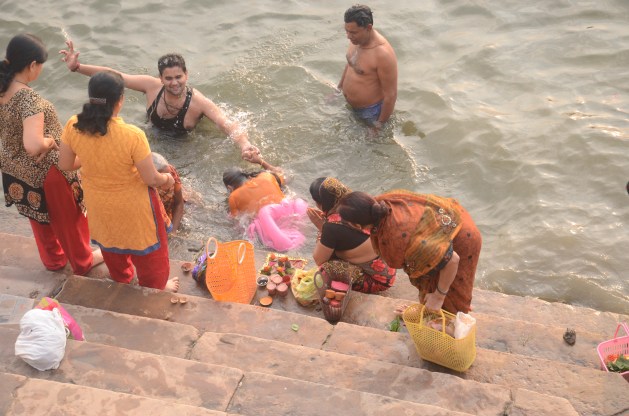
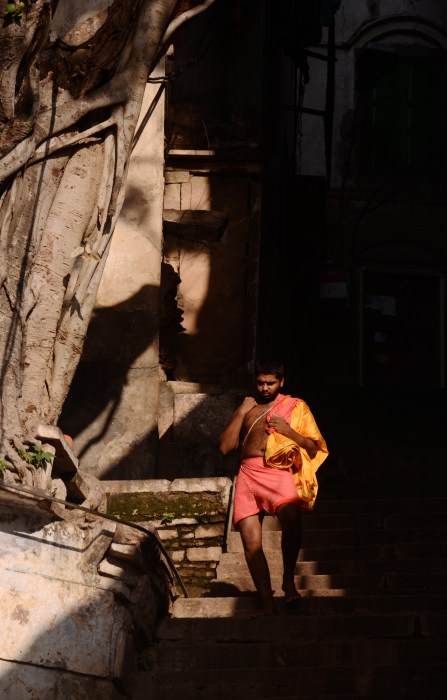
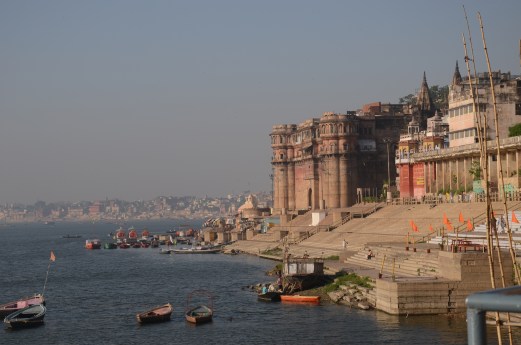
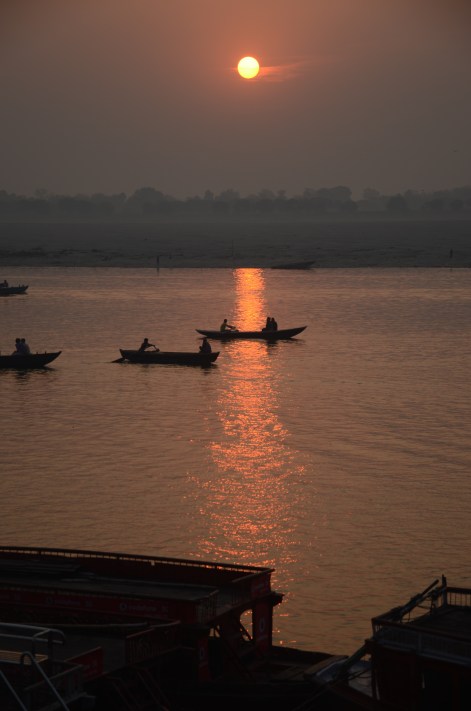
On arriving in Varanasi we reconnected with our French friends, Helene and Remy, from Benaulim. They stay above Shree Café whose owner, Santosh, is an accomplished photographer. We arranged to meet on the Ghat early the next morning to take pictures. As the sun rises over the river, pilgrims do their puja and ritual bath. With so much activity no one notices that we’re taking pictures. Being accompanied by a local helps us to see the theater of ritualistic Varanasi, the most holy city of India, through his eyes. Santosh and Remy are both such good photographers, I feel intimidated. I can either get so immersed in what’s going on, I forget to take the picture or, preoccupied with taking the picture, I miss the rest of the scene. But the city is a photographer’s paradise and being in the company of more skilled shooters helps me to think more about what it is I want to portray through the lens. It’s also inspiring for Gerard to be with other enthusiasts; it broadens his view of both what to capture and how to do that. We both know that, like most other practices, the more you do it the better you get at it.

DSC_0368

Santosh and his family have now become friends after many years of a casual acquaintance, which began around Indian classical music and Santosh recommending the names of local musicians we hadn’t heard of. It’s through photography that we’ve gotten to know him better.  Whenever we need advice he’s always available, with his soft spoken manner.

Meeting people isn’t hard in Varanasi but being connected to an Indian family opens a door not always available to tourists. Gerard and I were happy when, for the second year, Santosh and Seema asked us to join them and their three children for their marriage anniversary. If you own an excellent ‘pure veg’ Indian restaurant where do you go for a treat? We piled into cycle rickshaws and headed to a fancy Chinese restaurant. After chile paneer and sezhuwan noodles, everyone went next door for gelato.

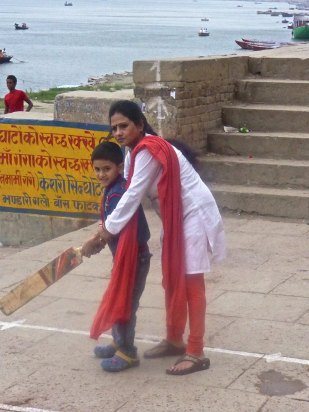
seema and cricket

On the weekend, we again joined the family for an afternoon walk. They arrived with their son, Gulu, brandishing a cricket bat. Other small boys converge and within minutes, a game begins along a narrow platform on the ghat. His mother, Seema, takes charge as an enthusiastic umpire. The game proceeds slowly, with frequent interruptions to search for the ball — on the riverbank, inside a docked boat, or among the ruins behind the steps.


DSC_0335

Varanasi has a strong appeal for a certain type of traveler, but one that defies definition. One night our guesthouse rings with Chinese chatter, a few days later there’s a group of 22 Chileans. What is it we all find so attractive? The city is dirty, the lanes congested with oversized cows, stray dogs and noisy motor scooters; the Ganges is polluted (although thousands bathe in it daily without apparently getting sick). In spite of all this, many like us return year after year.

DSC_0450

Gerard and I have asked each other what it is that brings us back here.  and, each time we try to narrow it down to this thing or that; but it just doesn’t capture how we feel. Overall Indian cities don’t attract either one of us. But Varanasi, the oldest living city in the world, one could say is a ‘living monument.’ It may not be the prettiest of ancient cities, but at least it hasn’t been torn down and replaced with concrete. The stone pavers in the alleys are worn smooth, wooden doors have hundreds of years of patina, and as we’ve mentioned before, for us, it’s lanes are so reminiscent of the medinas in Morocco that we fell in love with some forty years ago. It is the river, it is the narrow lanes, the ghats, the public cremation, the underlying spiritual quest by so many…and the people. Not only concerned with extracting money from tourists, they have time to smile and talk, making Varanasi feel more like a large village, not a city.

india 2013(298) 4-8-2013 4-23-45 AM

P1010417

In the chai shop we frequent every morning, Gerard said, “I know that man.” And before he had a chance to say to me who he was, Martyn looked over and smiled, “I know you.” Gerard said, “And where’s the rest of your family?” Three years before, Martyn, his wife and two young children were traveling for a year when our paths first crossed in Varanasi. A few weeks later we saw them again in Darjeeling and this time we became more acquainted. All of us continued on to Sikim where we went our separate ways. Martyn is one of those jolly souls who seem to see the positive in everything, making it easy to connect with him. He explained that this year he had come by himself for only three weeks, primarily to have dental work done in Delhi. He had time and briefly thought of going to Goa, but quickly decided on returning yet again to Varanasi. He’s been coming here since 2000. We asked him what it was that kept pulling him back here, and he replied, “I can’t put my finger on it.” But he did say on his first visit he’d planned to stay three or four days and ended up staying a month. He just couldn’t leave, and still hasn’t had enough.


DSC_0453

On our last morning, Santosh, Gerard and I went out early again to take pictures. Santosh thought it would be more interesting to go downstream, past the burning ghat, to an area we’d never seen before. The tourists and pilgrims quickly faded; no more “boat ma’am?” no girls selling faded postcards, even the chai wallahs disappeared. Far less congested, you get the sense that this part of the city hasn’t changed in decades, possibly in a century.

DSC_0489

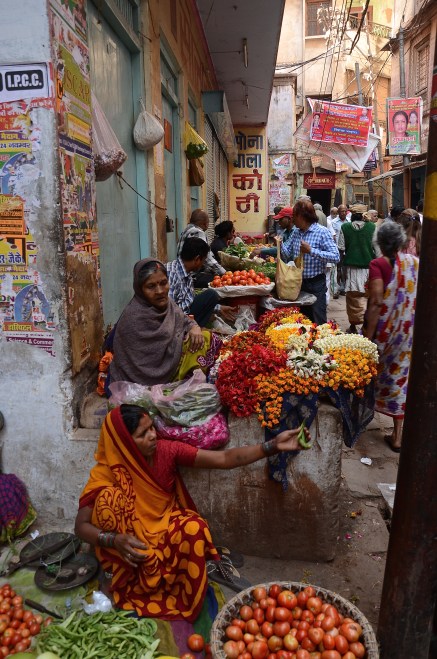
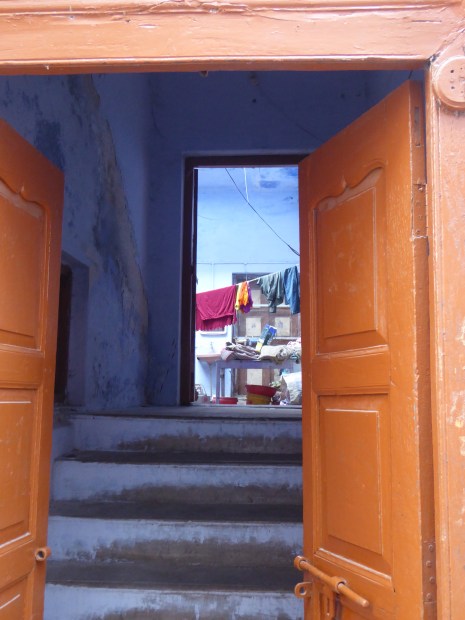
Finally we turned away from the river and into the lanes. Winding our way back, through vegetable and fruit markets, cow pens, doors left open for passesby to see in: it’s another Varanasi.

P1010478

Without Santosh we would never have been able to negotiate the winding, twisting lanes. A great opportunity to be led through this maze and take photographs with a local. He has less reserve to point the lens at an interesting face, which in turn gave both of us more confidence to do the same. It was a great ending to our stay in this city that continues to call us back.

DSC_0386

In previous posts we’ve tried to capture what attracts us so much to Varanasi. Eastern Sounds, Varanasi: the Lotus on the Ganges


Dhrupad Mela and Shiverati


P1010196

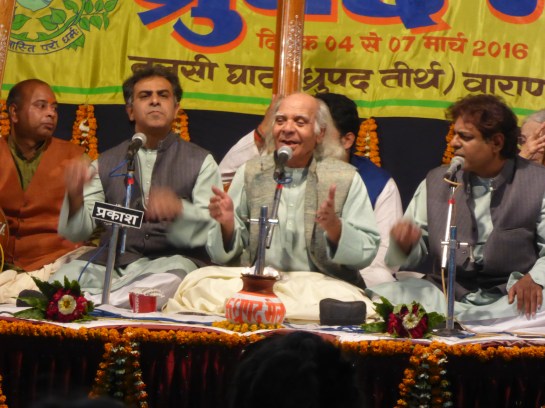
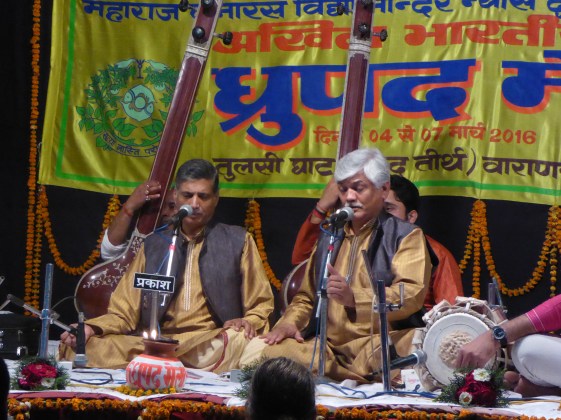
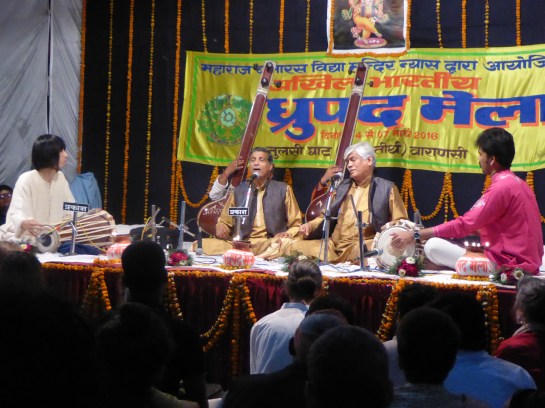
Our arrival in Varanasi this year was deliberately timed with a four-day Druphad Mela (festival). Druphad is an ancient form of Indian classical music developed in the Mogul court more than five hundred years ago. It is one of Gerard’s favorite music forms. Even though I’d heard it being played a lot in the house, I’d never paid a whole lot of attention not finding the singing compelling. But as I’ve experienced in the past, with certain jazz players like pianist Cecil Taylor, seeing it is a whole different thing from just hearing a recording. As the festival progressed I slowly began to appreciate what I was hearing. By the last night, I was sharing in the anticipation for the Gundecha Brothers, one of the more famous dhrupad singers in India today. The depth of this art form was beginning to reveal itself to me.

japanese singer

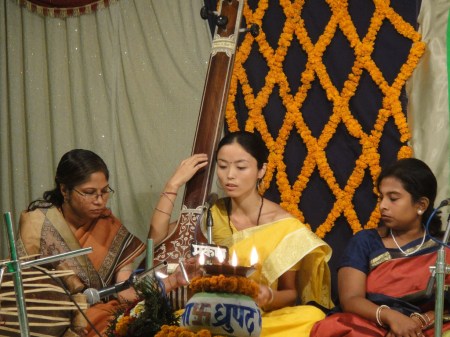
The evening began with a young Japanese woman singing dhrupad in a very correct but cautious manner. (Many south Asians are attracted to Varanasi, whether it’s because of the music or the spirituality or both. They come and stay for many months studying music, dance and yoga.) As she finished playing, thunder began to rumble and lightening flashed. Within minutes the skies opened and the rain came down in torrents. The back part of the tent sagged as the water quickly began pouring through. We were all asked to move in front of the stage, where an outer roof protected the tent. Abandoning the seated area, we all crowded forward, jostling to make room for each other. Even if I’d wanted to leave, how could I? No rickshaws and too far to walk back to the guesthouse.

P1010233

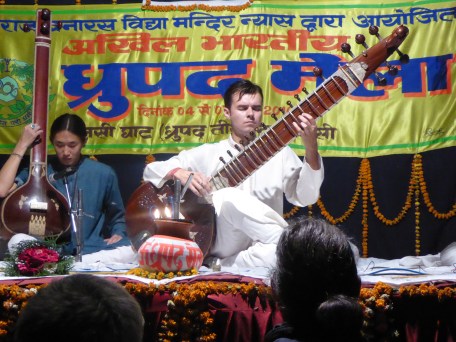
The curtains of the tent flapped like broken sails in the wind and water sprayed everywhere. A young European man sat on the stage anxiously clutching his subahar (an instrument similar to the sitar but with a wonderful deep sound). He was finally asked to play. The music from this instrument was so beautiful. And again even though Gerard has played loads of it I’d never taken the time to listen to its unique sound.

P1010234

By the time the Gundencha Brothers appeared the rain had stopped, two thirds of the tent, with our shoes, was a swamp, and the crowd had greatly thinned. But after the first number, I turned around and again the tent was packed with an enthusiastic audience – a 50/50 mix of westerners and Indians.

P1010237

The alap, the first movement of the raga began softly and then gradually built, exploring all of the variations within the raga. The interplay between the two voices was instinctive, one left off as the other picked up. After the alap, two pakhwaj drummers joined in. One a Japanese guest, who might have felt out of his depth on the stage, nevertheless he held his own. As the music built with the percussionists, I forgot being tired, wet and uncomfortable. It seemed everyone in the soggy tent was swept up in the excitement.

They played for almost two hours, finishing with “Shiva Shiva”, an incantation to the God Shiva.  What a perfect choice for Shiverati (the birthday) in the City of Shiva! Most of the crowd was familiar with the song and the atmosphere more akin to that of a popular music concert than a classical one. The audience wouldn’t let the Gundecha Brothers leave and they played an encore raga.  There were other acts to follow, but who could play after this? It was almost midnight, and we were both totally saturated by the music…not to mention the rain. We put on our water-logged shoes and trudged out to the main road to find a cycle rickshaw. We hadn’t been back in the guesthouse for long when there was another cloudburst.

Stopover in Bombay

P1010044

Our long weekend in Mumbai was more than a convenient break in a long (42 hr.) train ride from Goa to Varanasi. It was a wonderful chance to reconnect with the Shinkar family. They immediately make us feel at home in their apartment, an oasis of cool comfort, in central Mumbai. Thirteen floors up, it looks out on a sea of new high-rise building construction. It’s our third visit and in a relatively short period of time we’ve become part of the family. This has also been our experience with other families in India.

We first stayed with the Shinkars when we attended a meditation program of about 2,000 people in Mumbai three years ago, organized and managed by our host, Subodh. He’s a successful businessman in a high-pressure world of finance but is always ready and willing to do whatever he can to be helpful. And picking us up at 11.30 pm on Friday night exemplifies this. We particularly like to hear his stories of going to the ashram in Rajasthan and the Indian perspective.

After almost two months of eating in restaurants, any home cooked food would have been a refreshing change. But that would hardly describe what was in store for us. At each meal we were treated to dishes we’d never tasted before. Subodh’s wife, Sunita, is an excellent cook who explained how she learned regional cooking, Gujarati, Maharati, Punjabi etc. from different members of the extended family. Each time we sat down at the table she surprised us with a variety of dishes that we’d never seen or heard of before. (And who said vegetarian food was boring?)

We have a special fondness for Subodh’s parents who also live in the apartment. Damu met Gerard’s brother at a retreat in the late 80s and we first connected with Damu about 10 years ago. His wife, Kudum, speaks very little English but has a laugh so infectious that we laugh along with her, often having no idea what the joke is. We all get up in the morning to meditate and she’s sitting at the dining room table drinking chai already finding humor in something, spreading the joy.

Subodh’s sons, Nirmal, in seventh grade and Sunil in second year college, were both about to enter the exam period and studying hard, but they graciously gave up their room to us without showing any sign of being inconvenienced. Sunil had adopted an optimum study schedule, staying at the library all night, and sleeping during the day, amidst a household of noisy activity. This meant we hardly saw him at all. With 1.3 billion, these kids are under huge pressure to excel. Nirmal perseveres with his studies during the day, breaking the tedium by singing, usually a popular western song, much to the amusement of the rest of the family. He’s a natural entertainer, and it could be in his future.

P1010046

Once again, Subodh and Sunita took us out on Saturday evening and drove around some of the older parts of the city: Colaba, home for generations to rich Farsees, Church Gate beside the Raj built train station and Marine Drive where families promenaded beside the ocean in the evening light. Driving around the confusing and crowded streets, Gerard asks Subodh if all the traffic stresses him out. He says, “No, I’m used to it. I grew up here.”

Our last night, Subodh and his parents took us to an upscale, family style, veg restaurant. On the way, Subodh and his mother sang bhajans. Again we were introduced to a variety of local dishes Subodh wanted us to try.

Our train tickets for Varanasi were “Reservation against Cancellation” which meant we weren’t notified until the night before if we actually had confirmed seats or not. This caused a certain amount of anguish…and relief when we finally got the computer confirmation and carriage and seat numbers. With trains of 22(?) carriages, you need to know your own carriage to be able to find it on the platform.

Our train left very early Monday morning. We insisted on taking a cab; everyone had a busy day coming up. But they wouldn’t hear of it. And like family, Subodh and Sunita, gave us a heartfelt send off from the platform. The weekend had been too short.

P1010042


LAST DAYS IN AGONDA

Our last week in Agonda took quite a social turn. First, dinner with Lakshmi and her family. We’ve known her since they first came to Agonda eight years ago and she opened her shop selling cheap clothing and trinkets to tourists.

new

Somehow she’s supported a family of four children on this meager income. Her husband may work sporadically but is often hanging around the shop or cooking meals at home. Her eldest daughter, Manjula, now works in a casino in north Goa, improving the family’s finances. Krishna and Puja both in their late teens help manage the shop. Krishna is supposed to start training soon to also work in a casino. Fourteen-year-old Mohan, being the baby of the family, tends to be spoiled and has an easy life of soccer playing and surfboarding that I don’t think his older siblings ever had.

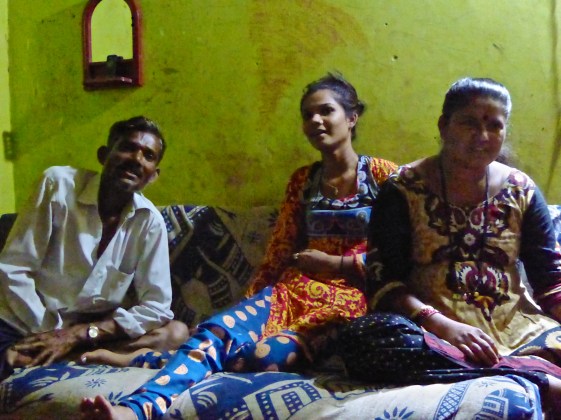
This year, for the first time, Lakshmi invited us to visit her home. Her husband, Ramesh, and Puja would cook rice and dahl for us. They live in a very basic three-room house with no running water, but we were made to feel completely at home and we relaxed into the family atmosphere. The most ornate feature in the living room was a shelf holding a family shrine complete with a picture of their guru and a photo of Ramesh’s father. If it weren’t for the flashing lights around the shrine, an old box television and the cellphone charging on the wall, the scene was timeless. We were reminded of sparse rooms in Morocco, sitting with similarly hospitable families, forty years ago. The TV stayed on the whole time we were there, quietly playing an Indian version of the Oscars that happened a year ago and still reruns on a weekly basis, Puja told us.

P1000985

Puja served us dahl, brindi baji and rice. Simple, but honestly the tastiest meal we’d had in Agonda. We persuaded Lakshmi to eat a little with us. Daughter and father, Puja and Ramesh, sat on the day bed chatting and laughing. They will eat later, at 10 pm after they’ve closed the shop. Lakshmi reminded us of her career in sales starting at the age of seven, when her uncle (she was an orphan) would send her with a small bag of trinkets to the beach. She learned English from the tourists in the process. Her daughter, Manjula, hopes to get a job on a cruise ship earning a substantial salary and wants her mother to finally stop working. But Lakshmi says, “Then what will I do? I can’t stay home all the time.” Before we left, Puja took me outside to see the well that supplies them good drinking water. We looked down into a deep dark hole where she shone her phone light to see fishes and frogs swimming around.

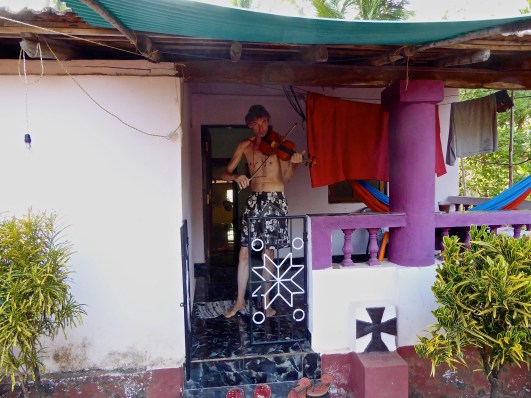
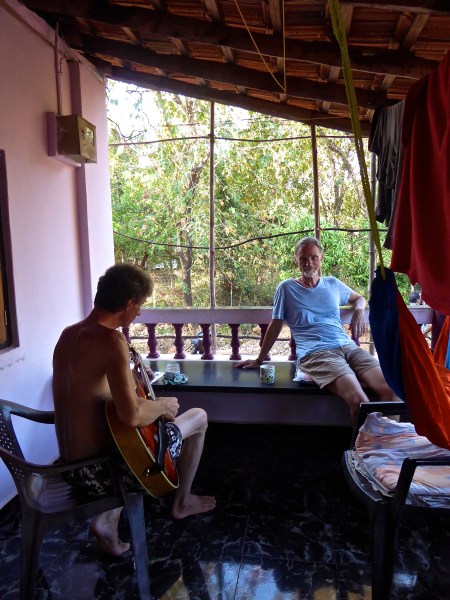
The following day we visited “six-meter Peter” a beanpole of a man from Switzerland who comes to Agonda every winter carrying his violin and jazz guitar. He practices long hours during the day and plays in a restaurant at night when invited. He first came to Agonda long before the rest of us. He has a photo from 1986 when it was a large empty beach with only a couple of buildings nestled in the jungle reaching down to the sea.


P1010036

Peter rents a house back in the village. His Polish wife, as plump as he is skinny, comes for two weeks; Peter stays for two and half months. We arrived to find him sitting on the porch practicing his guitar.

P1010003

Though only a mile or so away, the residential neighborhood was a far cry from the tourist beach scene. No noisy motorbikes and taxis, only children riding their pushbikes on the empty street, playing in the yard,

P1010011

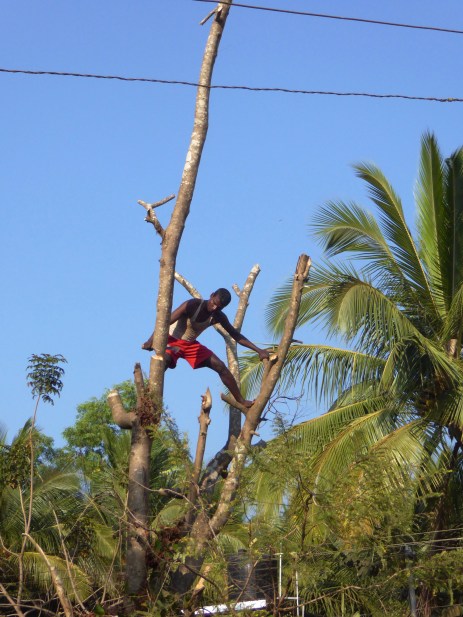
a man up a tree perilously hacking branches off to clear the telephone wires.

P1000996

Five days before we were leaving, our friend Jonny from England arrived. We first became friends in Agonda six years ago, and have met up in various parts of India over the years, and also kept in touch via email. But the last time we saw him was over two years ago, when we stopped off in England on the way back from India. It was good to be together again, if only for a few days.

When he offered to take one of us on the back of his scooter for a day out we jumped at the opportunity to visit another beach down the coast, and managed to cajole another friend, Mickey from Vichy, to come along too. Gerard with his dyslexia is loth to rent a scooter in India and I haven’t driven since we moved into the inner city. It keeps us beach bound. But driving through the countryside, I realized why so many tourists take the risk. Beware of pigs crossing, cows meandering, dogs sleeping, chickens scampering — not to mention crazy Goan drivers.

P1010041

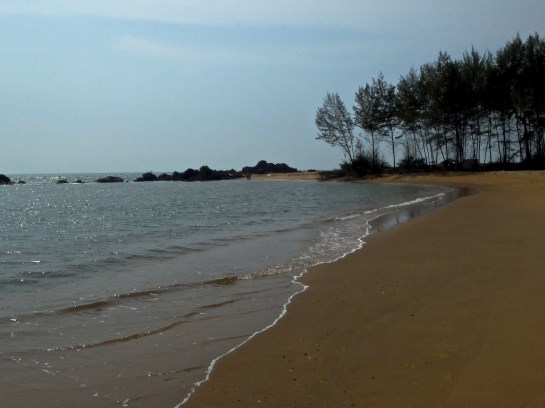
We had visited the out-of-the way beach a year ago and like everywhere else tourism is flourishing. It won’t remain the quaint destination that it is now for very much longer. But for us, it was a break from the hubbub of Agonda and a wonderful place to spend our last day in Goa.


Dental work and Shiva temples

It seemed a good idea to go to the dentist in Goa. Friends had root canals, implants and bridges, all with success, and the crowns we both needed were an 85% saving. Hard to turn down. But like all coins, there was another side.

DSC_0219

Early Sunday morning, we arrived on time for the first appointment of the day and waited in the open balcony that served as a waiting room for over a half an hour. , but the dentist was on Indian time. Meanwhile the two young dentist assistants scurried around preparing for the day. While we waited, the girls would come out and look over the balcony for the dentist. Finally they decided they could risk it and order their breakfast from across the street. Coming back with newspaper parcels, they sat in the surgery eating pav bhaji (a potato stew) and fried puris. We visualised them sitting in the dentist chair enjoying their meal. Five minutes later we heard them washing off their plates and hands with what sounded like the water jet.
Finally the white-jacketed dentist and his assistant arrived and with an air of professional confidence, dare I say arrogance. Wasting no time, they fitted first Gerard for a mold and slapped on a temporary, and then did the same for me. I was told to get up. Waiting for the back of the chair to lift, I realized it wasn’t going to happen. With the blood all running to my head and dizzy, I managed to swing myself up out of the chair. As the world came back into focus, I realized the dentist had made no attempt to clean off the excess cement around the temporary. For the next half hour I was spitting out bits of cement. And in Gerard’s case, the temporary was too large and for the next week he continued to chomp into his cheek.

We went back the following week and an even quicker procedure was fitting the permanent. Mine seemed to fit perfectly but for some reason, the dentist whipped it off again and told me to come the following week for the final fitting. Gerard had a less satisfactory experience. The crown was so tight that the dentist had great difficulty getting it off, finally resorting to a pair of pliers.

During the following week, the conversation of dentists came up with a few of our acquaintances. Even though everyone was satisfied with the work in the end, we all had bones to pick. Gerard noticed the instrument tray had stains and was pitted by who knows what? But from out of the corner of his eye it looked even worse. As the dentist drilled away his mind drifted to what exactly is that on the instrument tray? Couldn’t they have at least covered it with a clean cloth?  (My eyes are not as fine tuned as Gerard’s, the more so without my glasses). Then we got laughing about the plastic cup for rinsing your mouth. Did they really change it after each patient? Even though we had a good laugh, everyone agreed in the end it all worked out.

On our last appointment, our crowns were fitted, and fine-tuned. Gerard would not leave until he was 100% satisfied with the bite, insisting on having it polished yet again after adjusting. In my case, I was content on the first fitting. Out of a five star rating, they get three stars. But I’ll still come back for teeth cleaning and examination next year.

Yesterday we took time out from our busy schedule in Agonda, to visit Gokarna. It’s surprising how much time it takes to get from our room to the balcony for breakfast…then to the beach shack for chai and then down to the water for a swim etc. etc.

DSC_0165

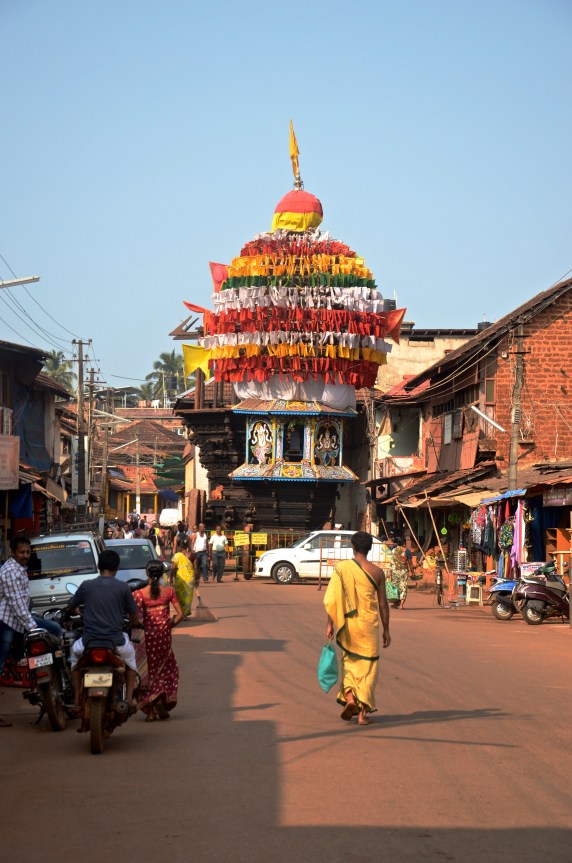
Gokarna has been long known as a place of pilgrimage for Shiva followers

P1000936

and in more recent years, it’s become one of the “destinations” for Gunja smoking hippies, living in shacks on remote beaches.

DSC_0206

Just over the border in the Karnataka, you’re most definitely back in India again. Goa of course is in India, but it’s Goa. We went for two reasons; one to see if it might be an alternative to Agonda, and two because our friend Oliver is staying there and we wanted to see him again.

In Orchha, two years ago on a cold rainy late December day, we were looking for a guesthouse as an eccentric looking man dressed in homespun was stepping around the puddles approached us. Gerard asked where he was staying and he led us to his guesthouse. Over the next few days, we slowly built up a friendship with this unusual Englishman from Devon. He’s an artist who’s been all over India capturing street scenes of every day life. The town was small so inevitably our paths crossed – Oliver would be sitting in a shadowy spot beside the temple sketching figures that he would later assemble in pen and ink. We were both drawn to his company and the cold damp days passed quickly. Agreeing to stay in touch, the fact that he had no email or cellphone meant that was not possible in India. Three months after we got home, a folder came in the mail of five prints of his recent work, including the one he’d been developing in Orchha. We’ve stayed in contact ever since through ‘snail mail’. This past fall he told us he would be spending a couple of months in Gokarna and included a very precise map of the three places where he would likely be loitering.

P1000846

So along with our friend Tatiana and two Russian friends of hers, we rented a car and driver and traveled the two hours to Gokarna in style. We left at 6.30 am and were there in time for breakfast. But first we went to Oliver’s hotel – he was out. So we wandered down the long main street to the beach, all the time with our eyes peeled for Oliver. Tatiana had been there a few times before and took us around.

P1000897

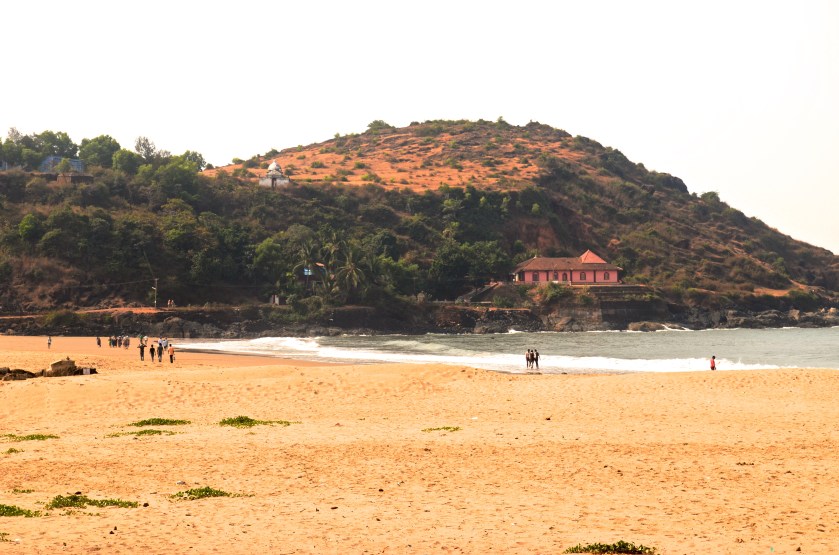
Gokarna is an interesting town because it still has a sense of authenticity and character that the beach towns of Goa don’t have. On the other hand, the beach is nowhere near as nice as Agonda

DSC_0174

We visited a hillside temple overlooking the ocean

T3

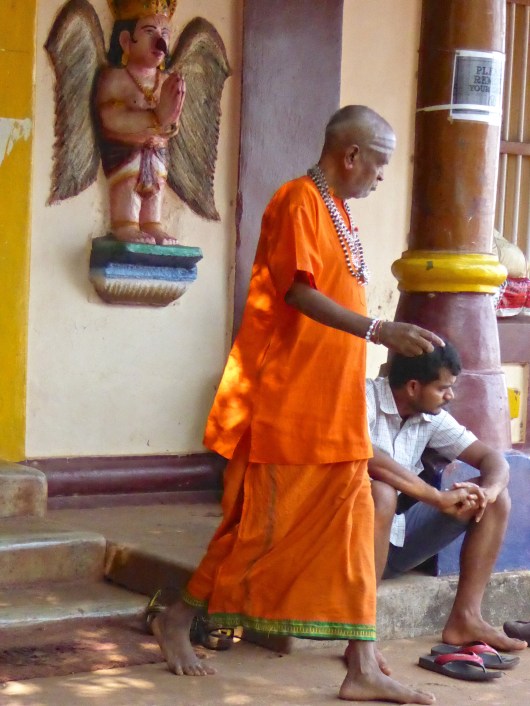
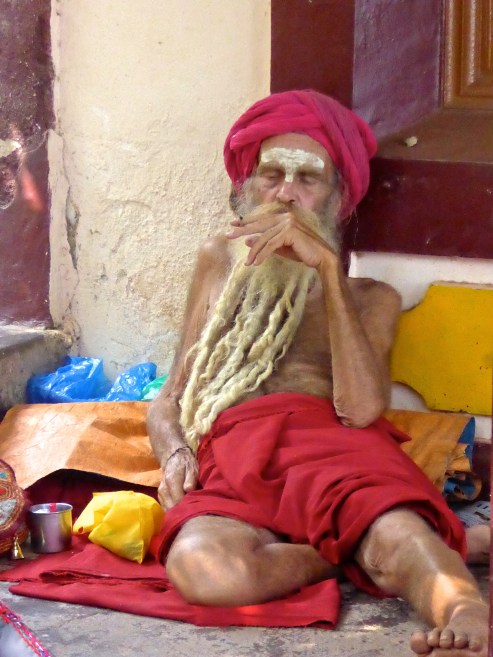
where we photographed what we thought was an old Sadhu, but when someone engaged him in conversation it turned out that he was an American — still an old Sadhu. Who know how long he’s been there.

P1000873

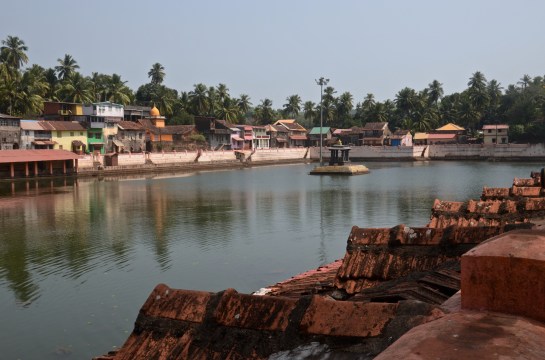
Tatiana took us to a peaceful water tank, we did some shopping and had lunch. Still no sign of Oliver.

DSC_0198Gerard walked back towards the car, while I did one final sweep of the designated spots – with no luck. It looked like I was not going to see Oliver again. But on the way back to the car, I heard a voice call out from a small chai shop – and there was Gerard sitting with Oliver. He’d found him!

There was hardly time to catch up. The Russians were anxious to get going. But we were still so glad to see each other. He promised to stay in touch by letter, of course, and would send prints of his new work. Oliver encouraged us to spend time in Gokarna. He’s been there for nearly two months and likes it. We’re now seriously considering it, not as an alternative to Agonda, but definitely an addition.

T4


Agonda: same same, but different


20140214_183712_Richtone(HDR)

Each year we return to Agonda there’s more change – more tourism, less fishing. And this year is no exception. But one constant is Fatima’s birthday party.  We’ve known Fatima since we first arrived many years ago and stayed at her guesthouse, before moving to Dominic and Rita’s.

P1000558

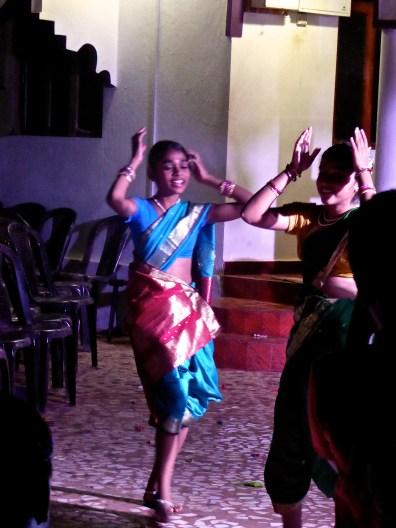
Her party is an open event with a full buffet, musicians, dancing girls, and a fire dancer.

P1000570


New shops have sprung up like mushrooms after a spring rain. Almost every square foot has been filled with restaurants, cafes, and stalls. But it appears the merchants are appealing to a different clientele – the new shops are glass fronted with halogen lights, selling expensive Kashmiri jewelry and shawls. And the people coming here seemed to have changed. Most notably, the Indian tourists have arrived, and they have money to burn. But down at our far end of the beach it is not that different.

Many of the regulars are still here, but some friends have not come due to old age or bad economy. We were so pleased that our friends, Frederic from FranceP1000596

and Michael Golding from London, were here for at least the first week. Tatiana, who has been staying in our guesthouse almost as long as we have, was telling us the plight of the ruble. Five or six years ago it was 30 to the $1 then it dropped to 60, this year it’s around 80/90. No wonder we haven’t seen many Russians around.


We share our balcony with a young couple from Lithuania and Gerard inquired about how the economy was there. They smiled at each other, and said, “We’re hoping we don’t have to go back.” Gerard’s interest was piqued when Victorija (named after the Queen) said that the average salary was around 280/300 E a month. Out of that, 100 E goes for rent, and almost another 100 for utilities. It sounded quite grim. Then she said, “Unemployment is high and there’s little motivation to get a job because welfare is almost the same as an average salary.”

DSC_0130

We were both reminded of England in the late 60s/early 70s, when Gerard was working in London. His take home pay was £10 per week; rent was £4½, which didn’t leave much for food, heat, or the little extras in life. Gerard suggested as a cost saving scheme that I should move in immediately. Americans are an impulsive bunch. I hoped I knew what I was getting into! Meanwhile a lot of our friends in England were collecting £9 a week on welfare.

Working as a graphic designer, Victorija was gone from the house twelve hours a day and was frequently required to work overtime for no pay. “If you don’t like it, you can leave,” she was told. Ron (named after President Reagan) worked in a hospital. He said, “Lithuanians are a sad and depressed people. Crime and suicide rates are high, and alcoholism is a major problem. We don’t want to go back.”

“So where are you going?” we asked. “We’ll try our luck in Spain. We know the economy is not good but it’s better than Lithuania and housing is cheap.” They think they can support themselves with an Internet based business. Ron is already selling on eBay and talked about online gaming. They tell us there are more Lithuanians living in Europe than in Lithuania.

Asked why they came to India in the first place, Victorija replied, “I wanted to learn yoga.” They’d read a popular Lithuanian book about India that also mentioned Agonda. So Victorija enrolled here in a month long yoga teacher training course. They are vegans, like an increasing number of young western travelers, and when we took them to dinner, they consumed together no less than seven servings of rice! Even the waiter was amazed!

P1000590

Ron said that since a young boy he has eaten an inordinate amount of rice! In this respect India suits them well. Both 24 years old, we liked the self-confidence in leaving their homeland with little money in their pocket and setting out to find a new life.

Back in the guesthouse loggia, Tatiana talks more about the Russian economy. To live in Moscow, she says, “You must find a way to be flexible. The government wants to take all your money.’ Gerard says all governments have that in mind. Tania says, “Yes, but the difference in Russia, the government not only has it mind, but does it!”

P1000642

Worse still there is no sun in Moscow. It may be shining 400 kms away, but in Moscow, she says,” it’s rain, rain, rain…then snow. The government has controlled even the weather!” If the weather is so bad, you just go to work, come home and go to work again. No inclination to think about anything else, and that’s just what the government wants. But when there’s a national holiday, like May Day, the sun always shines. She believes the government then artificially forces the rain clouds away from the city and instead rain falls in sheets in the suburbs. We don’t want rain falling on the May Day parade now do we? If the government really can control the weather, they should sell the technology to Britain. Since the ruble is near worthless, the government has devised a scheme to encourage the few Russians, who can afford to take a vacation, to holiday within the motherland by giving them a $600 credit.

We’ve no way of knowing if Tatiana is typically Russian or not, but in the few years we’ve known her, we’ve grown very fond of her. She’s also an inspiration regarding her photography.


Friends in Benaulim

Instead of going directly to Agonda this year, friends persuaded us to spend a few days first in Benaulim, 35kms north. We met Helene and Remy, who are from France, in Varanasi three or four years ago. They were also the ones who recommended going to Bundi and that was such a success that we felt inclined to follow up and meet them in Benaulim. Because of the train delay we arrived in the village late in the evening. Fortunately Remy had booked us into a guesthouse so we didn’t have to hustle around finding something ourselves. The next morning they showed us around and then we headed down to their favorite beach shack.

P1000493

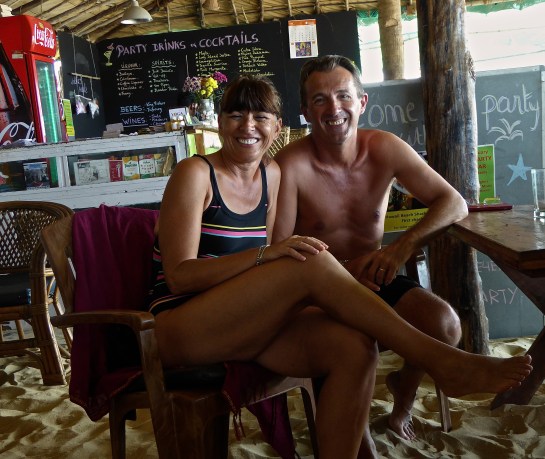
Since it was a 2 km walk from the guesthouse to the beach, once you were there you stayed for the day. The shack Helen and Remy frequent was owned by a Belgian/Indian couple and more than half of the customers spoke French. For us, the unique feature of these beach shacks that are scattered along a 20 km stretch is that once you’ve settled in you can leave your possessions in complete confidence sitting on the table while you go for a swim or take a walk . This includes cameras, computers, cellphones etc. Or at least this was the case at the Hawaii beach shack. We were also VERY impressed by the level of hygiene, only surpassed by a five star hotel. (Of course, we’re so familiar with the standards of five star hotels.) The staff was completely professional, food expertly prepared, glasses shining from a dishwasher, a spotless toilet and outdoor shower — we had to ask ourselves if we were still in India. Clearly the Belgian wife’s sense of cleanliness had made its mark.

P1000504

When we learned that her husband was from Nagar and that they return there in April so their kids can go to school, we all got excited talking about Nicolai Roerich, the early 20C Russian artist/philosopher/explorer who lived there. His bungalow is now a small museum. We look forward to seeing them in April when we plan to visit Nagar again.

P1000503

One of the main differences between Agonda and Benaulim is the fact that Benaulim sits on a long straight stretch of beach, while Agonda is only 3 km long with headlands on either end, much more scenic. The downside is that Agonda has become over crowded.

P1000509

It was so nice to spend time with Helene and Remy in such a different environment than Varanasi and gave us the opportunity to get to know them better. They have been traveling SE Asia for over twenty years and every time we brought a place in India we’d visited, they’d already been there. Remy is an exceptional photographer and has an amazing ability to capture candid portraits of the many characters of Varanasi, and beyond. Gerard said, “After seeing your pictures, I feel like throwing my camera away.” We’re looking forward to seeing them again in Varanasi in March and they’ve promised to show us some of the Varanasi that they know.

P1000514


A long train ride

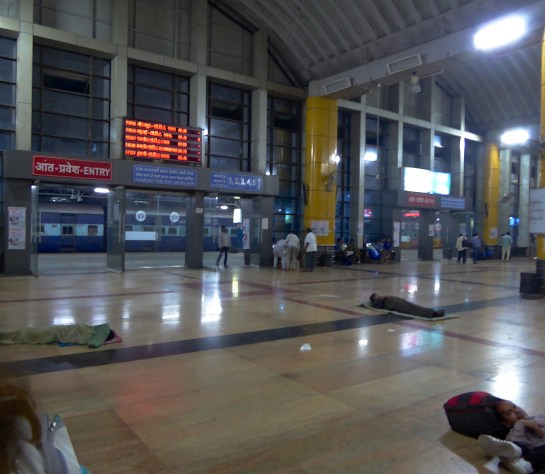
Gerard tells me that one of the things he likes about traveling is being forced to embrace the unexpected. But it also involves letting go of what you want and when you want it, not so simple for me.

Our train trip from Bundi to Goa illustrates the need to stay flexible. The train originated in Chandigarh, north of Delhi, and was delayed three hours in reaching Bundi because of fog. A three-hour delay I felt I handled quite well. We boarded the train hoping it might make up for lost time; it was late and we went to bed with that thought in mind. In the morning, rumours started circulating among the chai wallahs that the train was going to be four or five hours late reaching Goa. Bear in mind that we were traveling on a single-track train line. Once a train is off schedule it loses it place in the queue. We were continually waiting at stations to let other trains go by.

train st by night

As the day progressed, our estimated arrival time continued to grow. A little before our station, a fellow passenger with her husband and daughter was happy to be finally arriving in the night, seven hours late. She said: “It is a matter of congratulations if you are getting off now!”
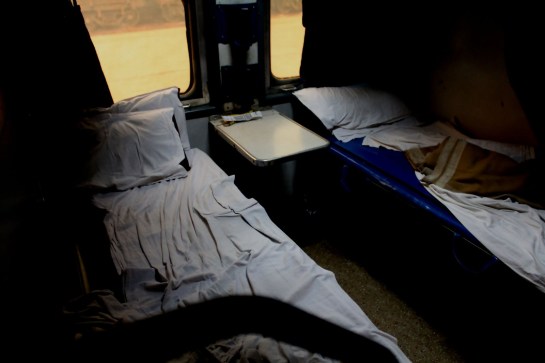
Back when were boarded the train in Bundi, an elderly Indian gentleman, his thick shock of white hair matching his white Safari suit, sat on the top bunk across from me, looking like a Brahmin gentleman. Propped up  the wall, he was reading his newspaper. He looked over his heavy black frame glasses watching me struggle to make up my bunk for the night. In 2AC we’re given a paper parcel of clean sheets and pillow.

sleeper2

Observing my efforts to reach my top bunk, he joked, “You’re trying to make it perfect with hospital corners and all.” I defended that at least I wanted to start the journey perfectly, knowing full well that the sheets would end up in a twisted mess. He returned, “In India, you have to go with the flow.” I feigned agreement, not registering that his odd accent and turn of phrase were not typically Indian. The next morning, he greeted me with, “I’m sorry I laughed at you.” It was then I realized he had strong Scottish accent. During the journey, he launched into his story. (As a young boy he was called Akeem.)

Akeem’s father immigrated to Edinburgh from the Punjab after Partition. The family had owned a farm in Pakistan, but lost the land. The Pakistani government was supposed to compensate. The problem was that when they crossed the border into India, the Pakistanis took their birth certificates, deeds etc. and burned them so the government didn’t have to provide compensation. (The Indian government did the same in the other direction, for those crossing into Pakistan).

In Scotland, his father sold clothes door-to-door out of a suitcase. Akeem was only ten years old and spoke no English. When he went to school, the headmaster, who happened to have been to India, gave him special help, but he learned the language most from playing with the local kids.

When Akeem was 15, his father wanting to return to farming, decided to go to America. But with his Muslim name he continually ran into roadblocks. A friend suggested, “Just change your name and you’ll have no problem.” And that’s exactly what happened. He changed the family name from Bakshir, meaning ‘scattering of truth’, and Akeem became Alistair Ross. His father settled in Sacramento Valley and planned to stay two years before bringing the family. But aged only 38, he died of a massive heart attack.

Back in Scotland, Alistair was forced to leave school just before graduating and went to work in the coal mines. It was regular work in the area and paid well. The mines also sent him to college part time while he worked. Finally he graduated and became an inspector. He worked for the mines for many years, toward the end as a consultant. Then at 48, he took early retirement. He thought he would go back to school for a degree in accountancy to round out his consulting skills. But when he looked at his mining pension, he thought, why bother? I can live comfortably on the pension.

Along the way, he married a Scottish woman and had 5 children. One girl immigrated to Australia, another became a lawyer. Two sons died; we didn’t like to push why. When the first son died, it put a huge strain on the relationship. When the second son died it was too much, they went to separate parts of the house and grieved alone. It ended in divorce – Alistair had not only lost two children but also his wife. He set her up in a flat and moved himself into a retirement community where he now amuses the other residents by traveling every winter somewhere warm.

He enjoys Scottish summers and has no intention of moving back to India permanently. A while ago, he did return to the village in Pakistan where his family had lived. He hoped to reclaim some of their land and submitted an application. A many page document came back. It contained all the information he’d given about himself and his family, and at the end merely said, “No record available.”

Having this travel companion tell us his interesting story helped the frustration of being on a train seven hours late that continually stopped.

maxresdefault